MVRDV's Zigzagging Buildings Come Top In Mainz Basin Contest

News: MVRDV and fellow Rotterdam studio MorePlatz have been selected to create a pair of dockside office blocks in Mainz, Germany, with designs for buildings featuring zigzagging profiles.

Named Hafenspitze, the two buildings will become the first new structures in the proposed transformation of the city’s former shipping container harbour, described by the architects as “one of the city’s most important regeneration projects of the last decades”.


Related story: Central Business District at Shanghai Hongqiao Airport by MVRDV with Aedas


MVRDV invited MorePlatz – a studio founded by former MVRDV architects Caro Baumann and Johannes Schele, with an office in Munich – to act as local architect on the project. Their proposal is for a glazed 11-storey tower and a five-storey block with a roof terrace.
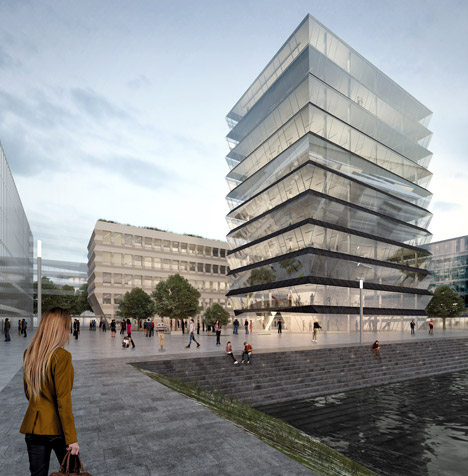
Hafenspitze by MVRDV

While the two buildings will differ in appearance and materiality, both are designed with zigzagging outer walls made up of angular windows, designed to offer better views across the city and waterfront.

The exterior of the tower will be divided up by horizontal bands clad in slate shingles, intended to reference local roofing, while the low-rise block will have a faceted concrete-panel facade designed to match the town’s stone-walled buildings.


Dezeen Book of Interviews: MVRDV’s Winy Maas features in our new book, which is on sale now


The two buildings will be located at the northern end of the basin and will frame a new public plaza.

“The design handles the tight urban restrictions in an extremely convincing manner,” said architect Axel Bienhaus, the deputy chairman of the competition jury.
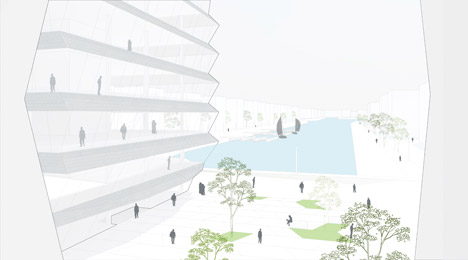
Hafenspitze by MVRDV

MVRDV succeeds in setting a strong urban development accent and simultaneously in fulfilling the important noise prevention conditions.”

City mayor Michael Ebling added: “MVRDV will create an architectural highlight in the Zollhafen quarter. The profile of the city will be given a contemporary twist along Neustadt’s future promenade by the Rhine, forming an antithesis to the medieval heart of the old town.”

Construction of Hafenspitze is set to commence next year.

Dezeen

Elsa Urquijo's Campus For A Spanish Charity Is Made Up Of "serene" White Buildings

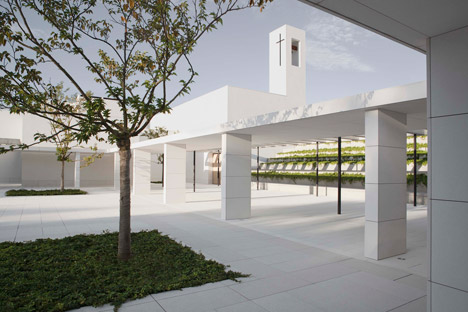
This complex of interlocking white buildings was designed by Elsa Urquijo Arquitectos to house the different activities of Spanish social charity Padre Rubinos .

Padre Rubinos Complex by Elsa Urquijo

Spanish studio Elsa Urquijo Arquitectos designed Padre Rubinos Complex in A Coruña, a city on the north-west coast of Spain. The charity, Padre Rubinos, was founded in the city almost a century ago to provide social services for the community.


Related story: Historic Spanish chapel renovated and repurposed by Adam Bresnick Architects


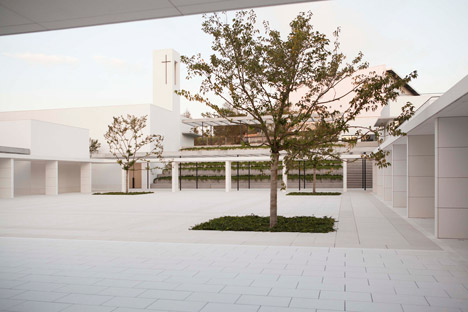
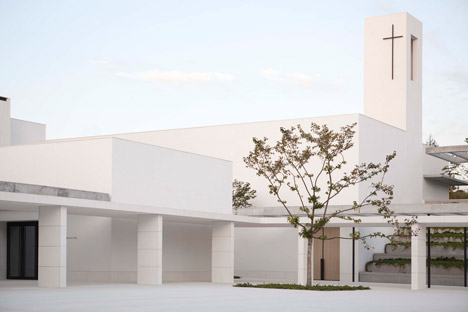
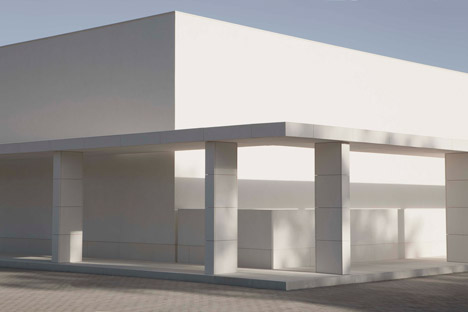
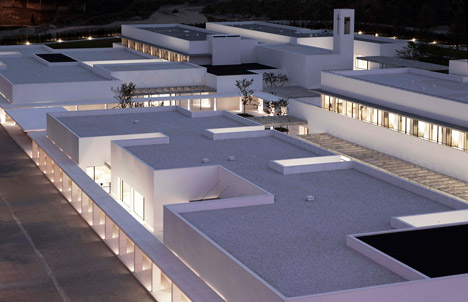
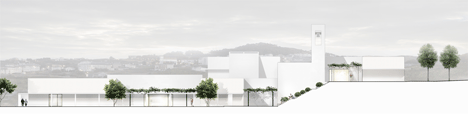
The white-rendered buildings of the complex occupy a 16,000-square-metre site and include a nursery school, sheltered accommodation for the elderly and homeless, and a chapel with a bell tower.

Padre Rubinos Complex by Elsa Urquijo

“The construction is conceived as a shelter, a serene space, unpretentious and [designed] to endure,” project architect Xavier Loureiro told Dezeen. “It is space that revolves around those individuals in need.”

Padre Rubinos Complex by Elsa Urquijo

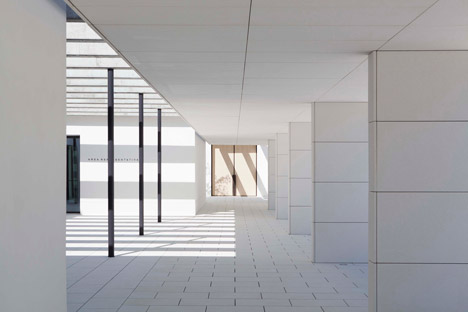
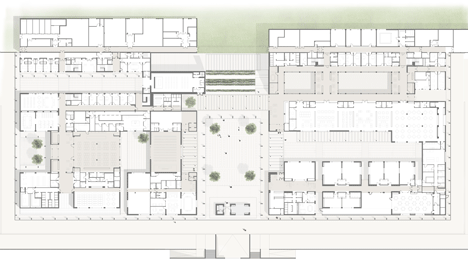
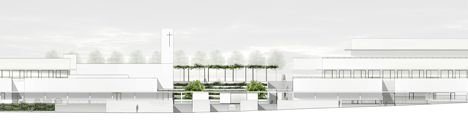
Flat-roofed buildings of varying heights frame a central courtyard. A portico surrounds the buildings and the courtyard, creating a connection between the main square and the different areas of the complex.

Padre Rubinos Complex by Elsa Urquijo

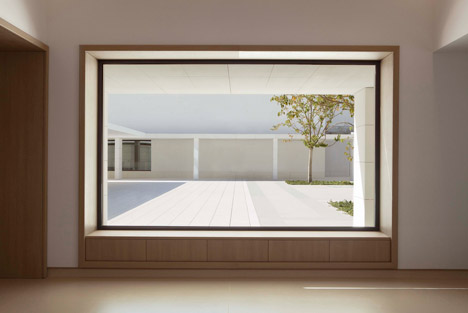
Large sections of glazing in the facade provide entrance points and lighting for the interior spaces. “It seeks to strengthen the visual continuity between interior and exterior,” said the architect.

The use of covered walkways is intended to reference the cloistered design of historic religious buildings, and echo the charitable and religious purpose of the structure.

Padre Rubinos Complex by Elsa Urquijo

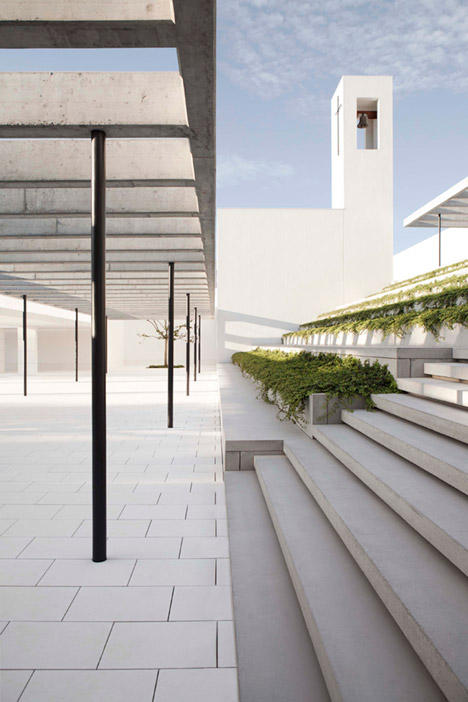
The portico is made up of stacked slabs, rather than continuous masonry, to give the site a more human scale and provide comfort for visitors approaching the huge complex.

“The use of horizontal lines arises from the search for peace and relaxation, creating a sequence of measured and ordered spaces,” said Loureiro.

Padre Rubinos Complex by Elsa Urquijo

At the rear of the paved courtyard, the ground steeply inclines with terraced planting and steps leading to a segment of the complex built above the level of the main square. A bell tower with a simple crucifix affixed to the facade is built into the slope.

Padre Rubinos Complex by Elsa Urquijo

A set of wooden double doors off the courtyard leads into the chapel below the bell tower.

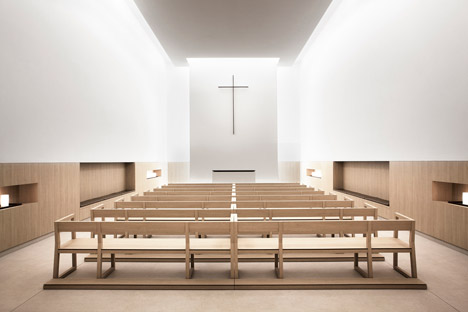
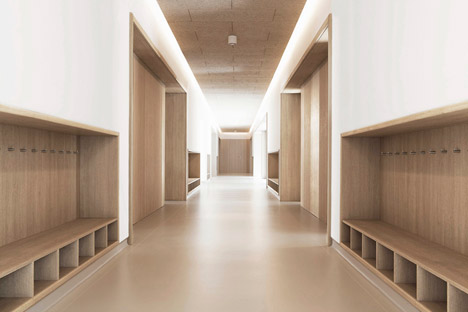
In contrast to the stark white and block-like exterior of the complex, the interiors are clad in warm-toned wood and neutral-coloured flooring designed to add “humanity, serenity and warmth” to the space.

Padre Rubinos Complex by Elsa Urquijo

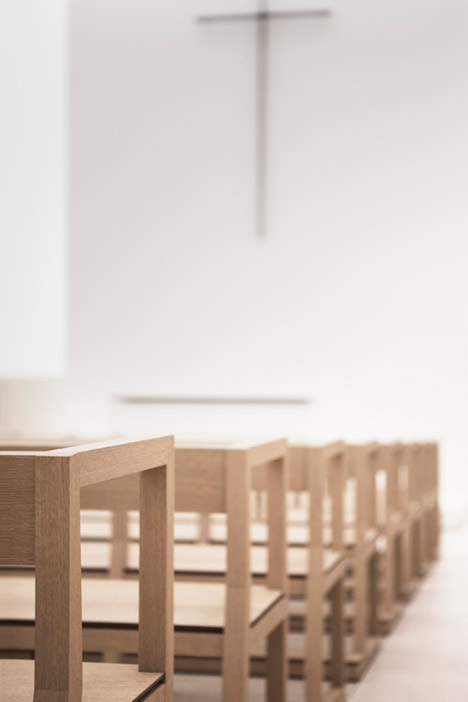
The chapel has pale wooden pews and a section of paneling along the lower parts of the walls. Recesses in the walls form overflow bench seating for the congregation.

Circulation corridors in each of the buildings have wood-lined alcoves with coat hooks and cubby-holes for storage.

Padre Rubinos Complex by Elsa Urquijo

The largest proportion of the Padre Rubinos Complex is taken up by a nursing home for the elderly, to the right of the central square. Living rooms and treatment areas are situated across the ground floor of this building, while residents’  bedrooms are on the upper two floors.

Padre Rubinos Complex by Elsa Urquijo

A nursey school is set on a single floor of the wing opposite the nursing home, with a narrow terrace in between. The nursery is positioned to form a connection between the different generations that use the space.

“A visual and symbolic relationship to the common areas of the nursing home was sought so that both generations can relate and bond,” said the architect.

Padre Rubinos Complex by Elsa Urquijo

The left-hand side of the complex is given over to a homeless shelter with a dining area and socialising rooms on the ground floor, and bedrooms on the first floor.

Accommodation for the sisters who run the services and offices that form the headquarters for the charity are housed in the blocks surrounding the shelter.

Padre Rubinos Complex by Elsa UrquijoPlan – Padre Rubinos Complex by Elsa UrquijoSection Padre Rubinos Complex by Elsa UrquijoElevation –
Dezeen

Football Pitch Hovers Above Basketball Courts In Winning UFCSPA Campus Design

News: Brazilian studio OSPA has won a competition to design a sports education campus in Porto Alegre, with a proposal that includes a floating football pitch .

UFCSPA Campus Igara by OSPA

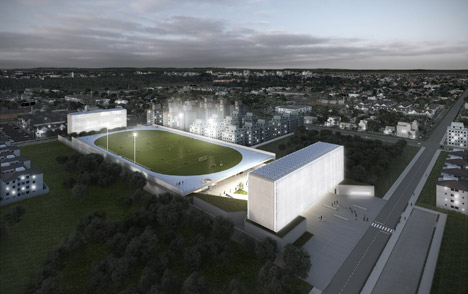
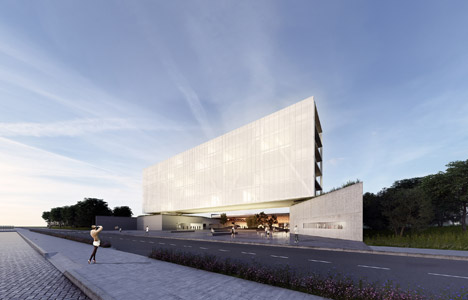
OSPA Architecture and Urbanism’s “two-faced” design was selected as the winner of a national competition to design the new Campus Igara for the Health Sciences Federal University of Porto Alegre (UFCSPA), in the Canoas area of the city.


Related story: Herzog & de Meuron completes Arena do Morro gymnasium in Brazil


UFCSPA Campus Igara by OSPA

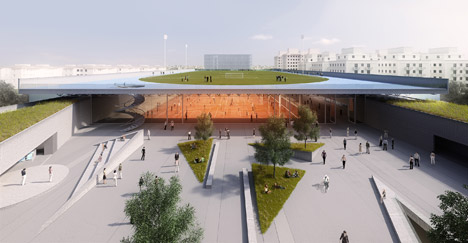
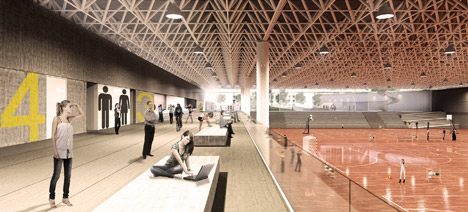
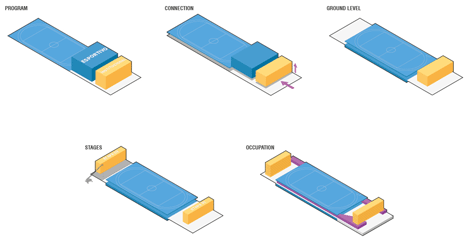
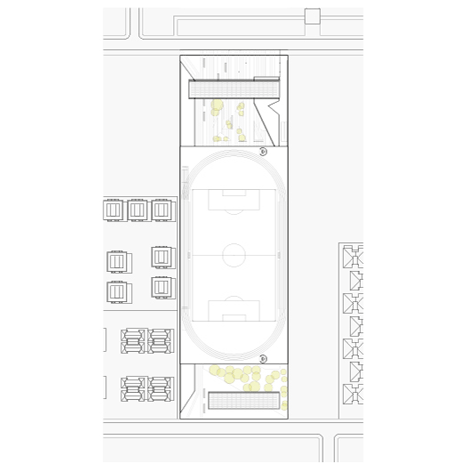
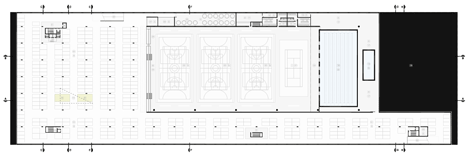
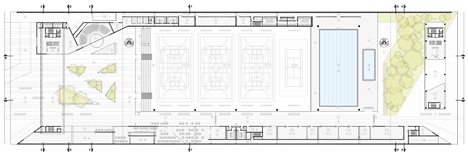
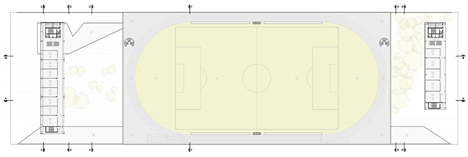
The 25,000-square-metre campus will house classrooms, offices and other university facilities within a pair of high-rise blocks at the two ends of the site. Between these, the architects propose a series of basketball courts sheltered beneath an elevated football pitch.

UFCSPA Campus Igara by OSPA

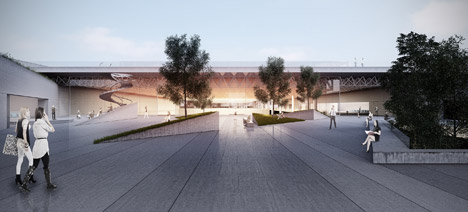
“More than a public institution, a public space. This is the premise and guiding goal for the development of the new campus of UFCSPA,” said OSPA in a statement.

UFCSPA Campus Igara by OSPA

“The program develops within the natural extension of the sidewalk,” said the team. “The open space articulates the campus’ functions far beyond the academic activities. The independent access also encourages diversity of users. “

UFCSPA Campus Igara by OSPA

The campus will be built in two phases, using a framework that combines steel and concrete elements. Students will move to the campus after the completion of stage one, so the architects have developed a strategy that will allow study and construction to take place simultaneously.

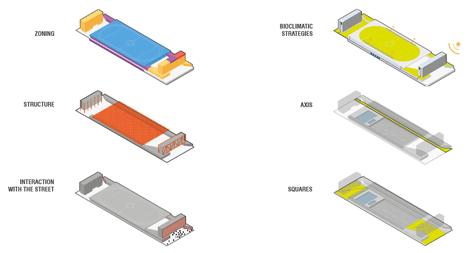
UFCSPA Campus Igara by OSPAConcept diagram –

“A project can not stop or even detrimentally interfere in the routine of the campus,” said the team. “Possibly excluding some architects and engineers, no one wants to study at a construction site.”

UFCSPA Campus Igara by OSPAPhasing diagram –

The buildings will be orientated to lower thermal load whilst allowing plenty of natural light and ventilation through the interiors. Wherever possible, staircases will be selected over elevators to encourage student interaction.

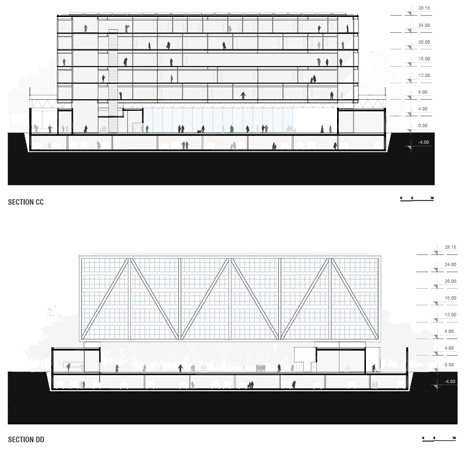
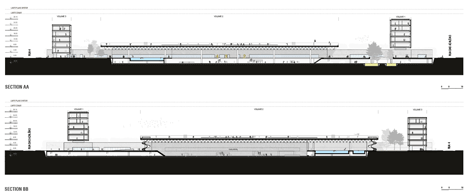
UFCSPA Campus Igara by OSPA Site plan UFCSPA Campus Igara by OSPAUnderground floor plan – UFCSPA Campus Igara by OSPAGround floor plan UFCSPA Campus Igara by OSPAThird floor plan – click for larger UFCSPA Campus Igara by OSPACross sections UFCSPA Campus Igara by OSPALong sections
Dezeen

Google Rolls Out Material Design Guidelines With Lollipop Android Update

News: tech giant Google has released the latest version of its Android operating system called Lollipop – the first to use the company’s “flat” design guidelines unveiled earlier this year .

Google Nexus tablet

Google’s Lollipop update, previewed at the Google I/O developer conference in June, will work over all Android-powered devices and share information across a user’s different screens.

The interface features redesigned buttons, colour schemes and uniform typography laid out in accordance to Google’s Material Design guidelines, which it is now rolling out across all its platforms.


Related story: Google’s design guidelines spell the end of days for skeumorphism


Google Nexus tablet

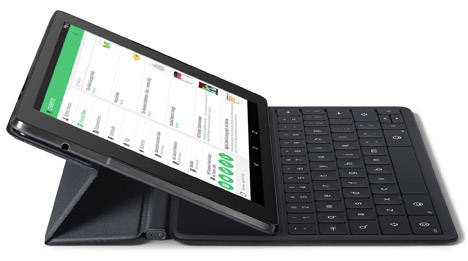
The company is launching the redesigned operating system on three new devices – the Nexus 9 tablet, Nexus 6 phone and Nexus Player.

“With more devices connecting together, your expectation is that things just work,” said an official blog post from Google. “With Lollipop, it’s easier than ever to pick up where you left off, so the songs, photos, apps, and even recent searches from one of your Android devices can be immediately enjoyed across all the other ones.”

Google Nexus tablet

In an article for Dezeen earlier this year, technology writer Alex Wiltshire described Material Design as “part of a new way of thinking about software presentation commonly referred to – if maybe a little too broadly – as ‘flat design’.”

“Here, buttons are often simply text, blocks of colour are used to guide the eye and finger, and smooth animations respond to each interaction.”

Google Nexus tablet

Google said that Lollipop’s Material Design design approach had created “a bold, colorful, and responsive UI design for consistent, intuitive experiences across all your devices”.

“Vivid new colours, typography, and edge-to-edge imagery help to focus your attention. Responsive, natural motion, realistic lighting and shadows, and familiar visual elements make it easier to navigate your device.”

Google Nexus tablet

Other features in the new system include an option that allows users to adjust which notifications come through at different times. Only messages from certain contacts can be set to appear while important meetings or social events take place.

A battery saver feature extends the life of devices by up to 90 minutes. Multiple accounts on devices offer more privacy to users who share their phones or tablets with others.

Google Nexus tablet

Devices can be secured with a PIN, password, pattern, or even by pairing them to personal items like a watch or a car with the Smart Lock function.

Google Nexus tablet

Lollipop will come pre-installed on Google’s latest Nexus devices. The first is the Nexus 6, a six-inch smartphone developed with Motorola.

Google Nexus tablet

The phone features a contoured aluminium frame, a Quad HD display and a 13 megapixel camera. Its dual front-facing stereo speakers are designed for watching movies and gaming.

Google Nexus tablet

A Turbo Charger is intended to give six hours of use with only 15 minutes of charge. The Nexus 6 will be available to pre-order later this month.

Google Nexus tablet

Google has also unveiled the Nexus 9 tablet, built with brushed metal sides and an 8.9-inch screen by HTC, which can be pre-ordered from tomorrow.

Dezeen

Andrea Rekalidis' Ceramic Desk-tidies Take The Form Of Italian Landmarks

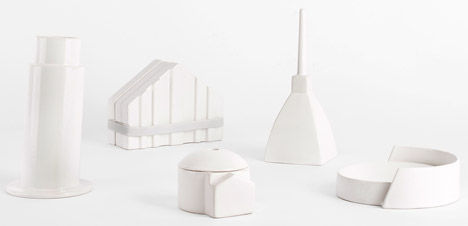
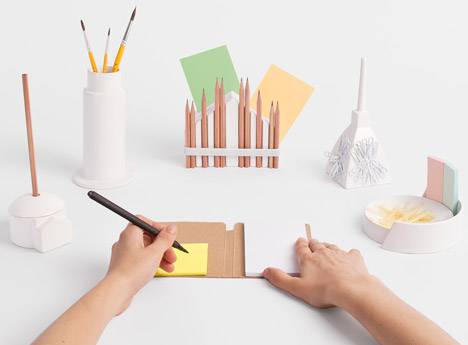
Maison&Objet 2014: designer Andrea Rekadlidis has created a set of white-glazed ceramic desk organisers based on the simplified outlines of five famous Italian monuments .

Souvenir Collection by Andrea Rekalidis

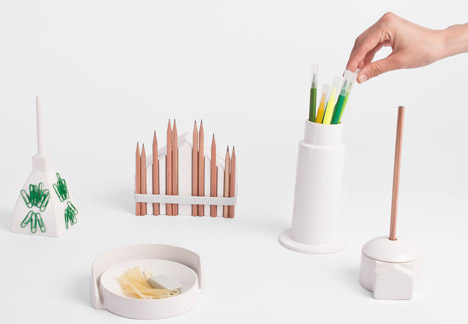
Italian designer Andrea Rekalidis’ Souvenirs Collection for design brand BOZU includes a pencil pot, magnetic paperclip holder and a pencil sharpener in the shape of popular tourist attractions from his home country.


Related story: Function follows form in Bruno Schillinger’s Unidentified products collection


The items in the collection replicate the small models of landmarks usually brought home by tourists as momentos of travels, but are given a useful function.

Souvenir Collection by Andrea Rekalidis

“In Italy and in the rest of the world it is easy to find small statues of the most known monuments, these souvenirs are useless, and quite ‘kitsch’,” Rekalidis told Dezeen.

“The goal of the project was to play with this situation by creating objects that pay homage to the most important Italian monuments, but also to give them an everyday use,” he added.

Souvenir Collection by Andrea Rekalidis

Rekalidis pared down the complex forms of the monuments to produce simple outlines for his collection of glazed white ceramic desk-tidies.

“I wanted to simplify the forms as more as possible. I gave as put as little detail as possible into the geometries to let people think about what every piece is by a mental association – it’s possible to identify them, but not too easy,” said Rekalidis.

Souvenir Collection by Andrea Rekalidis

“I think that white colour is perfect for showing the pure forms,” he added.

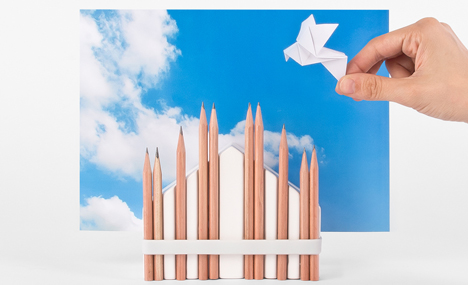
The ornate Milan Cathedral, one of the largest in the world, is reduced to two pieces of ceramic bonded together by a rubber band that secures pencils in notches around its perimeter to form its spires.

Souvenir Collection by Andrea Rekalidis

“When they are placed within the corresponding slots, they mimic gothic spires,” said the designer.

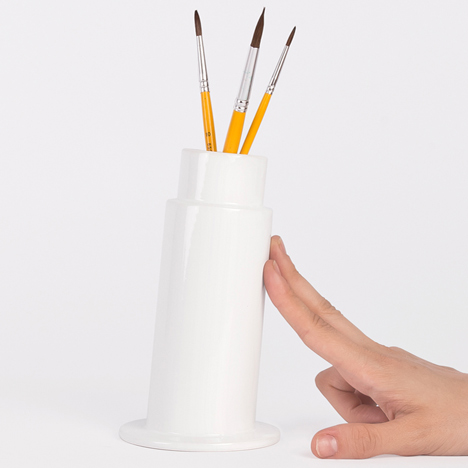
A ceramic tube that tilts precariously to one side forms a pen pot made in the shape of the Leaning Tower of Pisa.

Souvenir Collection by Andrea Rekalidis

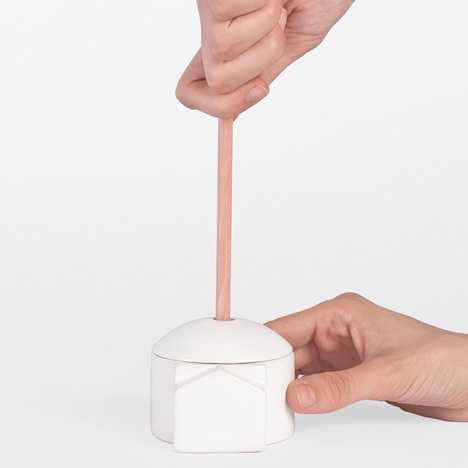
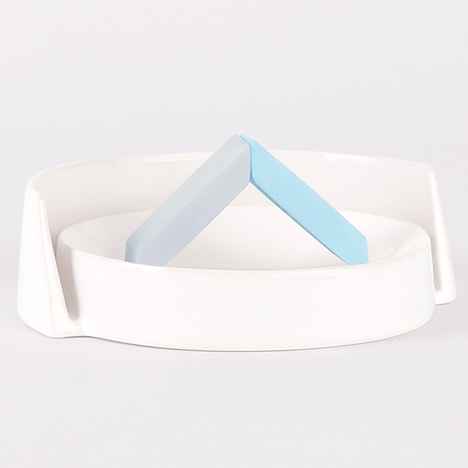
The oculus in the domed roof of the Roman Pantheon forms an opening for a pencil sharpener, while the Colosseum’s elliptical outline can be used to hold elastic bands. Erasers and other small items of stationary can be wedged in a gap between the concave amphitheatre floor and curved wall.

Souvenir Collection by Andrea Rekalidis

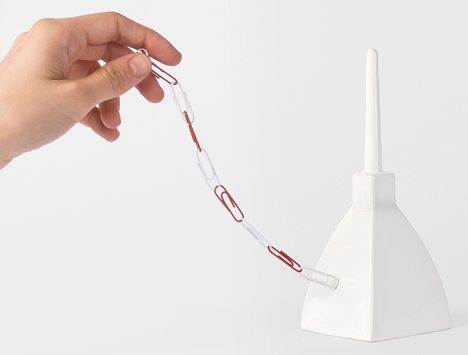
A spired paperweight represents the roof of the Mole Antonelliana, which houses the National Museum of Cinema in Turin. The weighted piece also has a magnetised surface to attract paperclips.

Souvenir Collection by Andrea Rekalidis

Rekalidis debuted Souvenirs Collection with BOZU at Maison&Objet in Paris earlier this year.

Dezeen

Latest Ideas!