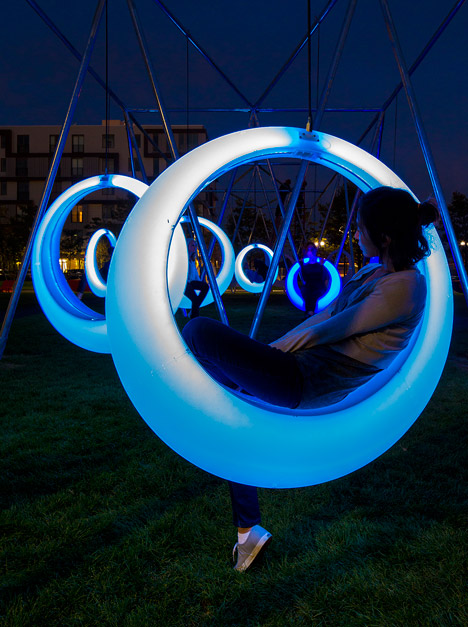
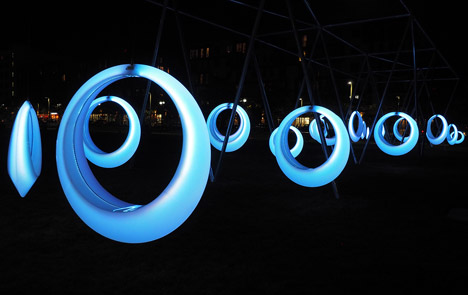
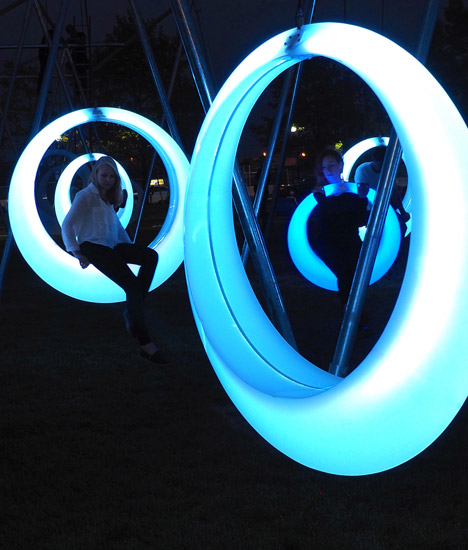
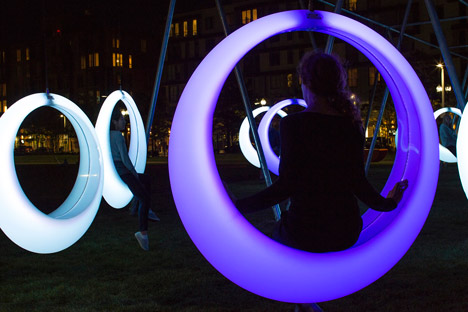
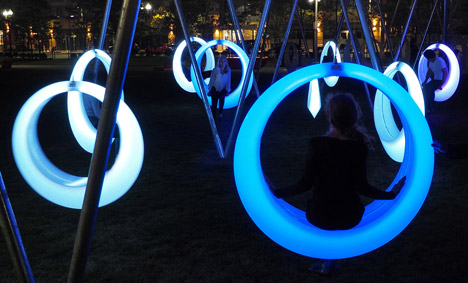
These glowing circular swings have been installed by Höweler + Yoon Architecture to brighten up a patch of Boston parkland and to encourage children to play outside the confines of the playground (+ movie).
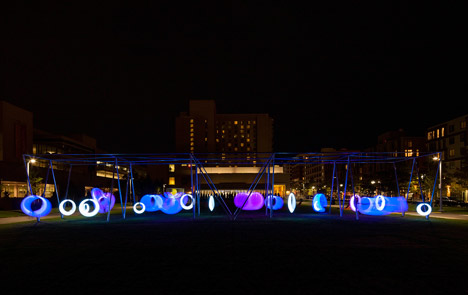
The Boston-based studio was commissioned by the city’s Convention Centre to create the centrepiece of a new temporary park set in an industrial area of the city.
Related story: Swing by Moradavaga
Named the Lawn on D, the park is part of a redevelopment scheme aimed to attract technological companies to the area.
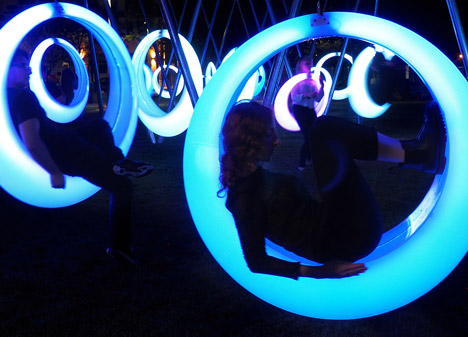
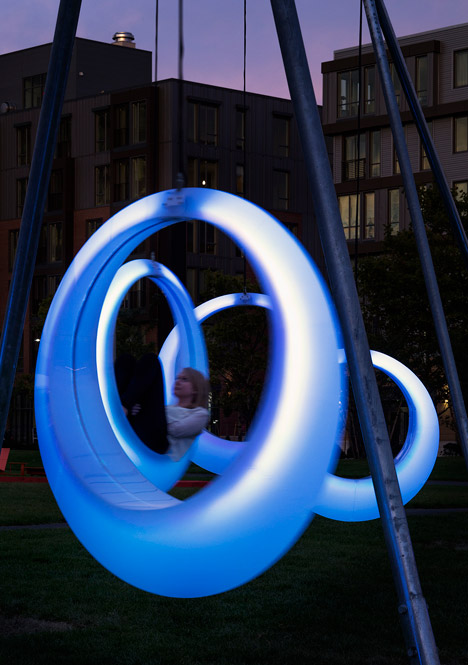
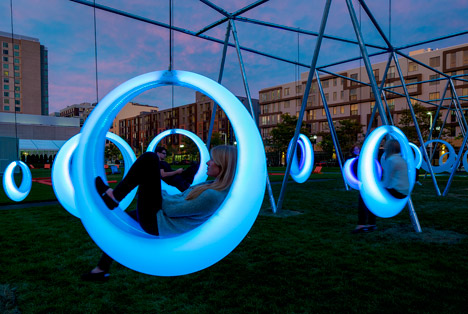
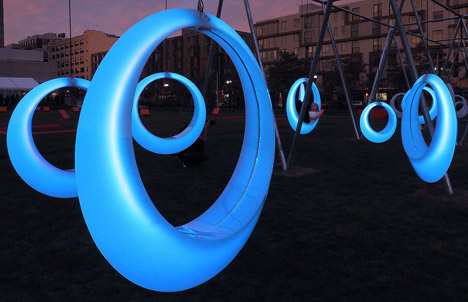
Höweler + Yoon Architecture came up with Swing Time, a set of 20 illuminated swings suspended from steel scaffolding that create an interactive installation on the green.
“We feel that play should not be limited to kids, nor to playgrounds. We had the idea of a playscape in the city that engages people of all ages in active play,” Eric Höweler, co-founder of Höweler + Yoon Architecture, told Dezeen.
“[It is] a defamiliarised playground – kind of like the tyre swing from your back yard, but this time with a twist,” he added.
The translucent plastic hoops contain LED lights that respond to activity. A microcontroller and accelerometer in each swing chart levels of motion and inclination to inform the colour changes.
“The basic principle of responsiveness tends to encourage people to interact with the piece and with each other,” Höweler said.
Immobile swings glow white, while blue indicates the swing is in use and a range of violet tones radiate depending on swinging intensity.
The installation opened to the public two weeks ago and will remain in place for the next 18 months.
“We’ve had an overwhelming response. The swings were super crowded on opening night and we’ve had requests for further installations from all around the country and internationally,” the designer said.
Höweler co-founded Höweler + Yoon Architecture alongside fellow architect Meejin Yoon. In 2012 the studio won the Audi Urban Future Award for their conceptual project BosWash, which imagined with a hybrid of individual and public transport.
Speaking at the launch of his first major built project in the UK – a gin distillery in Hampshire – London designer Thomas Heatherwick said he was “lucky” to be a British designer, but said projects that promoted industry in the UK were “rare” (+ interview).
Opening this week, the Bombay Sapphire Distillery at Laverstock Mill in Hampshire is Heatherwick’s biggest built project in his home country, despite having created some of the most iconic British designs in recent years including the London 2012 Olympic Cauldron and the UK’s pavilion at the Shanghai Expo in 2010.
Photograph by Iwan Baan
Heatherwick said that British designers were enjoying a period of “receptiveness” in the industry.
“Some of the best minds of the world are based in Britain and I feel very lucky to be working at a time when there is receptiveness to what we’re all doing,” said Heatherwick.
Related story: Thomas Heatherwick’s gin distillery for Bombay Sapphire opens
“When we worked on the UK pavilion in Shanghai I was trying to redress the image of Britain only being about castles and Sherlock Holmes and postboxes, to the level of innovation and different lateral thinking that in Britain we have around us. I feel lucky to be working at this time and in that context.”
Photograph by Iwan Baan
Heatherwick said the distillery project, which involved reviving an historic paper mill, was an opportunity to celebrate British industry and production – which has been in decline after years of political neglect and recession.
“This could easily become a gated housing community, but it’s most meaningful if we can retain in-Britain production,” he said. “What drove our excitement in this project, the whole way through, was how rare that was to grow production in Britain.”
Photograph by Iwan Baan
Laverstoke Mill operated as a paper mill and sole-manufacturer of Bank of England bank notes between 1719-1963, but the site sat unused for over a decade before singled out as the new home for Bombay Sapphire Distillery.
Heatherwick Studio began work on the Bombay Sapphire Distillery four years ago, at the height of the recession when many industries were making cutbacks.
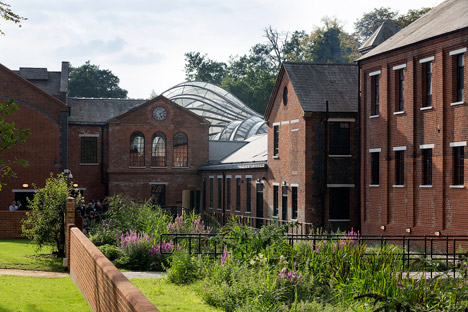
21 lean-to extensions and structures were removed from the “jumble” of 49 existing buildings on the site, leaving a collection of low-rise red brick buildings that date from the mid-19th to 20th centuries, three of which are now Grade-II listed.
“We felt blessed to have a site with so many layers to work with, and a sense that we were just adding a next layer, an imprint,” said Heatherwick. “In another two centuries from now, will this still be a distillery or will it be reappropriated for another form of manufacture? Whatever we do, if we can make it that housing is the least likely to be, that would be great.”
Photograph by Iwan Baan
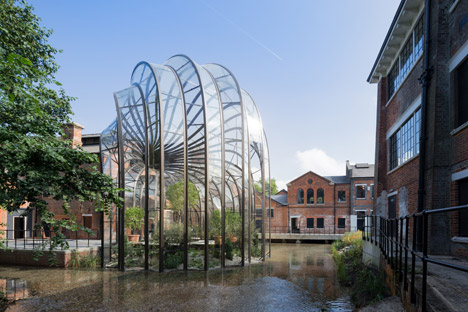
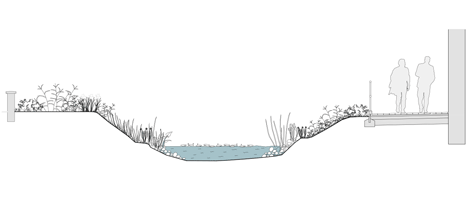
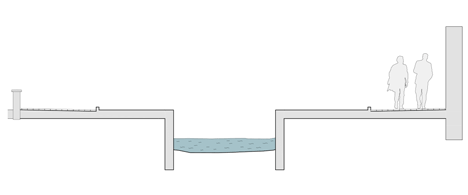
The River Test, which once powered the mill, had been “industrially squashed”, and was excavated as part of the project to increase its breadth by up to three times at its widest. The main distillery entrance to the distillery is positioned over this newly exposed section of river.
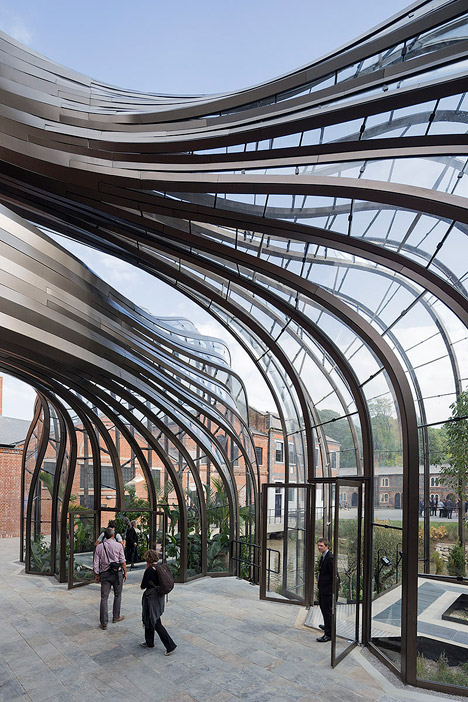
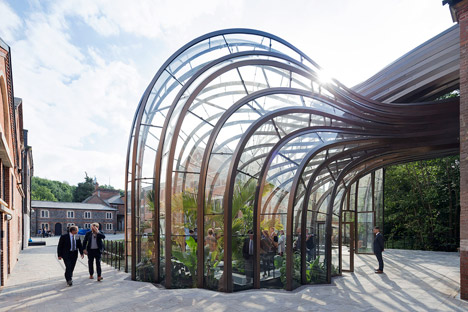
It runs from the entrance park, below the main entrance hall of the building and pools under the centrepiece of Heatherwick’s design – a pair of glasshouses that contain the 10 botanicals used to create the London gin’s distinctive flavor.
These fluted glass structures are made up of over 10, 000 separate components and represent a reaction against the “sterility” of modern high-tech glasshouse design, according to Heatherwick.
“There’s been this heritage of historical phenomenal glasshouses, people like Joseph Paxton, who did the palm house at Kew, and The Crystal Palace,” he said.
“We felt that there was an opportunity to make the smallest attempt to regain some of the confidence that some of those glasshouses and structures used to have. In high-tech manufacture, sterility has crept into more recent forms of glasshouses.”
The taller of the two structures stands at 15-metres-high and houses botanicals originating in a Mediterranean climate, the shorter 11-metre-high structure is kept at 75 per cent humidity to suit tropical species. A flue at the top of each hothouse connects with the redbrick building to the rear, which houses two copper gin stills and an educational area for visitors.
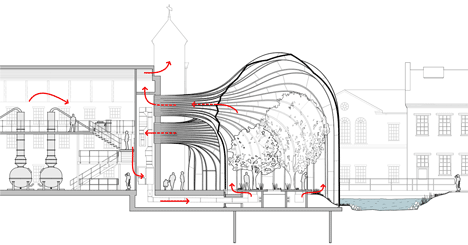
The heat produced by the stills is drawn into air vents below grates in both glasshouses and not only heats the houses but encourages air circulation that prevents a build up of condensation on the panes.
Together the structures form an educational area for visitors that is integrated into the main body of the distillery, and Heatherwick’s get-out clause for the visitor centre that was originally included in the brief. “We actually felt allergic to visitor centres,” said Heatherwick.
Read on for an edited transcript of the interview with Thomas Heatherwick and project architect Eliot Postma:
Jessica Mairs: Can you tell me about how you came to work on the distillery project?
Thomas Heatherwick: The studio was lucky to win a competition. Bombay Sapphire had a glass design prize every year for about a decade, and we won it about ten years ago. It was a design for a glass bridge – an idea for a concept of a bridge built from just glass. Ten years later we won a competition, to figure out how we could turn this historical, complex jumble of buildings, untangle it and put industrial production into it.
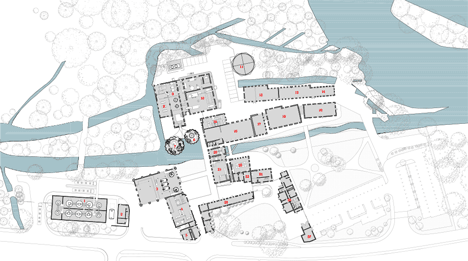
Site plan –
Jessica Mairs: Can you tell me about the changes you’ve made to the site?
Eliot Postma: Really the predominant thing, and what we felt when Thomas and myself first visited the site, was that there was this amazing asset sitting right in the heart of it. It’s the clearest river – it’s certainly the most beautiful river – that I’ve seen in the UK and you just couldn’t see it. We came here and we walked around and it was a couple of old buildings and there was just this general sense of a maze on the site and you would feel lost as you were walking around it.
So it was two things – an amazing opportunity to bring this river back to life, whilst [allowing] the historic buildi ngs on site to sort of breathe. These modern buildings had started to suffocate it a little bit. The real focus for us was creating this organisational device, using the river to help people understand the way through the site and navigate their way across it. So, widening those riverbanks and bringing their natural habitat back.
Thomas Heatherwick: Because it [the river] had been channeled. There was no foreshore. So there was no sort of interstitial space between English countryside and the other piece of the countryside, which was the river water itself – the purest in Britain. All channeled, industrially squashed. By opening it up we not only allowed you to see it, but we also allowed the plants and animal species to thrive and reconnect itself, in certain places opening it up to three times as wide as it originally had been which was exciting to be able to do.
Glasshouse section –
The trigger of it was this making of a public space at the heart of the site, using the decision to put the arrival over to one part so that the river drew through the site and that heart space wasn’t immediately as you arrived. I suppose we deliberately used our master plan to tease you, you can see some clues over the top from where you first arrive. The river draws you towards them, and then pulls you in. There were 21 different structures needing to be removed to do that. So that was a big work.
I was brought up with the sense that English Heritage stopped everything, but actually English Heritage were fantastic and really worked with us and get the spirit of what we were trying to do. This could easily become a gated housing community, but it’s most meaningful if we can retain in Britain production. So what drove our excitement in this project, the whole way through, was how rare that was to grow production in Britain.
We were able to use the excess heat from the production to grow the plants that are key to the particularity of that product and then place them in the river itself. And the Environment Agency and British Nature really worked with us to let that happen. I don’t think we expected that.
So in a way it’s a big sign of a culture in these British agencies of openness. People sometimes assume that they’re going to be limited.
Jessica Mairs: Other than the glasshouses, have you added any new structures to the site?
Eliot Postma: For this to be a state-of-the-art distillery there are certain production facilities that needed to come in. A huge aspect of the master plan was ensuring that tankers could come in and there’s also an enormous sprinkler tank behind these buildings here, so there are other aspects that we’ve had to add in that were production orientated to make the distillery work and make it as efficient as possible.
River section
Jessica Mairs: Can you tell me about the glasshouses?
Thomas Heatherwick: The shape is derived from this need, by creating an umbilical link, to use the excess heat from the gin production we needed to collect, in order to be able to take the warm air in at the low level and then extract the air from the top to make it flow. So that was driven by the physics of the air movement.
There’s been this heritage of historical phenomenal glasshouses, people like Joseph Paxton, who did the palm house at Kew, and The Crystal Palace. We felt that there was an opportunity to make the smallest attempt to regain some of the confidence that some of those glasshouses and structures used to have. In high-tech manufacture, sterility has crept into more recent forms of glasshouses.
We looked at some of the cloches that were used in some of the kitchen gardens. Gardeners used these glass domes that they placed over particular plant specimens that they want to give extra heat to and to help them grow. So to us these were just like two cloches. The Victorians also had a craze for these things called wardian cases which people would have in their living rooms and grow exotic plant species in. We were really interested in these wardian cases and the culture for the glasshouses with botanical specimens in. [We thought] why can’t this be a botanical distillery. So that drove a lot of our decisions.
River section
80 per cent of our work was with the exiting buildings and only 20 per cent with the glass houses. With the existing buildings, in general they were office buildings with polystyrene ceilings and nasty fitted carpets and so there were no spaces big enough to have the stills. So it was figuring out how we could create gin halls of sufficient space, working to see whether we could get permission for those major moves – three of those buildings were grade II listed structures. And then trying to unreel – sort of delicately take off layers – and be proud of all the layers and layers that exist here because the site is built up from the mill workers cottages, which are built up literally over centuries.
We felt blessed to have a site with so many layers to work with and a sense that we were just adding a next layer and imprint. In another two centuries from now, will this still be a distillery or will it be reappropriated for another form of manufacture? Whatever we do, if we can make it that housing is the least likely to be, that would be great.
Jessica Mairs: This is your first major project in the UK. How do feel about the state of British design and where you fit into that?
Thomas Heatherwick: I think some of the best minds of the worlds are based in Britain and I feel very lucky to be working at a time when there is receptiveness to what we’re all doing. When we worked on the UK pavilion in Shanghai, I was trying to redress the image of Britain only being about castles and Sherlock Holmes and postboxes, to the level of innovation and different lateral thinking that in Britain we have around us. I feel lucky to be working at this time and in that context.
So, in this week’s Outlander, we finally get to the episode all Outlander book fans have been waiting for. The wedding! It’s an arranged marriage, basically forced upon Claire, in order to make her Scottish and protect her from the evil British Army Captain Randall. (Meanwhile, she still has a 20th century husband whom she loves). This is a complicated tale of lost love and new beginnings, the potential for death and dismemberment around every corner and 18th century customs and superstitions meeting 20th century budding feminism. It’s not a simple romance (where we’d have had bodices ripping by the end of the first episode) and things aren’t always as they first appeared. The episode itself is quite simple: Claire and Jamie get married and how that was pulled off, and, what they each did during the day to prepare. Claire drinks – a lot – while Jamie and his cohort see to the details of obtaining the dress, the groom’s family tartan, the ring, the church, the priest and by the end, gawping ear-witnesses to the consummation so that everything is all legal. Certainly, things are turned on their heads as the groom does all the work (and comes to the union a virgin) while the bride is drowning her sorrows trying to forget her troubles.
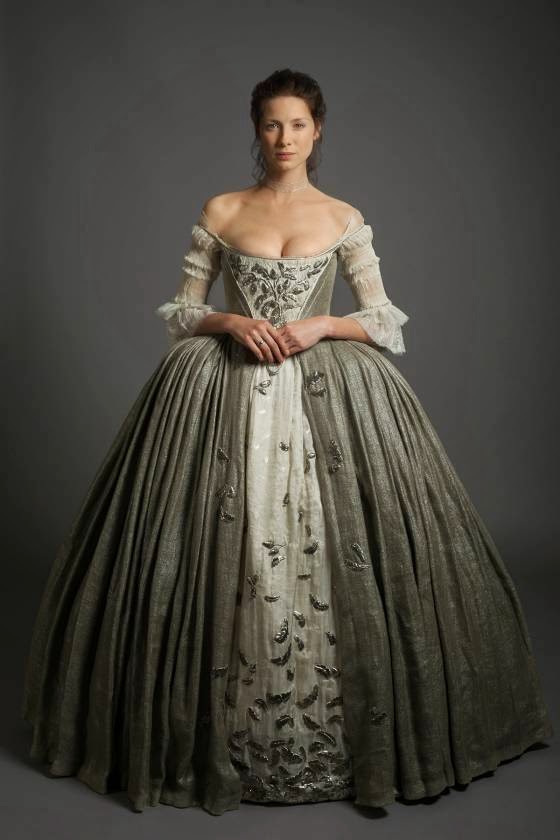
All that said, a dramatic wedding always has great costume potential and this one did not disappoint. Costume designer Terry Dresbach and her team truly created a showstopping masterpiece for Claire’s dress. Terry’s blog offers a lot of back story, how they made the dress (3000 hours of work!), historical references and more. One of the most notable aspects of the Outlander books is the detail that author Diana Gabaldon gets into. Every physical detail of the characters and their clothes was described. Eagle-eyed readers are looking out for the smallest details and some have been very vocal with their disappointment if even a hair is not the right shade or texture, or that actress Caitroina Balfe’s (Claire) eyes are blue and not the perfect shade of “sherry” colored eyes described so often in the book.
So, for the production team to bring its own creativity to the table, they are potentially pissing off the rabid fan base. It’s kind of like designing for the most picky client in the world (times thousands) who wants everything exactly so and nothing less will do. This is not to dis the fans (I am one, after all) – it’s just that the author created a million monsters with her attention to detail.
Anyway, there’s not much to the set decor. It’s set in a wayside inn somewhere and while there’s some pretty atmosphere, the accommodations are, as they would have been, pretty basic. It’s all about Claire and Jamie getting to know one another, and of course, their costumes.
Claire’s gown features silver metal embroidered acorns and leaves falling to the ground. They used real metal strips, not metallic embroidery yard, and painted a patina on them. Again, if costume design is of interest, check out Terry Dresbach’s blog.
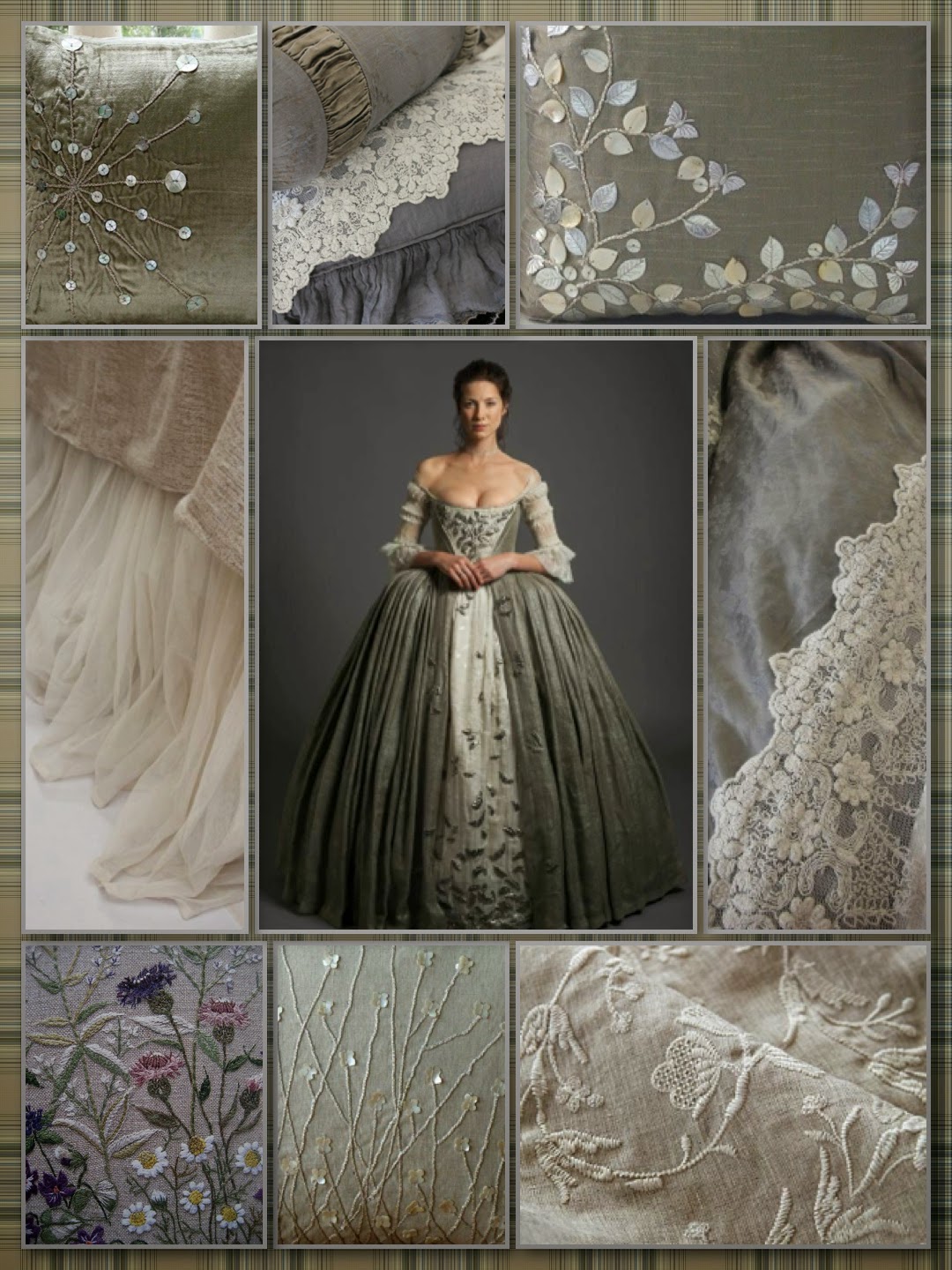
The costumes themselves are so detailed and glorious that it’s easy enough to use them as inspirations for beautiful interior details:
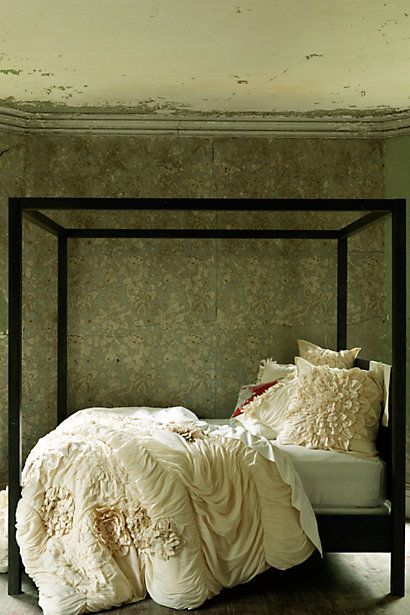
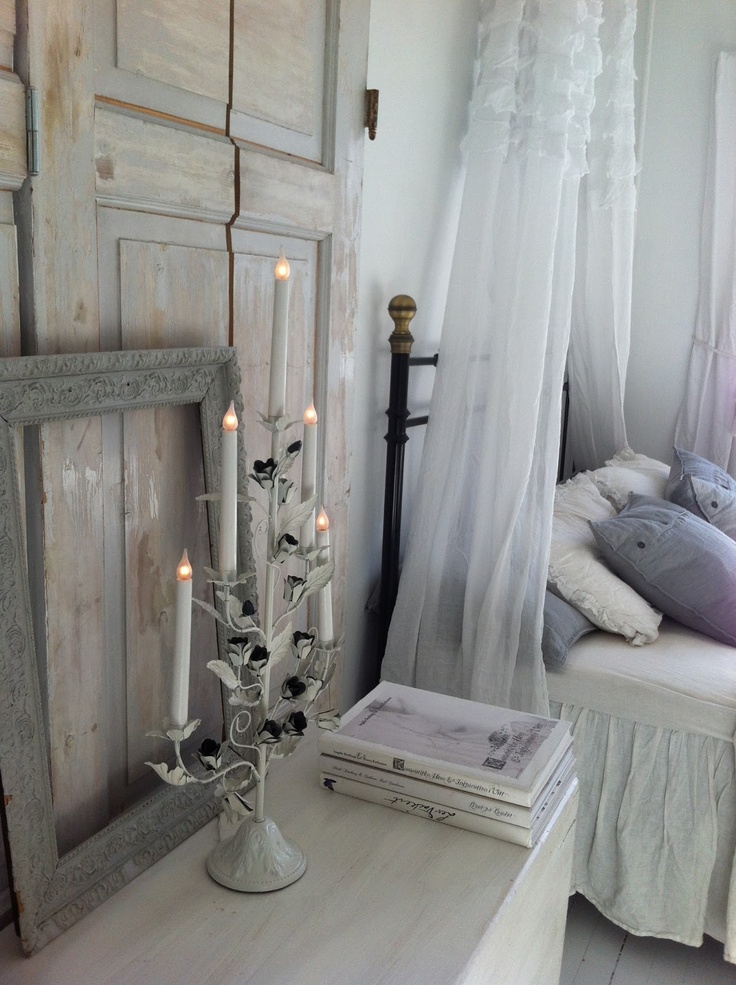
This Anthropologie bedding reminded me of the sleeves on the dress.
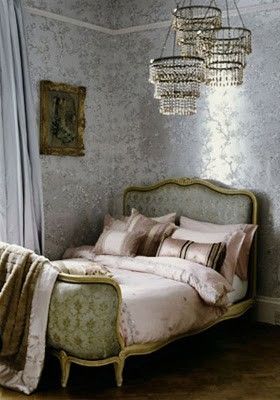
This palette with its mix of grays and sheer fabrics, rough woods and a little sparkle captures the essence of the dress.
And perhaps a little more sparkle. Note: they used shaved mica to create a sparkle in the dress. Also note, Season 2 of the series will bring us to the Court of Louis XV in France – so we’ll certainly finally have some wonderful interiors as well as costumes!
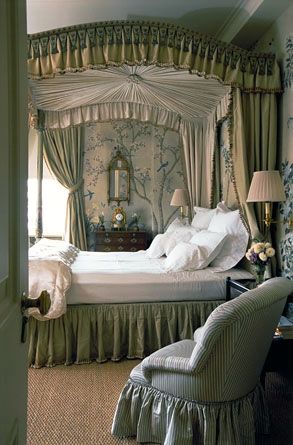
I thought the shirring of the fabric underneath the canopy reminded me of the structure and gathers of the skirt.
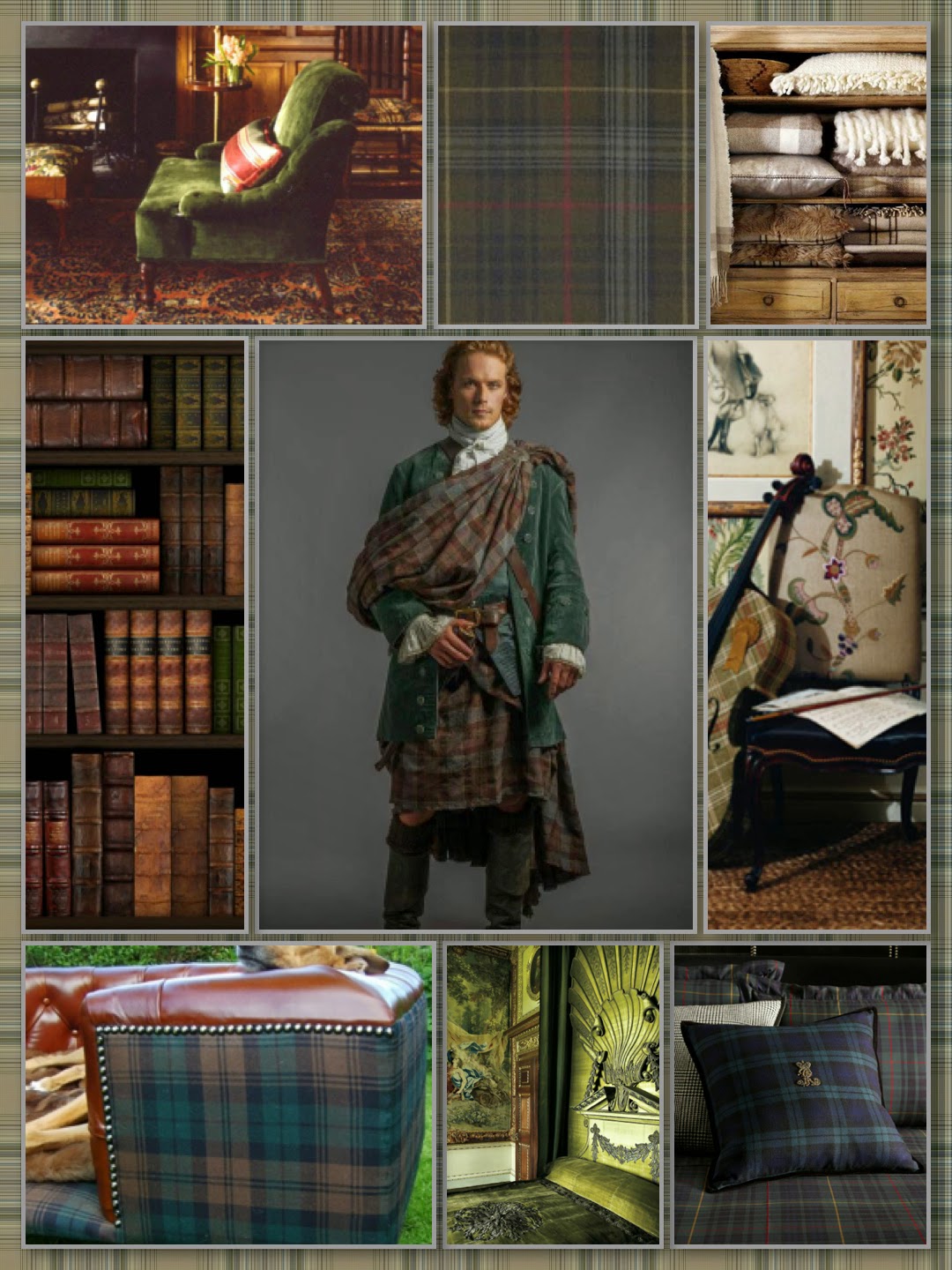
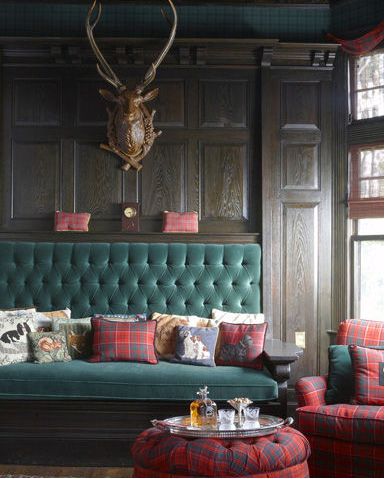
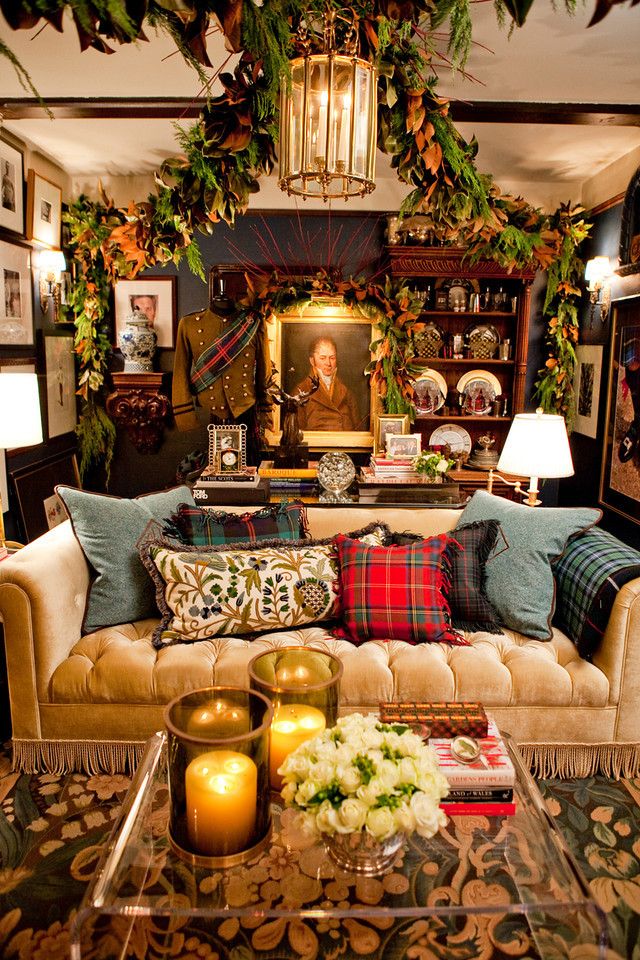
And now, for a few moment’s with our bridegroom, James Alexander Malcolm MacKenzie Fraser. In the book, his borrowed clothes were bright red. For the series, they decided to have Jamie want to wear his own clan tartan, which was created for the show to be related, though not the same, as the muted MacKenzie clan tartan. Up until this point, Jamie has been a “simple” young man (he’s only 23) – an ex-mercenary soldier, a stable hand and a MacKenzie clan relative with a price on his head. Claire doesn’t even know is real last name until the wedding because he’s in hiding from the British. So, it initially seems that Claire is marrying “down” – someone younger, less experienced and not as sophisticated. His education was briefly referenced a few episodes back, but they have intentionally kept his true depths a little hidden. In fact, the character speaks several languages, including Latin and Greek, was educated in Paris, and is surprisingly sophisticated. He’s Claire’s match and his wedding cloths had to symbolize his true status – though he is poor, he is technically Laird of his own estate and had a deep seeded sense of honor and chivalry that would make most women swoon. And, speaking of swoon-worthy – not so much the stable hand here: As for inspiring interiors – two names came immediate to mind: Ralph Lauren and my friend and fellow decorator and blogger Scot Meacham Wood:
Scot Meacham Wood’s living room (aka Tartan Scot)
Note: all links and credits to above images here. Only one more episode before the mid-season hiatus of the show, to return in January, along with Downton Abbey and Mad Men. There are lots of sad faces out here in tv land!
If you’re looking to create the home of your dreams, contact me to discuss the possibilities! ::Surroundings::
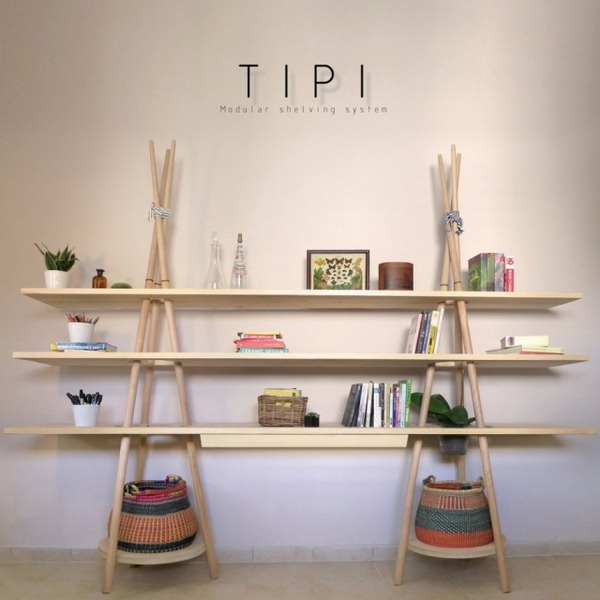
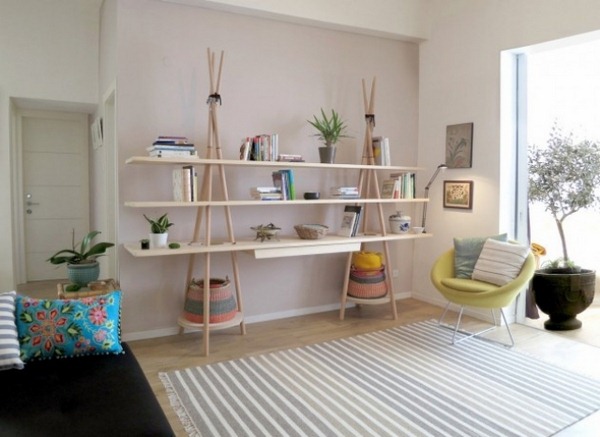
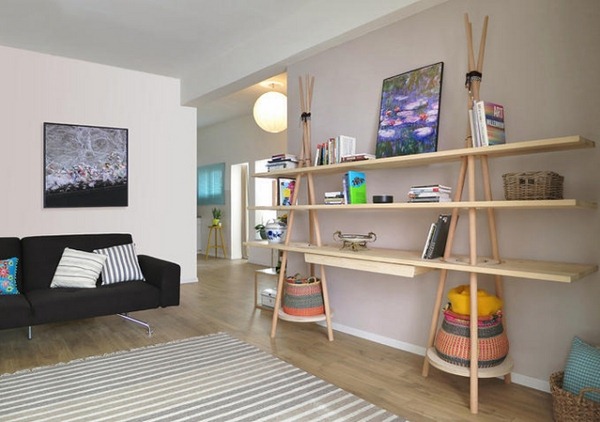
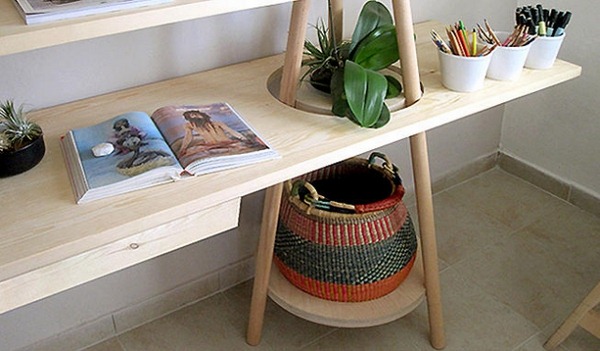
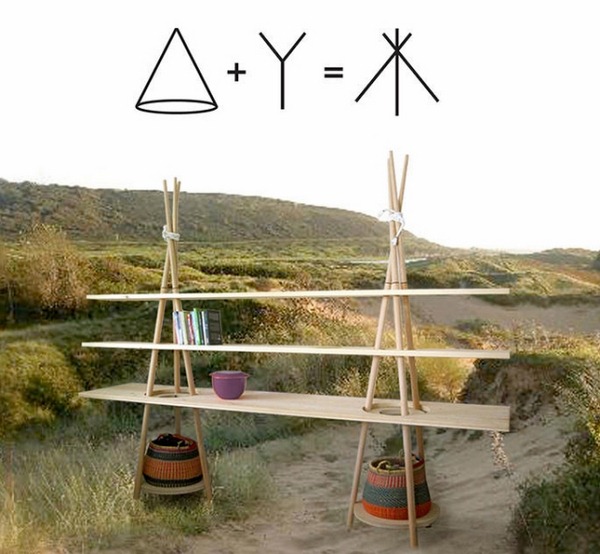
Inspired by the alleged ease of nomadism, he created a modular shelving system industrial designer Assaf Israel and named him to the tent of the North American Indian “Tipi”. The multi-functional piece of furniture certainly meets the needs of today’s ‘city nomad”and Studio is offered by Joynout.
“Tipi” was created following a year-long world tour during the Assaf Israel dealt with topics such as the yearning for change. The idea of a living, combined with constant movement and new discoveries employed the brain in a special way. The curiosity-driven, dynamic world of travel could be a sort of challenge, an adventure, a journey into the unknown. A piece of furniture, which gives you more freedom and flexibility designed Assaf to open new horizons for the user. An object associated with the static, with the attachment Gets a new definition in his project.
Thanks to its modular design fits the Regylsystem “Tipi” in small apartments, as well as in public spaces. Quick and easy Assembly, disassembly and transportation go to the needs of mobile people today.
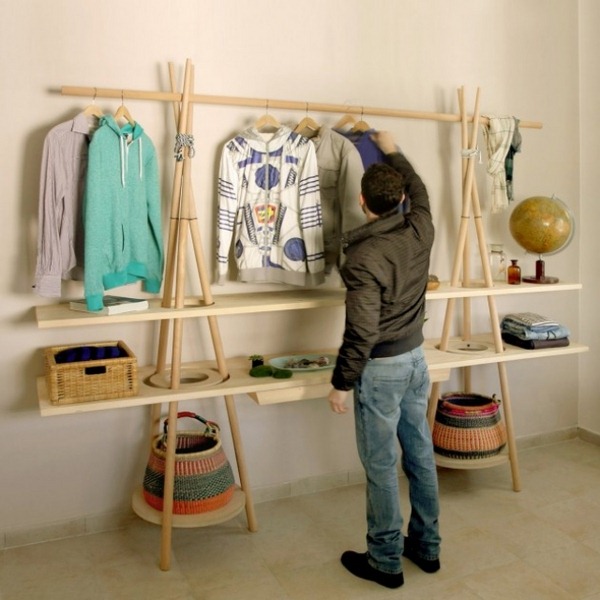
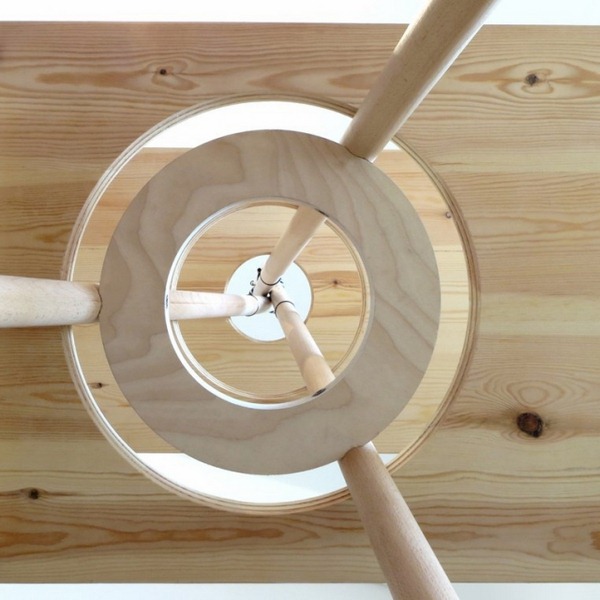
“Tipi” accompanies the user for several years and offers a sustainable alternative for the modern consumer people. Yes, nothing new under the Sun but is a modular shelving with drawers and a clothes rail. Tipi but also works as a compact desk and is a real eye-catcher. The cone-shaped structure allows simple and convenient setting of the racks without necessity to fix. Only the upper part of the rods is fixed with screws to allow the perfect positioning of shelves.
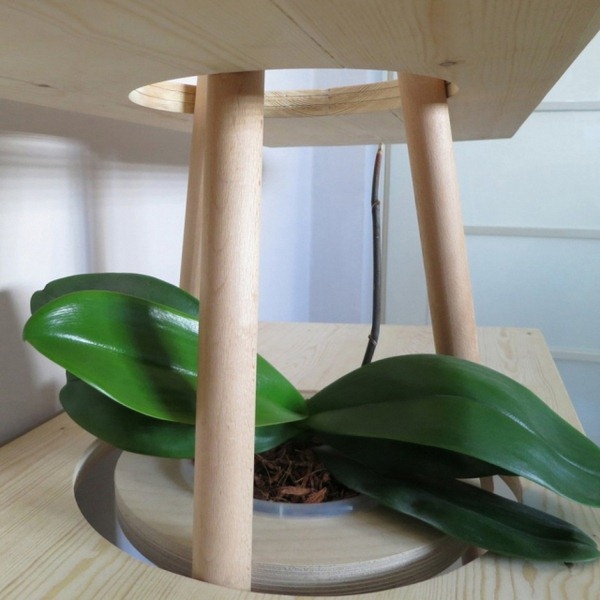
The Kontstuktion is the rods made of wood – and Regalboards were Very much precisely cut from solid oak and the mounting rings – made of Birch plywood on a CNC cutting machine. Tipi system is 220 cm, 250 cm, depth 52 cm and is composed of 3 shelves, 1 hanger rail, 1 shelf. The African storage baskets are made in a traditional technique from “Veta-Vera” grass by hand. The shelving system in original color wood or with black paint is available.
Related posts:
Storage and shelving systems wood for private purposesDecorating a home with booksLatest trend in shelves Room Decorating Ideas
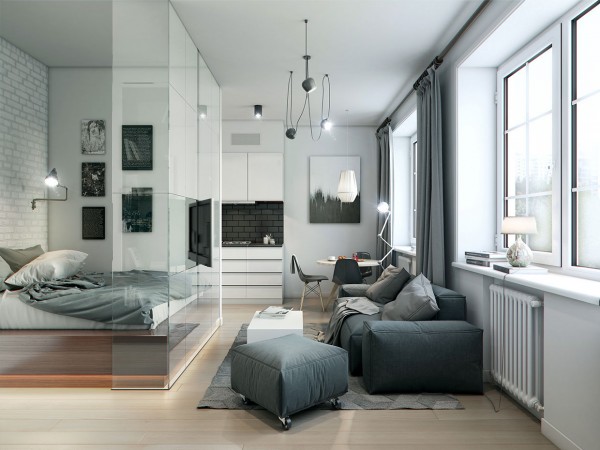
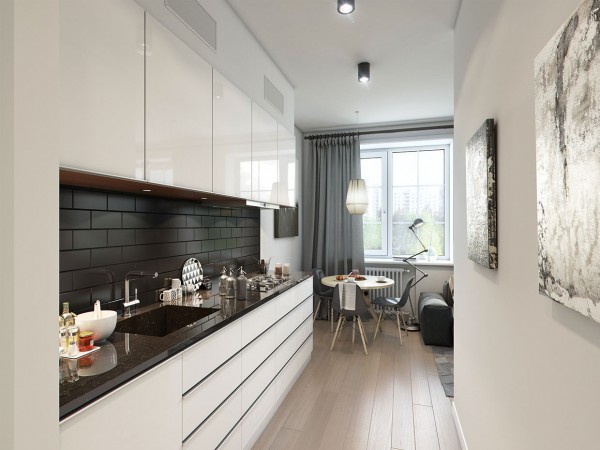
This 32 square meter (344 square foot) apartment uses interior glass walls to create a bedroom that doesn’t make the home feel any smaller.
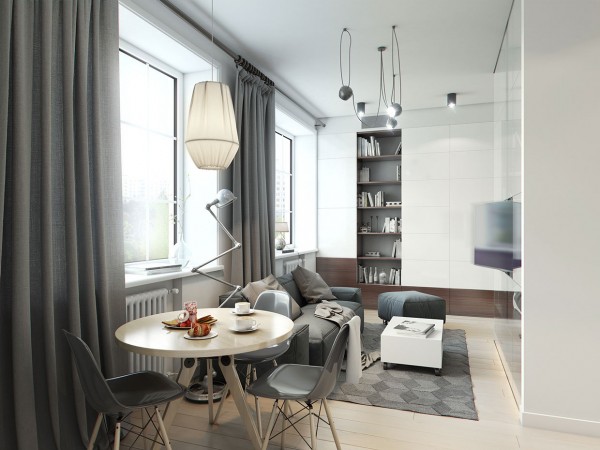
A small dining area, with lovely Eames-inspired chairs, is perfect for a guest or two.
The use of neutral colors, which extends into the narrow kitchen, makes the space feel more open and calm, despite the lack of extra floorspace.
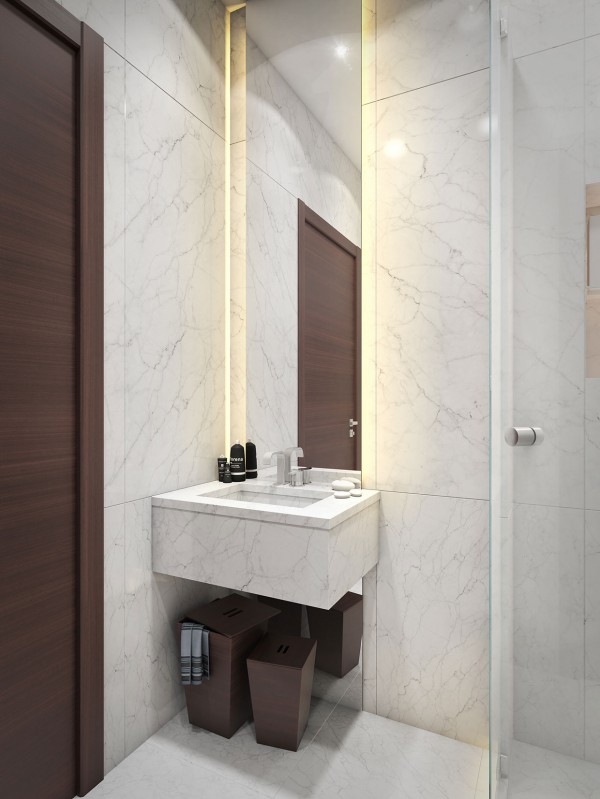
Even the smallest bathroom feels luxurious when it’s decked out in white marble.
A small shower stall is the perfect solution for cleanliness without spaciousness.
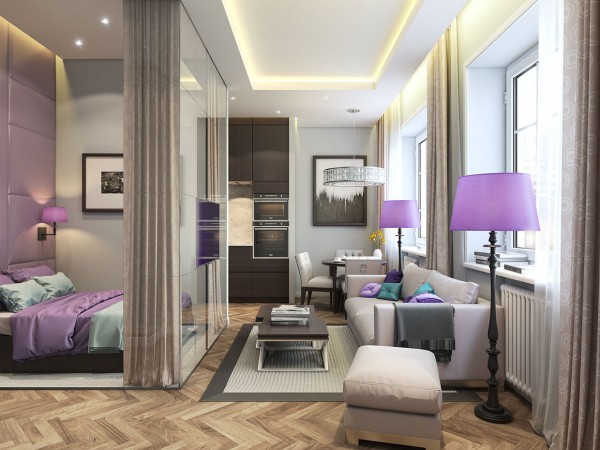
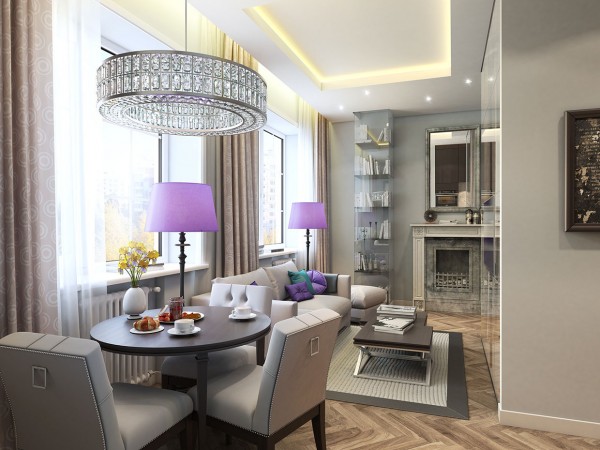
This next apartment actually uses the same floorplan as the first, but with some stylistic differences.
We can see that some more classical elements come in with a crystal chandelier and cushy dining chairs.
Pops of purple are visible even from the kitchen, bringing a bit of boisterousness whimsy to the overall atmosphere.
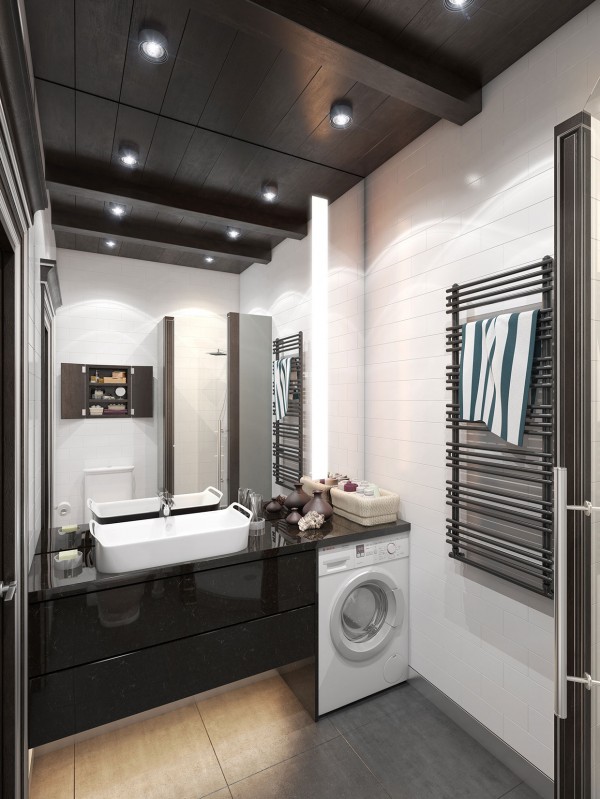
The tiled bathroom is not quite as decadent, but does manage to slip a washing machine under the counter, which is quite convenient in an apartment this size.
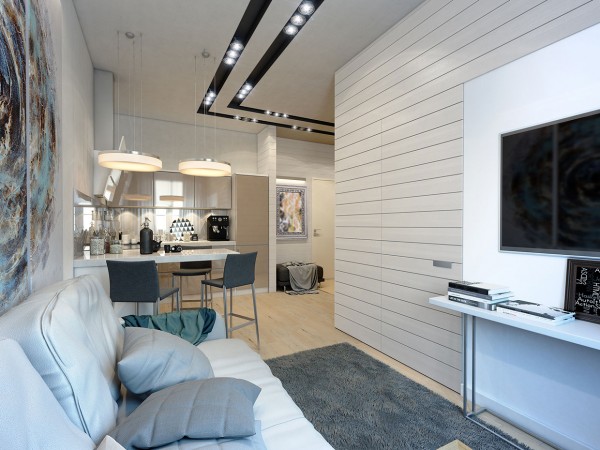
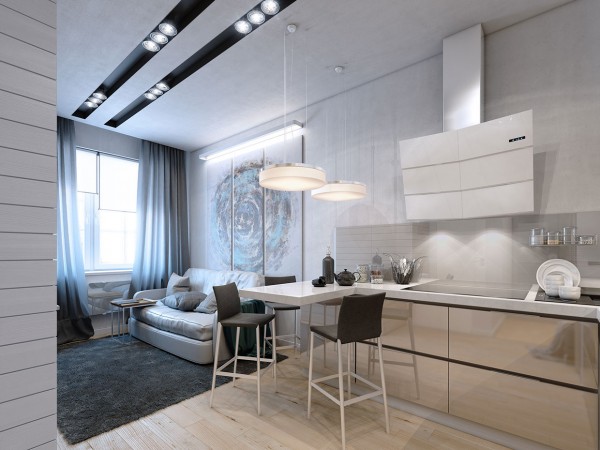
The third apartment measures 35 square meters (375 square feet) and tackles a different floorplan with the same panache.
In this case, the narrowest room is the living room which has just enough space for a comfy couch.
Rather than take up precious inches with a separate dining area, this design uses a small breakfast bar that doubles as a kitchen prep area.
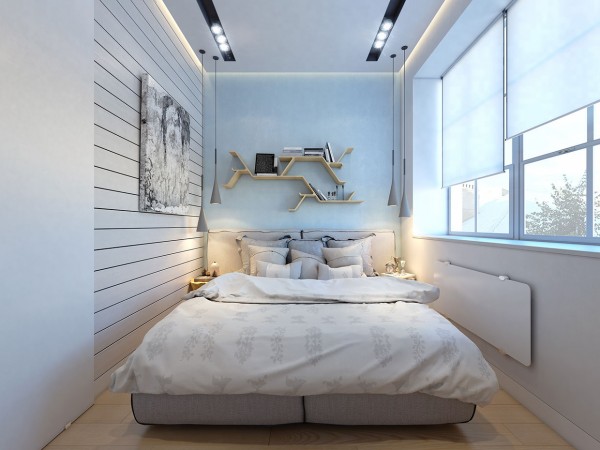
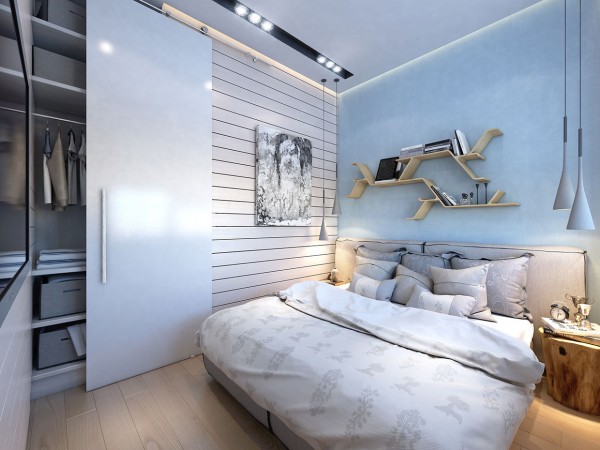
The bedroom is small but large windows keep it from feeling at all closed in.
Shelving doubles as a headboard, which adds interest and a bit of useful storage.
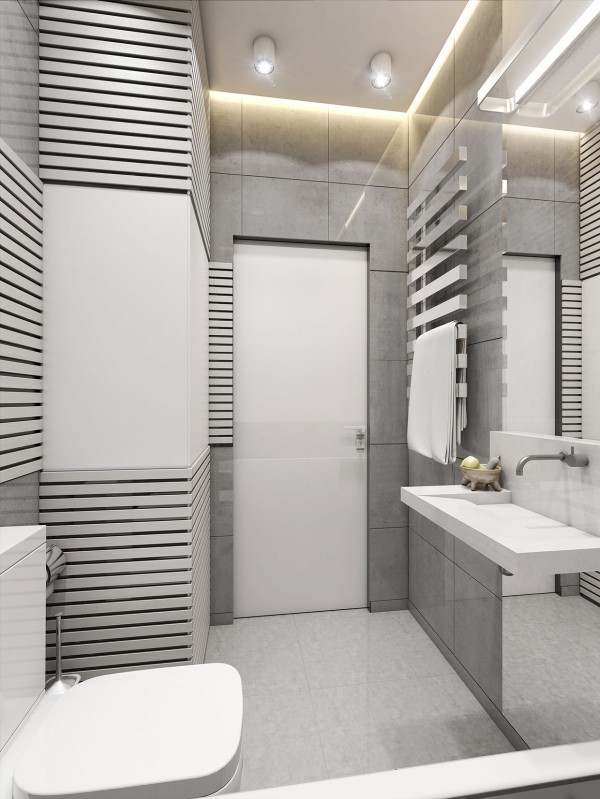
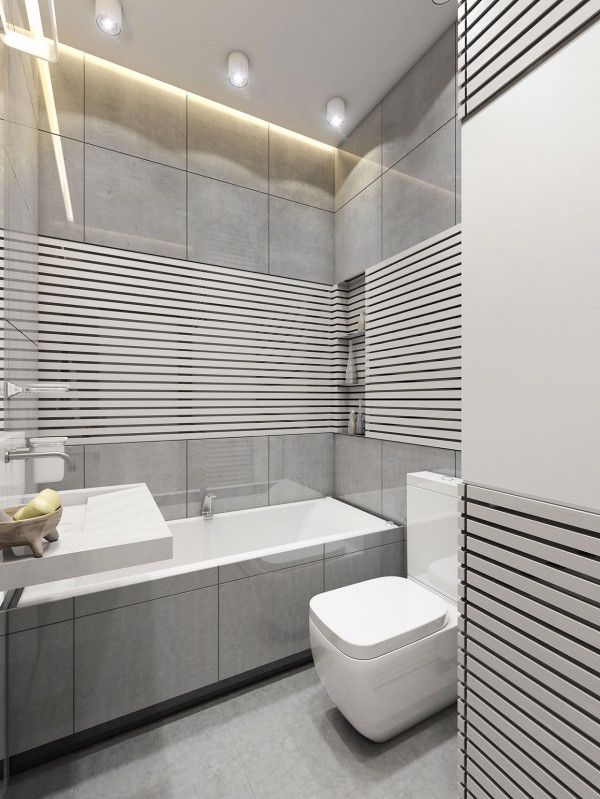
In the bathroom, reflective surfaces are always a must but here in particular they keep the space from feeling cramped.
Related Posts:
Small Open Plan Home Interiors
Secret Places Inside Homes!
Chic Apartment in Barcelona’s L’Eixample District
Homes Under 400 Square Feet: 5 Apartments That Squeeze Utility Out Of Every Square Inch
Interior Design Close To Nature: Rich Wood Themes And Indoor Vertical Gardens




 Photograph by Iwan Baan
 Photograph by Iwan Baan
 Photograph by Iwan Baan
 Photograph by Iwan Baan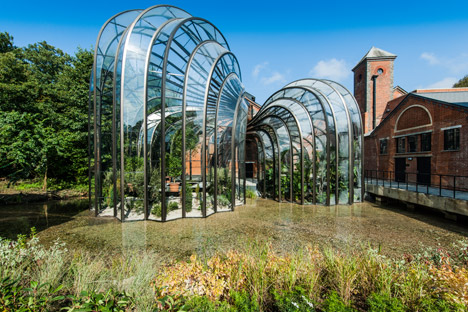
 Site plan –
 Glasshouse section –
 River section
 River section


 Scot Meacham Wood’s living room (aka Tartan Scot)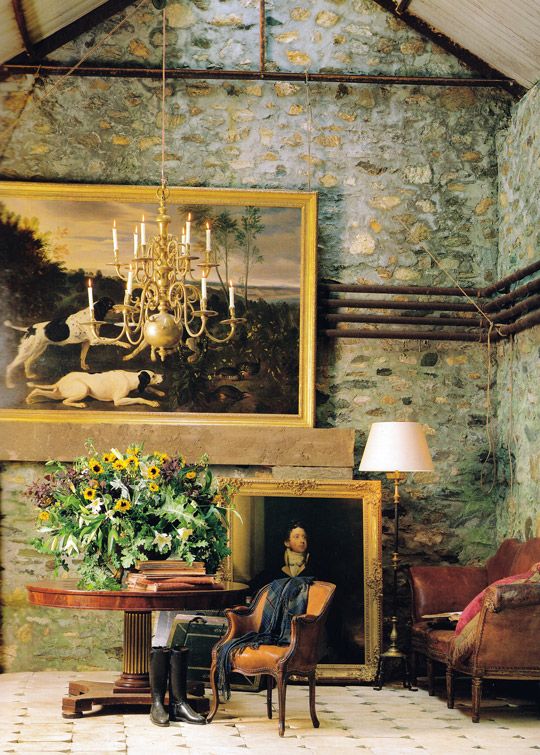









 Small Open Plan Home Interiors
 Secret Places Inside Homes!
 Chic Apartment in Barcelona’s L’Eixample District
 Homes Under 400 Square Feet: 5 Apartments That Squeeze Utility Out Of Every Square Inch
 Interior Design Close To Nature: Rich Wood Themes And Indoor Vertical Gardens
 Flowing Open Interiors from Euromobil