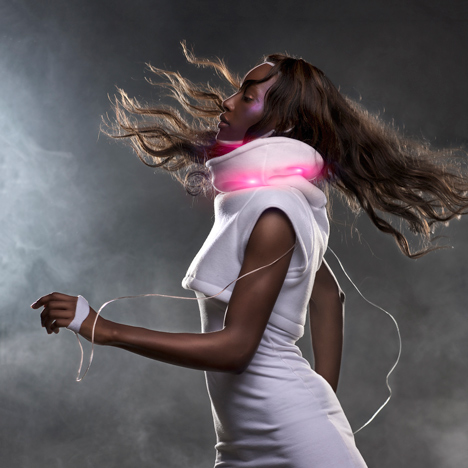
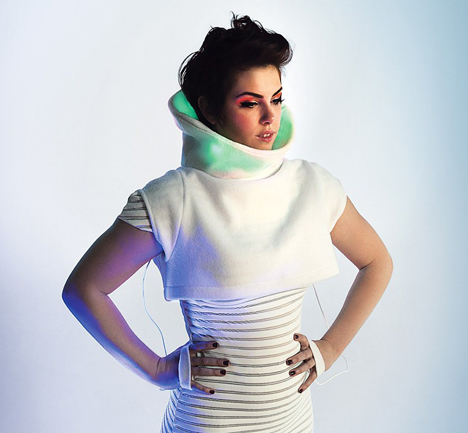
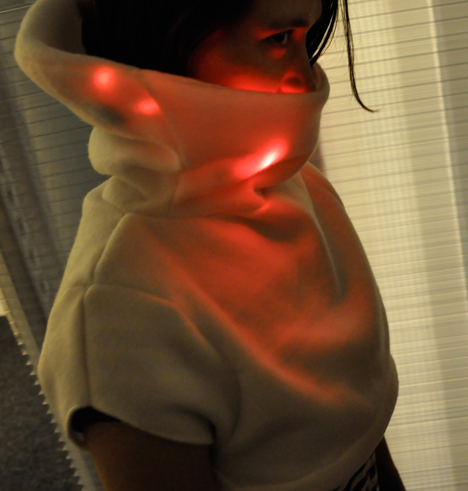
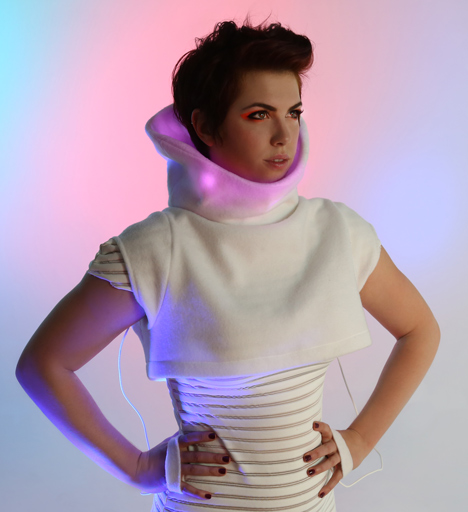
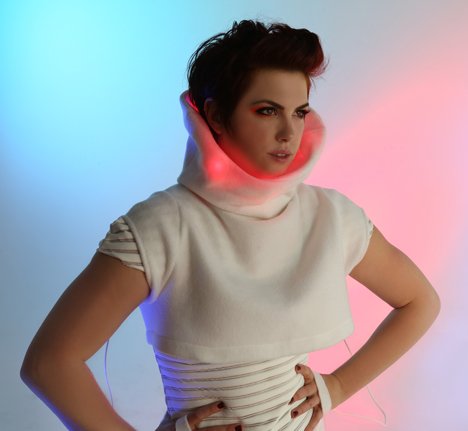
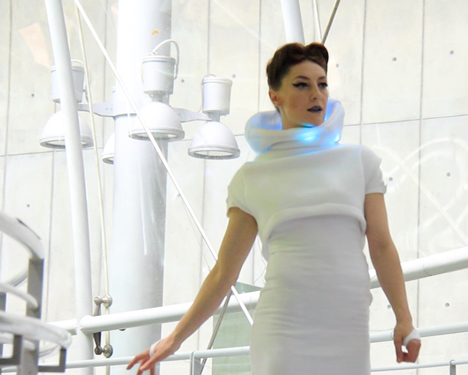
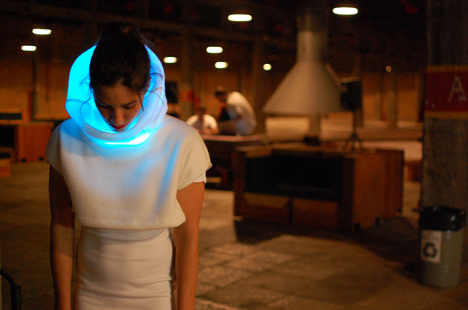
The collar of this sweater by San Francisco studio Sensoree changes colour depending on the wearer’s excitement levels .
Sensoree’s GER Mood Sweater, which goes on show in the UK for the first time today, has a series of LEDs embedded in fabric around the high collar that illuminate to display the wearer’s emotional state.
Related story: (No)where (Now)here: Two Gaze-activated Dresses by Ying Gao
Sensors that the studio calls galvanic extimacy responders (GER) are placed on the hands to read and interpret electric currents produced by chemical action in the skin.
These are connected along translucent wires to a node inside the garment, which translates the readings into specific colours created by the lights.
The white sweater glows red when the wearer feels nervous or in love, turns blue to show calm and can change to purple to represent excitement and yellow for contentment.
The technology presents an opportunity for individuals who are unable to communicate their mood to show others how they’re feeling.
“This concept holds exciting promise for the future, as wearable clothing could be adapted for the personal healthcare arena,” said Sensoree founder Kristin Neidlinger.
“For those who struggle to communicate their emotional state – in Alzheimer’s disease for instance – a person may easily become aggressive and agitated, often without warning and for no apparent reason.”
“Wearable technology, like the Mood Sweater, could be the first step in helping families and carers to better anticipate and understand the moods of people, so they can better support and care for them,” she added.
The GER Mood Sweater has been in development for over four years and was officially launched in New York last December.
A prototype of the garment will make its UK debut during the AXA PPP Health Tech & You Forum at London’s Design Museum today.
The forum will be used to discuss how wearable technology could impact and benefit the health industry in the future.
“We are delighted to showcase the GER Mood Sweater at the forward-thinking Health Tech & You Forum,” said Neidlinger.
“Personal technology is positively impacting many aspects of our lives, and with the GER Mood Sweater wearable technology, we are creating sensitive technology that is intuitive, responsive and illuminates the senses.”
Health Tech & You is also launching a competition for designers to submit their own health technology projects. Award winners will be exhibited at the Design Museum in March 2015.
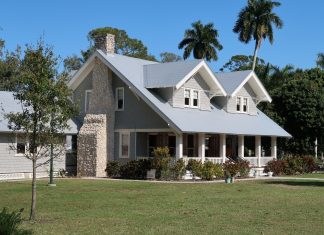
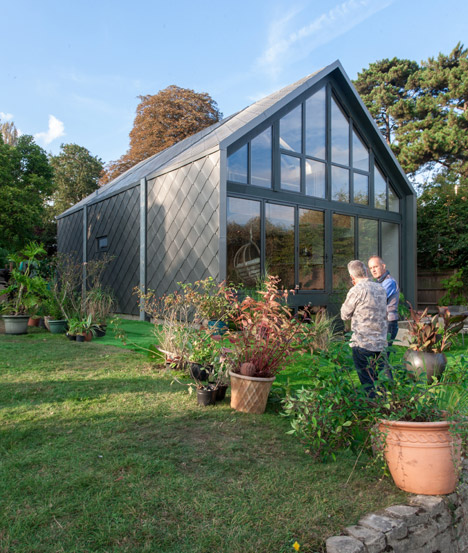
Work is nearing completion on the Amphibious House by Baca Architects – a family home on an island in the middle of the River Thames that can float on rising floodwater like a ship in its dock.
The Amphibious House nears completion
The house by London studio Baca Architects was designed for a couple who had been looking for a site to build a home on the flood-prone river island near Marlow in Buckinghamshire for seven years.
Related story: London’s largest living wall will “combat flooding”
“During the flood event the whole house will raise gently like a boat and will keep all of the habitable spaces safe above the flood level,” Baca co-founder Richard Coutts told Dezeen.
The couple chose Baca on the strength of research work on waterways that the firm has been carrying out with the UK’s Department for Environment, Food & Rural Affairs called The LifE (Long-term Initiatives for Flood-risk Environments) Project.
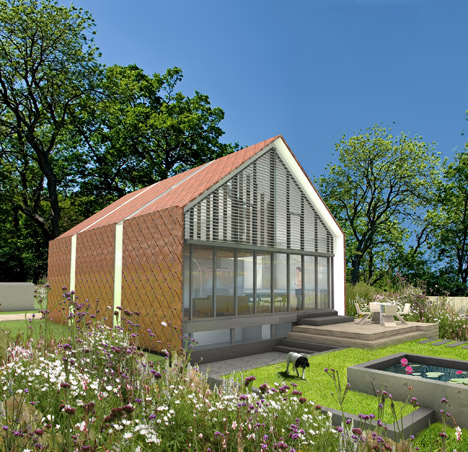
The original design for the Amphibious House
“Rather than building flood defences, [The LifE Project] considers a different approach, to acknowledge man cannot beat nature and to actually make space for water,” said Coutts. “Our work, until recently, was better known in Holland than here in the UK.”
Baca considered a number of different approaches to dealing with the unpredictable water levels on the site, including a fully floating structure – an option ruled out by officials from the government’s Environment Agency – and raising the house on stilts.
“If we’d have gone for an elevated house the ground floor would have been so high, almost two metres off the ground, the house would have looked out of keeping with its neighbours,” explained Coutts. “The benefit of an ‘amphibious house’ is that it looks in all intents and purposes like a normal house. Rather than having a house that’s up in the air you get proper engagement with the garden.”
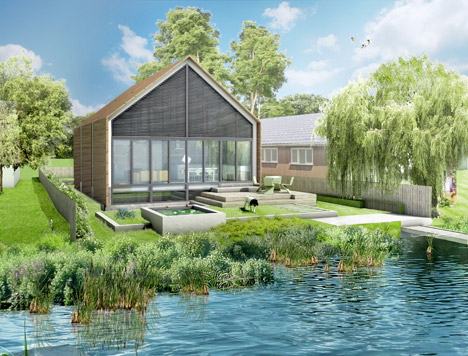
The garden design incorporates terraces that act as an “early warning system” for flooding
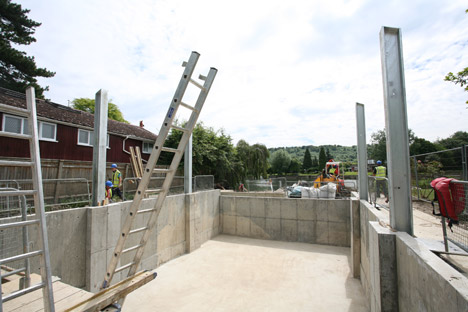
The lightweight timber-framed structure is fairly traditional in its form, but sits inside an excavated “wet dock” made from steel sheet piling with a mesh base to allow water to enter and escape naturally. This structure is independent of the house, which has a foundation of waterproofed concrete that wraps around the lower ground floor, acting like the hull of a ship.
The design was developed according to the Archimedes principle: “the house’s mass and volume are less than the equivalent of water, and that’s what creates buoyancy,” explained Coutts.
Four posts, nicknamed “dolphins” by the project’s engineer, act as vertical guideposts to allow it to slide up and down when it needs to move. These could be extended in future to cope with rising water levels.
Diagram –
“In the same way you have Liverpool Docks or the Royal Docks, which were man-made enclosures for building ships, this is a lot smaller scale and in this circumstance its built inland and will contain the house,” said Coutts. “When a flood event occurs, the river will rise gently and within the base of the wet dock the water will then start to rise.”
On the riverside, the garden is terraced to act as an “early warning system” for rising waters – when the first two terraces fill with water the house should begin to rise.
Diagram –
“At the front of our site we’ve designed something which is called an intuitive landscape. It’s a visual early warning system to the client to say ‘look your first two terraces are inundated with water’ and it’s an intuitive way to say change is happening within the river, the first two flood cells are filled, your house should have started moving.”
The house is currently designed to travel up to two and a half metres, based on worst-case scenario flood predications from the Environmental Agency and some additional tolerance for climate change.
Services are connected through “elephant cabling” – a flexible cable that carries electricity water and sewage. For safety reasons, the house only uses electric power and no gas.
The “wet dock” under construction
The island has no road access, so the architects used reclaimed NATO military equipment to build a floating pontoon that was used as a “chain ferry” to carry materials to the site. The size of the pieces of steel and glazing used in the construction of the house also had to be restricted due to the lack of mechanical lifting equipment.
“Prior to this project there had never been an amphibious house that had secured planning in England,” said Coutts. “It wasn’t covered by building regulations and is also located in a conservation area so during the course of the project we have had to go through numerous negotiations with all the various statutory bodies to set a responsible president for other houses that may well follow.”
Planning restrictions meant the house had to recreate the footprint of the previous structure that occupied the site, so the architects designed the structure with a habitable basement level to accommodate extra living space and a cinema room.
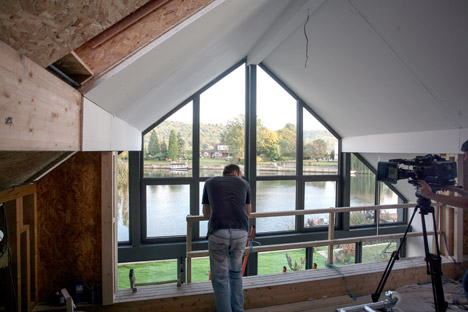
The incomplete interior during the filming of the TV programme Grand Designs
The structure is accessed via a flight of six steps that lead up to the raised ground floor, which contains an open-plan living and dining room as well as two bedrooms.
A mezzanine floor contains the master bedroom, with an en-suite bathroom and steam room.
A flood on site delayed construction, which was due to finish in time for the broadcast of the project on UK home building TV show Grand Designs tonight but will now complete next month.
Project Credits:
Project Architect: Richard Coutts Design Team: Baca Architects: Robert Barker, Riccardo Pellizzon, Robert Pattison Structural Engineer: Techniker Hydrological Engineer: HR Wallingfords
October 15th is tax day if you got an extension. With the book coming out in April I knew I couldn’t be trusted to be an adult and file our taxes without the possibility of being jailed for fraud because my brain had no room for numbers.
Today’s real life vignette looks like this. Because really, all those pretty little corners are meaningless if they can’t serve those who create them in the first place.
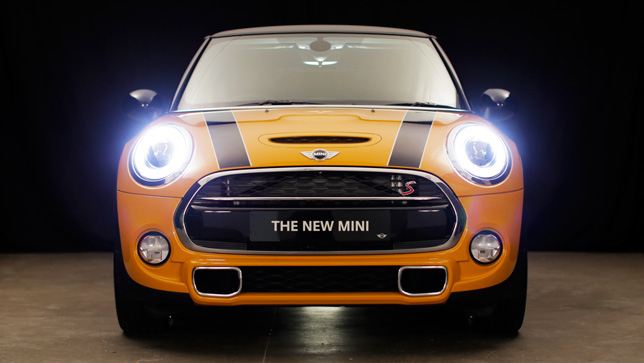
Opinion: with the petrol heads stuck firmly in rut, there’s an opportunity for designers to do something different with the new wave of electric cars. Elon Musk’s Tesla is among those leading the way, says Lucas Verweij.
The Paris Motor Show took place last week, and once again it showed us that cars are dull, ugly and predictable. Thirty years of safety and environmental regulations have eliminated all design freedom. The designers are not to be envied.
But while the petrol heads have ended up in a rut, there is plenty of progress from mobility start-ups who are developing electric cars and car-sharing concepts. We should expect cars from Silicon Valley to look different. But how exactly? After a century of car design, can a totally different visual language emerge?
It’s easy to believe that cars have reached their full potential technically, stylistically and culturally. A modern car can circle the earth five times and reach maximum speed easily, yet it rarely needs a visit to the garage. Petrol consumption in engines has halved over the past half century, and driving has become exponentially safer. In the past you hit a lamp post and died; now your car can overturn and you can walk away unharmed. Moreover, today’s car is more comfortable and easier to handle.
Experimentation within the auto industry has ceased
All those achievements are down to designers who have done their best. Cage frames, airbags, anti-lock braking systems, crumple zones, head supports and weight reductions have made cars smarter, cheaper and more economical. What a pity that aesthetics have deteriorated along the way, for today’s cars are ugly and incredibly boring.
You cannot blame designers, because the margins within which they have to design have become so narrow that there is scarcely any room for change. As sales have become increasingly stagnant, experimentation within the auto industry has ceased – in sixty years the automobile has transformed from wild, expressive and visionary to obedient, regressive and compliant.
All major car manufacturers make five incontestable models. Attempts to launch other concepts often flop, as we saw with the Fiat Multipla, Renault Avantime and Subaru SVX. Producers keep faith in what sells well. Cars resemble one another because there is so little technical variation, with most of them featuring a monocoque structure, front-wheel drive, and a water-cooled engine at the front. The wind tunnel does the rest in creating uniform shapes. Details don’t reveal much variation either. Everything from a cheap Fiat to a pricey Mercedes features the same connection between rear door and floor. All wheels are roughly the same size and clearly visible. The aesthetic values that apply to cars have become more uniform.
Manufacturers who have never produced a combustible engine are turning the automobile world upside down
What great vision there is today comes from mobility start-ups, whose motto may as well be “the car is dead, long live the car”. New car manufacturers who have never produced a combustible engine are turning the automobile world upside down. In the world of Silicon Valley it seems that consumers don’t necessarily even need to own a car. Apps like SnappCar and Uber already enable different kinds of car use. Newer car sharing initiatives like DriveNow and Car2Go are growing rapidly and car-poolers can team up through BlaBlaCar, Avego and PickupPal.
Automobile manufacturers like Tesla and Byd make nothing but electric cars and have a totally different company culture. Likewise, motorbike manufacturers like Zero and Brammo don’t use any petrol whatsoever, and so have a much clearer focus. These companies resemble computer firms more than car factories. An electric vehicle contains up to a million lines of program, so it’s no surprise that newcomers all operate out of Silicon Valley, since proximity to developers is vital. Apple, for example, is just around the corner from Tesla.
Electric power is a major advancement for the quality of life in cities. Noise, particulates, carbon emissions and exhaust smells are all reduced, and centralised generation of energy is much cleaner. Politicians – sometimes begrudgingly – agree, which is why electric cars are sometimes allowed on bus lanes and have designated parking spaces and their owners pay hardly any tax. A “full tank” costs just five euros.
A new design repertoire cannot be invented overnight
On top of that, drivers make a better impression, especially morally. I drive an electric motorcycle myself and I notice that it’s also a more social vehicle. Asking for directions or pulling away doesn’t cause a stink or lots of noise or intimidate anybody. Yet although you now can step out of an electric car and hold your head up high outside a hip cafe, it’s important that everybody can recognise what type of car it is – that it is not of the old guard.
There are therefore plenty of reasons to give electric cars a distinct appearance. But the challenge is not that simple. A new design repertoire cannot be invented overnight. So what opportunities are there to make these cars stand out?
Two technical differences offer pointers. Electric motors require hardly any cooling, which means that they do not need ventilation openings. Both BMW i3 and Renault have already detailed cars with a distinctly closed grille. In addition, electric motors are quiet, which is why Renault has added new sounds for parking and slow driving.
If technology doesn’t present much in the way of opportunity, then there is always ideology. Society believes in electric vehicles and wants this to be the future, so a futurist look is appropriate. Futurist style characteristics in the world of cars are the droplet-shaped bodywork, closed rear-wheel arches, and a smoothly curved back, all of which we see in the Honda Insight, and Volkswagen XL1. Fifteen years ago there was the General Motors Ev1, a radically different and futurist design. But the petrol heads in the GM boardroom got scared, and the popular car died a mysterious early death.
Futuristic cars have flopped remarkably often
The danger with futurism in design, however, is that it can frighten off customers. The design language is too far ahead of consumer acceptance. Futuristic cars – even from star designers – have flopped remarkably often. Just look at the Pininfarina svx, the Citroën SM, DeLorean DMC12, Tucker Torpedo and the above-mentioned Ev1.
That’s why the Tesla-S looks only moderately progressive. “A car like this needs to have a conventional appeal as well”, says Tesla’s design chief Franz von Holzhausen. The bodywork shape is deliberately conservative. They don’t hold back, however, when it comes to materials (97 per cent aluminium), interiors or coatings. A second back seat provides space for two children seated “the other way round” – a design that had never been done before.
In their detailing, too, Tesla cars are decidedly futuristic. The paintwork is coated twice to make it “look like glass”. Interior functions are operated on a big touchscreen, and door handles appear only after the car has been unlocked, just like in Star Wars.
Next year a model with two wing-doors – the ultimate futurist device – comes on the market. Tesla, the most important innovator, is not holding back. And that’ s good news. The future looks bright. Because believe me, very soon the automobile industry will be just as expressive, visionary and wild as it once was. Only this time it will be electric.
Lucas Verweij has been teaching at schools of design and architecture around Europe for over 20 years. He was director of a master’s programme in architecture and initiated a masters course in design. He is currently professor at the Kunsthochschile Weißensee and teaches master’s students at Design Academy Eindhoven. He has initiated and moderated various seminars devoted to designing design education.
Architects could become “closer to game designers or filmmakers”
Dezeen and MINI Frontiers: in the first in a series of extracts from interviews with the designers that participated in our exhibition on the future of mobility, Kieiichi Matsuda discusses how augmented reality could fundamentally transform the way we design buildings.
“I see the architectural profession splitting into two parts,” Matsuda says. “On the one side you’ll have the people that design the physical support structure of the building. On the other you’ll have people who are making the experience of a building – the way that we perceive it in the virtual layer. They’ll be much closer to game designers or filmmakers.”
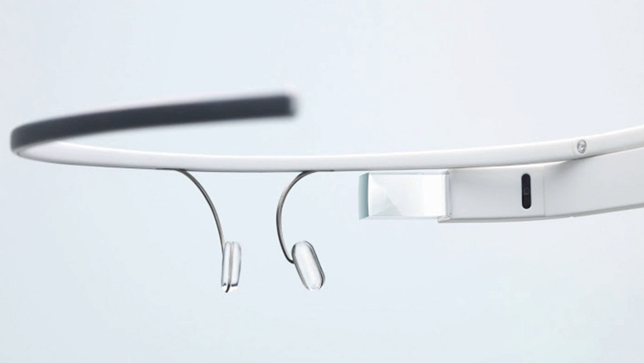
Google Glass
Augmented reality is a way of superimposing digital information over the real world. The technology currently works with smart phones, tablets or headsets such as Google Glass.
Related story: Virtual and augmented reality technology will converge in digital “contact lens”
However, in the future it could be possible to embed the technology into something as small as a contact lens. If such devices become commonplace, the way we use and interact with buildings could change dramatically.
Keiichi Matsuda
“I find it incredibly frustrating in architectural education that there’s no real drive to understand the way that technology is changing our cities,” Matsuda says.
“There’s this old architectural maxim that form follows function, the idea is you should design the form of your building around the function that it occupies. But [with augmented reality], that doesn’t exist anymore.”
Related story: Augmented reality devices “in your eye” will change how we see the world
“We bring the function with us, so how can you really design the form around a function that is not set? We want flexibility in buildings, we want the ability to be able to apply whatever function that we want and we want the building to be able to support that.”
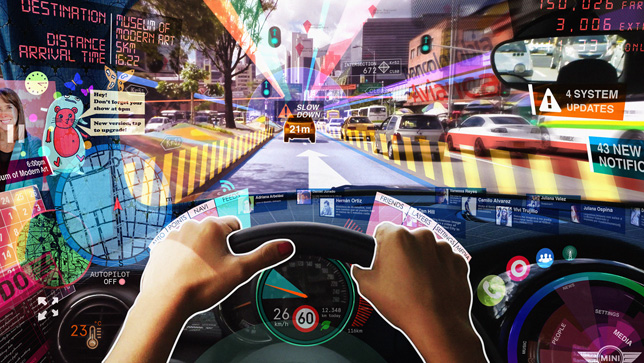
A still from Keiichi Matsuda’s Hyper-Reality film
The Dezeen and MINI Frontiers exhibition took place at designjunction during London Design Festival from 17 to 21 September 2014.
Matsuda produced a film looking at how ubiquitous augmented reality could transform the way we navigate cities, with signage and directions superimposed onto the streets digitally.
Dezeen and MINI Frontiers is a year-long collaboration with MINI exploring how design and technology are coming together to shape the future.




 The Amphibious House nears completion
 The original design for the Amphibious House
 The garden design incorporates terraces that act as an “early warning system” for flooding
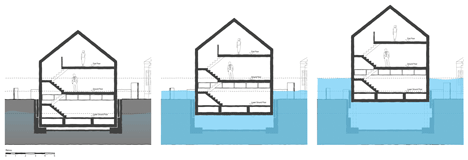 Diagram –
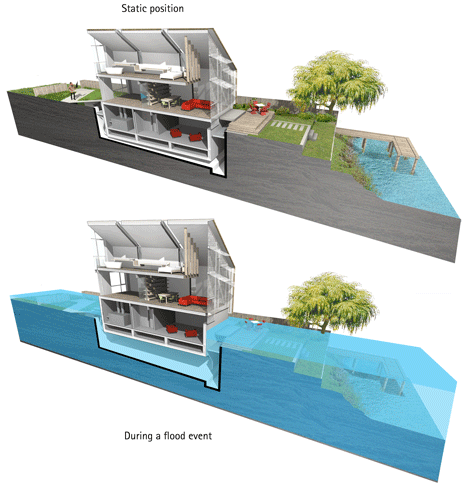 Diagram –
 The “wet dock” under construction
 The incomplete interior during the filming of the TV programme Grand Designs




 Google Glass
 Keiichi Matsuda
 A still from Keiichi Matsuda’s Hyper-Reality film