I’m headed back to Las Vegas this week to work on the fixer house and the next project I’m starting is a remodel of the master bathroom vanity. Right now it’s one of those builder grade specials that has been there since 1989 and a refresh is so happening. This is the kind of project that’s manageable to update with a reasonable amount of money if I don’t let my starry eyed dreams of pricey marble mosaic tile send me over budget (see below and you’ll see how I’m in danger).
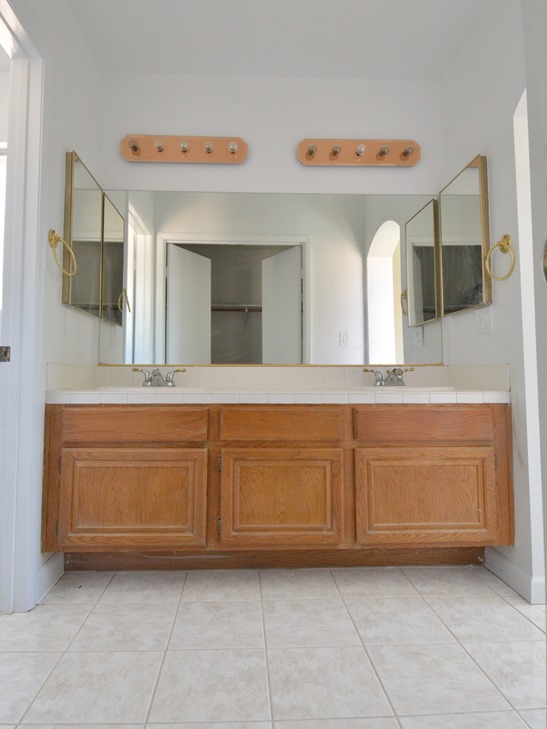
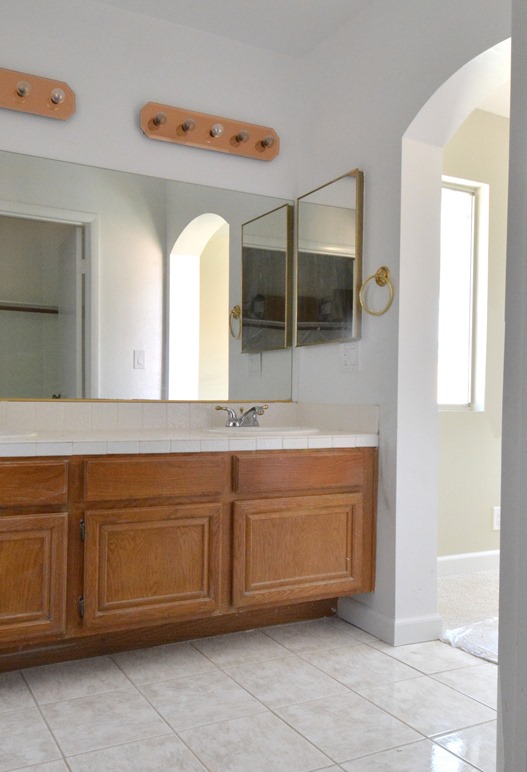
Someday we plan to sell this place so the goal is to not over improve it but at the same time we want to make it stand out with all of its modern upgrades when compared to similar properties. Here is the space right now, as you can see it’s that golden oak and ceramic tile combo that’s not awful but definitely dated. Everything will go except the vanity and flooring.
I had dreams of purchasing a new contemporary floating vanity for this space but I think it makes more sense to salvage this one because the base is solid wood and fits the space so I save a bundle by repurposing the vanity which also means I can spend more on a solid surface countertop and gorgeous tile on the wall which is really where I want to spend my cash.
A few months ago, I experimented with liming wax on a similar door from the kitchen to see if I could pull of a Restoration Hardware style gray/whitewashed look and at first it looked promising but when complete leaned too pink for my taste (dangerously close to 1980s pickled oak, yikes) but I believe that was due to the yellow undertones present in this kind of oak or perhaps first time error and not the liming process itself so I live to lime another day.
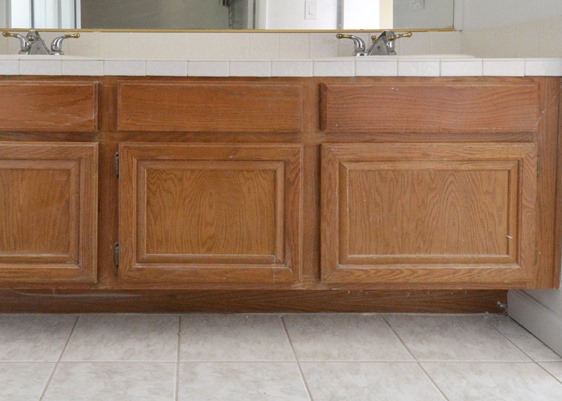
So now I’ve turned my thoughts to either a restaining process (dark of course) but I’m not crazy about the way oak takes stain, it’s very grainy so I’m thinking of having new cabinet doors made in a full overlay shaker style and staining the base and frame to match which could prove tricky but I think it could be done.
This door style is traditional which is fine so I could paint it and add new hardware but there is that lingering “oak is grainy” fact and even after two coats of primer and two coats of paint you can still see the grain which okay but in my head I have an intense desire to see a smoother finish so again I’m back to the idea of having new paint grade doors and drawer fronts made to accommodate hidden hinges.
I could live with it as is and patch the holes where the external hinges are and instead install hidden Euro hinges which doesn’t look too difficult. All of these things I’m considering. And perhaps overthinking.
And did you notice the floor tile? Of course you didn’t because it’s the definition of plain in the dictionary but here’s what happened with that. When we bought the house we found a few leftover boxes of this tile in the garage. This little vanity area used to have stained icky carpet and truth be told I think it’s a major crime to have carpet under a vanity so when we replaced all the carpet upstairs in August and installed the new tile downstairs, I had the installers add carpet back inside the closet and bedroom but not the vanity and we used the remaining 12 x 12” plain porcelain tile we found in the garage to fill in underneath because it matches the adjacent shower and toilet area (not shown) so now it all flows together and makes sense.
And let’s face it when you throw down a plush bathroom rug who’s really looking at the plain white floor tile, not me. As much as I adore a patterned tile floor I’m not about to rip this out for something fancier and expensive so it stays. Because again I plan to spend my cash on the countertop and wall tile and light fixtures, so let’s discuss.
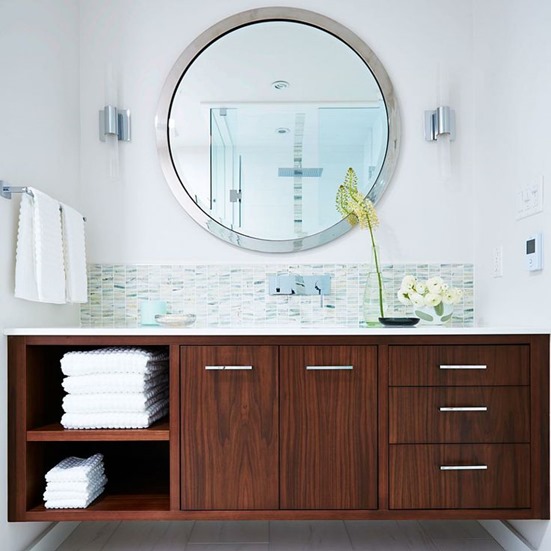
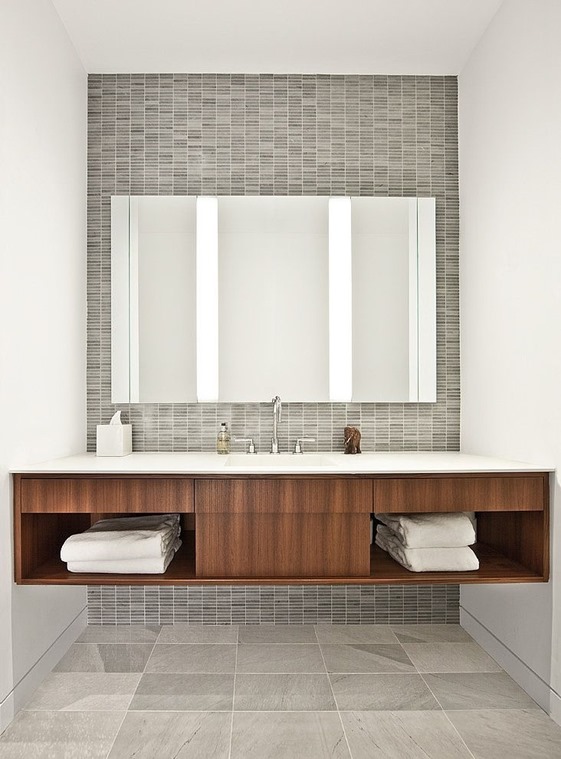
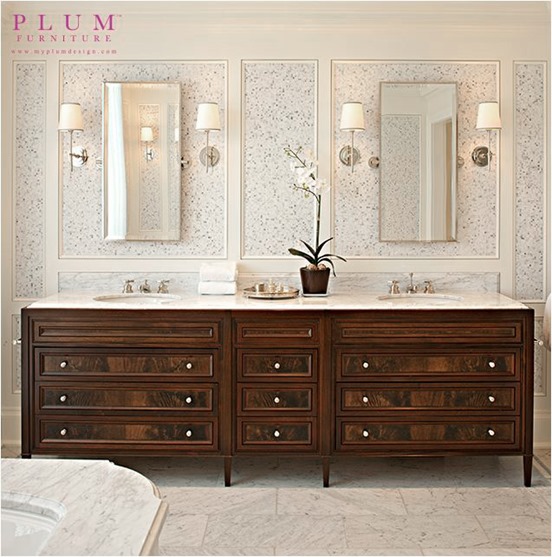
First, the inspiration. These sink vanities I just love because of their dark stain on the vanity cabinet and paired with a white or marble countertop. Divine!
sarah richardson
vinci hamp architects
mcgill design
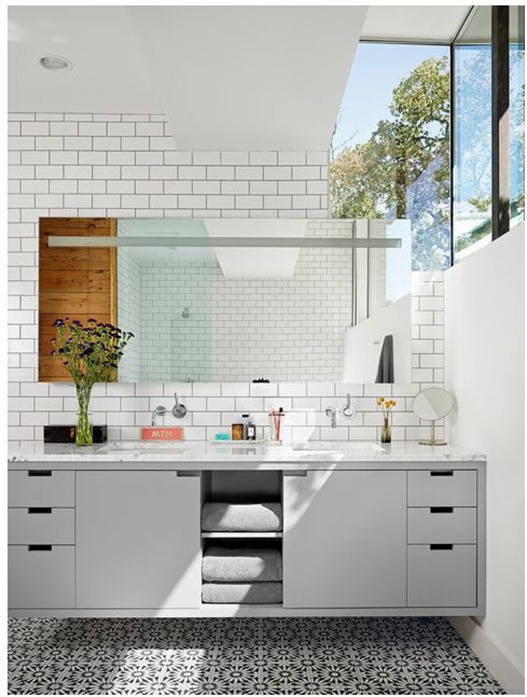
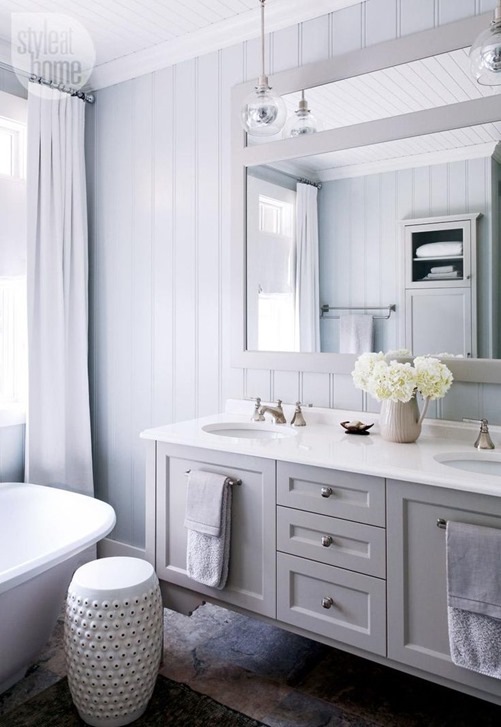
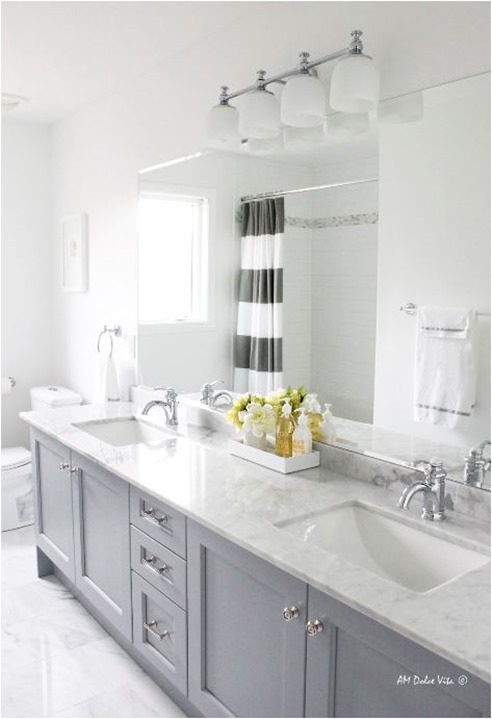
I also like the idea of painting the vanity a shade of gray since I have dreams of a marble mosaic backsplash and this is a design truth: gray painted vanities are delish.
austin architect
style at home
am dolce vita
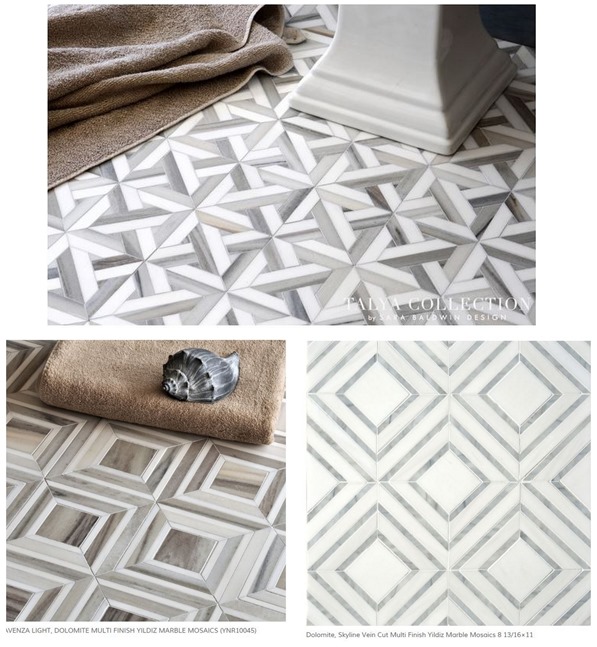
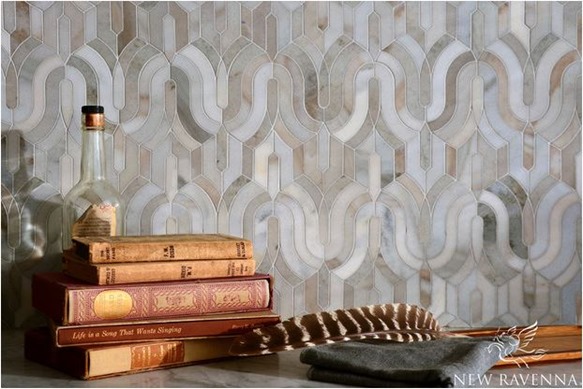
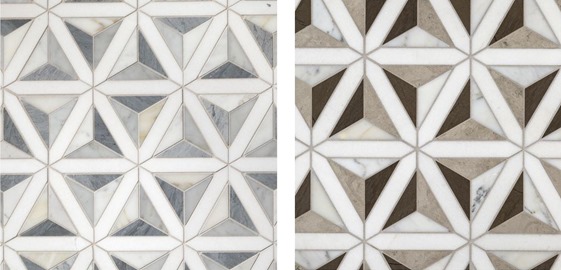
So let’s talk backsplash because I’m thinking a gorgeous geometric and taking it up to the ceiling like the #2 inspiration photo. The big dream is to install a marble geometric mosaic but they are the priciest and well wouldn’t you know I have super expensive taste in tile and fixate on ones that I cannot afford.
These beauties are from the Talya collection by Sara Baldwin and I get breathless just looking at them. This tile is so expensive per template it would make your jaw drop (\$150+) but hey a girl can drool dream.
I’m also drawn to this Duomo by Artistic Tile which is \$64 a square foot and never in my life have I spent half that on tile but I just can’t get it out of my head.
I’ll save on tile by avoiding installation on the wall space where mirrors will hang but I’m still trying to keep the tile cost below \$25 a square foot so unless the Tile Fairy pays me a visit with a very generous gift I don’t think the Duomo will happen. Finally, as much as I love bold pattern I do have to consider future resale someday and a tamer pattern of pretty glass might be more appropriate so there’s that to think about.
I’m meeting with a cabinet refacing specialist to see if refacing makes any sense for new cabinet doors and drawers. I’ve priced refacing before and it can be more expensive than replacement of new cabinets so I’m also getting a bid on just new doors and drawer fronts from a separate company too.
I’ll still have to find great lighting and fixtures and a countertop too. It will definitely be solid surface, something white or perhaps marble. You can get lucky with remnant leftovers in fabricator stockrooms so that’s where I’ll start because I really don’t want to pony up the cash for a full slab. But then there’s always engineered quartz like Ceaserstone or Siletone, much to consider! Wish me luck….…
Although I can hardly believe that we already are 7 days into October, our house has been in full Halloween spirit for several weeks now. You see, I’ve been gearing up for my part in this seasons’ Halloween Style Challenge for the Home Depot, and am pleased to announce that my feature went live today.
Click through to the Home Depot Apron blog for the full run down, packed full of purple, green and black goodies that (I hope) will have you excited for Halloween—an event that I personally look forward to each year since it serves as the kick off to the holiday season!
See the full feature on The Home Depot here and, in case you missed yesterday’s bonus Halloween tutorials, click through (or scroll down) for the run down on my DIY Halloween-Themed Apothecary Jars and DIY Spooky Skull Place Cards.
Back in the beginning of August, I had the pleasure of flying into Iowa to take a tour of the Meredith Corp. offices and meet with a few Better Homes and Gardens and Refresh magazine editors. I had so much fun wondering the halls of the impressive multi-level building, complete with in-progress photo studios and the most incredible “prop closet” I’ve ever laid eyes on (chairs and lamps and tables for days).
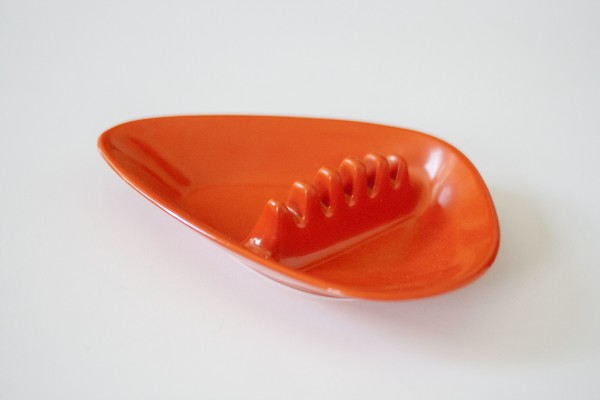
The actual city of Des Moines completely stole my heart, too. One of my hosts for the day took me around town to a couple of her favorite local shops, one being a pint-sized eclectic store called Domestica. The shop actually was closed when we stopped by that morning, but I made a point to go back the next day after my meetings, with John at my side. Although I had to resist the urge to buy everything in sight thanks to my teeny tiny carry on luggage, I did pick up a cool neon second hand ash tray for just a couple of bucks.
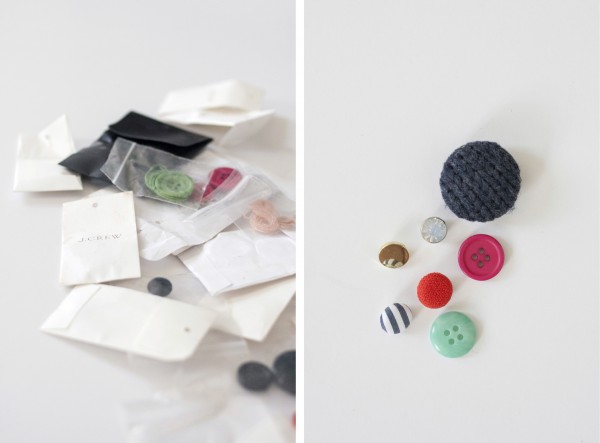
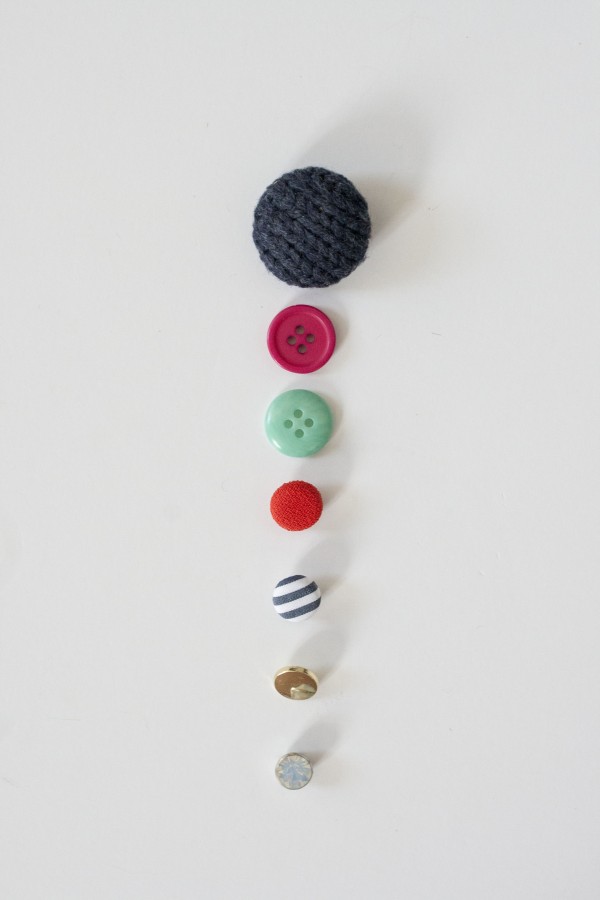
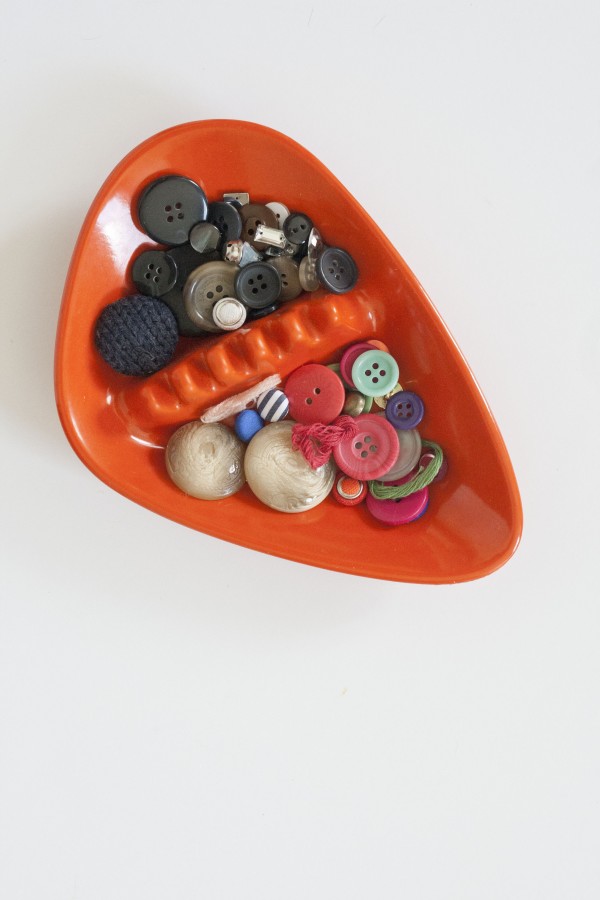
Now, anyone who knows me is well aware that I’ve never so much as considered lifting a cigarette, but I knew that retro shaped dish could be used for more than just nasty butts. Instead, I took it as the perfect opportunity to get my buttons in good organized order. I dumped my collection out on the floor of my studio, emptied the paper and plastic baggies of their colorful contents and then sorted the lone buttons into my thrifted ash tray—One side got the colorful ones, and the other got the black, white and brown buttons.
My hope now is that, should I ever have the need to grab a specific button for my favorite cardigan or wool coat, I will be able to find it with just a single fingertip dig rather than a full on excavation through mismatched baggies in my bathroom drawer. I’m curious though…Would you have gone a different direction if you had snagged this little orange cutie before me? Maybe use it to corral your jewelry? Paperclips? Or even ashes?? Do tell.
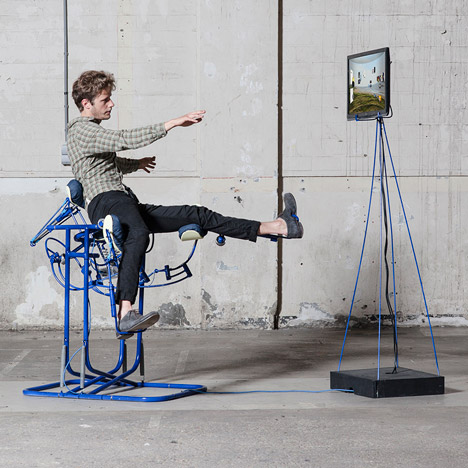
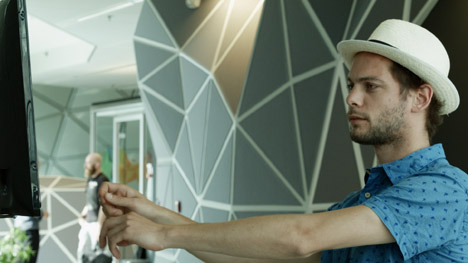
This chair by Design Academy Eindhoven graduate Govert Flint allows the user to control their computer cursor with a range of body movements (+ movie).
Govert Flint designed the Dynamic Chair to facilitate movement in all directions, then worked with programmer Sami Sabik to translate the motions made by the sitter into actions on-screen.
Photograph by Lisa Klappe
“The research started with trying to find functionalities related to bodily expression,” Flint told Dezeen.
Related story: Land Rover developing sight-activated controls for future vehicles
“I started to think about how we make chairs that are disconnected from their activity. Working in the office is an activity we sit for. From then on I tried to design a chair based on body movements.”
Separate elements form a back, a seat and a pair of leg supports, which move with the body independently from each other.
These are all made from polyester padding upholstered in wool felt and supported by a frame made from welded iron sections.
Three accelerometers positioned around the chair measure movement in X, Y and Z directions.
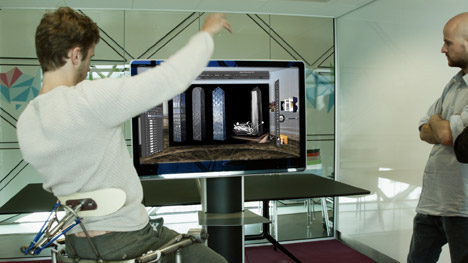
Collected data is then transferred along wires to a computer, which is programmed to use the information to move a cursor around a computer screen positioned at the sitter’s eye level.
One sensor located below the seat calculates the chair position relative to the X and Y planes. The user’s shifts forward, backward and side to side move the cursor in corresponding directions on the screen.
Sensors placed on both legs click the cursor when a swift kicking motion is detected.
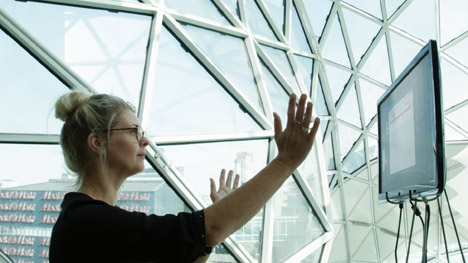
Although the technology currently only allows for the operation of a cursor, the designer hopes to extend the idea so it works with the full computer interface.
“For the future development we would like to collaborate with software developers and programmers to design an interface based on body movements,” said Govert. “Also, the keyboard will have to be replaced by body movements in a more precise manner.”
“For the consumer product the entire computer will have to function comfortably with body movements,” Govert added. “This will need further development.”
The chair will be displayed as part of Design Academy Eindhoven’s graduate exhibition, taking place from 18 to 26 October during Dutch Design Week.
World Architecture Festival 2014: after working as project architect for OMA’s giant CCTV tower, architect Ole Scheeren stepped out of Rem Koolhaas’ shadow and set up his own practice in China. He spoke to Dezeen about what he learned from his former mentor and the vastly different speed, scale and ambition of working in the east .
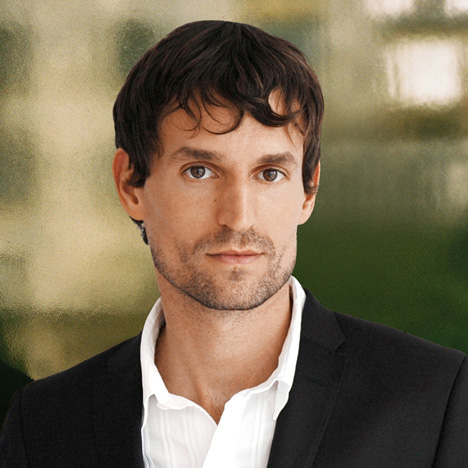
Ole Scheeren
“Asia clearly has a series of attributes that differ from Europe,” said Scheeren, shortly after delivering a keynote speech on the future of cities at the World Architecture Festival in Singapore last week.
“The two most obvious ones would be scale and speed, but I think there is also an even more fundamental one – a certain fearlessness and vision for the future. It is a dedication to what the future may be like without the fear of losing something.”
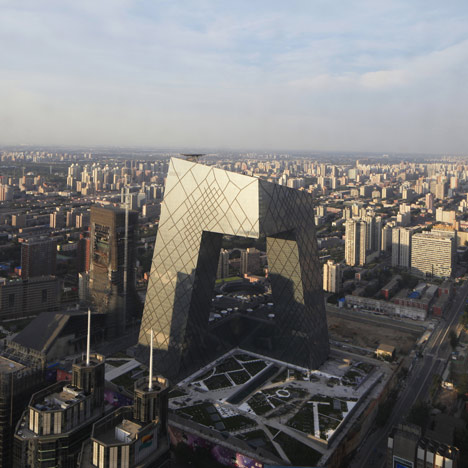
The German-born architect spent “15 incredible years” working with Rem Koolhaas, before leaving to launch Buro Ole Scheeren in 2010. As the partner in charge of OMA’s Asian output he was the driving force behind Beijing’s CCTV building and Singapore housing project The Interlace, but wanted to move away from the “antiquated model” of exporting projects to Asia from the West by basing himself in China.
CCTV Headquarters, Beijing
“I think having worked in this context has instilled in me a certain amount of courage to challenge things beyond the states quo that very much exists in most architecture,” Scheeren told Dezeen. “It has given me a kind of freedom to think broader and maybe also sometimes a freedom to be more bold in my propositions.”
“Obviously one of the features of China and Asia is that speed by far exceeds that of the West so you have to be incredibly agile and incredibly alert at every point in time,” he added.
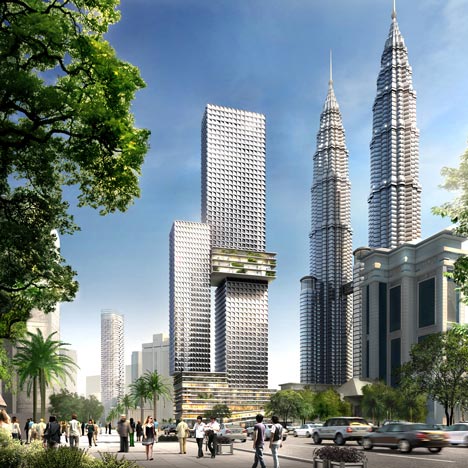
Scheeren’s current projects include a Kuala Lumpur skyscraper with a four-storey-high tropical garden slicing through its middle and a pair of Singapore towers that curve around public plazas – buildings he says will “challenge the singularity of architecture”.
Angkasa Raya, Kuala Lumpur
“I think architecture has become increasingly objectified, but not in the positive sense of the term” he explained, describing his distaste for buildings “designed as something that can be easily communicated in an image” and his ambition is to create “humane” spaces.
“It is very easy to photograph an object, but it’s very difficult for an image to capture space. I’m very interested in going beyond that. It doesn’t mean the buildings we do can’t function as objects, but they also function as other things. You don’t have to deny something entirely to accomplish something else. You can create new hybrids that simply accomplish more.”
Scheeren revealed he is also working on a “very very tall building” that could become the largest structure in the world – but insists that buildings can’t be just about height if they want to have meaning.
“Height cannot be the ultimate goal of a skyscraper because if that is its legitimisation then it will lose it very soon after,” he said.
“I think densification of this world is unavoidable. Density of cities is unavoidable. Therefore verticality will increase but the question is, what models we can develop to address that verticality?”
DUO skyscrapers, Singapore
Scroll down to read the interview in full:
Amy Frearson: What was your strategy for moving away from OMA and starting your own practice? Did you have a distinct idea about what kind of projects you wanted to work on?
Ole Scheeren: One thing I was interested in at that moment was the hypothesis of headquartering our office in Asia, so no longer being in Europe but ultimately still producing everything in the West and sending it over for execution in the East, which I think is an antiquated model of operating. I was very interested in placing us even more very explicitly into the context in which I had been working for almost a decade already. So that was one motivation. It was also a point in my career when I had spent 15 incredible years with Rem, which was really the best that could have ever happened. But I asked myself: what do the next 15 years look like? Having completed CCTV, it was a great moment for me to start my own office.
Amy Frearson: What do you think are the main lessons you took away from those years with Rem?
Ole Scheeren: It was obviously an incredible time, with the incredible opportunities he gave me and the office, starting with the projects for Prada that I was in charge of, at the end of the 90s and early 2000s, doing the stores in New York and LA. And then, the shift to Asia and the CCTV tower.
I think what was interesting about these two projects was that they almost represent the most extreme opposite ends of the scale-spectrum of the office. Prada was in a way was almost the smallest serious thing the office had ever done and CCTV by far the largest, so when I took on that project it was actually three times everything I had ever built in 25 years. So in a way it gave me a very acute sense of scale difference. In Prada we really controlled very screw, every little joint, every material to the absolute degree, and then going to a scale of a 600,000-square-metre project in China.
MahaNakhon, Bangkok
Amy Frearson: What were the benefits of moving your office to China, besides the proximity to the projects you were working on?
Ole Sheeren: One is that I have incredibly good relationships with all my clients, mainly because I’m there and have been there for a long time. We’re not opportunists that are in China and Asia because Europe is not doing so well. We have made a commitment to it that they really value and recognise the value of that. So I think that’s a very important basis for a much more intense and deeper dialogue.
The other is obviously that living in the place that you work for that period of time makes you acutely aware of all the things that are happening, of all the fluctuations, and it puts you into a position to react much faster. Obviously one of the features of China and Asia is that speed by far exceeds that of the West so you have to be incredibly agile and incredibly alert at every point in time.
Having said that I’m now also, after more than a decade of focus on Asia, looking back at Europe and starting an operation there that allows me to really look at what the benefits are, from having worked in both contexts for a long time. The first chapter of my life was building in Europe and the second in Asia. The value of our work is that we’re utterly familiar and embedded in both contexts simultaneously. And I think the possible transfer and synergies between that have a lot of potential.
Amy Frearson: Having been based in Asia for a while, how do you think your ideas on architecture have changed, especially now you’re looking to work in Europe again?
Ole Scheeren: Asia clearly has a series of attributes that differ from Europe. The two most obvious ones would be scale and speed, but I think there is also an even more fundamental one – a certain fearlessness and vision for the future. It is a dedication to what the future may be like without the fear of losing something. I think having worked in this context has instilled in me a certain amount of courage to challenge things beyond the states quo that very much exists in most architecture. It has given me a kind of freedom to think broader and maybe also sometimes a freedom to be more bold in my propositions.
Amy Frearson: Do you think that because in Europe we’re so concerned with preservation, that it prevents us being forward-thinking enough when designing for cities?
Ole Scheeren: Of course preservation is an incredibly essential thing and we are also involved in an number of ways in the Asian context in discussing how preservation could play a bigger role where maybe it is disregarded to often. But I think in Europe I see a potential to not disregard any of those values but nonetheless work beyond them at the same time. Clearly Europe is a context that requires far more subtle manoeuvring than the Asian context does. But again we’re very capable of that and also very interested in doing that.
Amy Frearson: It touches back on something you mentioned in your keynote speech about the idea of not thinking about a building as a single object and instead trying to think about how buildings frame spaces. Is that a theme throughout your work?
Ole Scheeren: For me there is a really a campaign to move beyond the object and I think architecture has become increasingly objectified, but not in the positive sense of the term. Really it is more and more designed as something that can be easily communicated in an image, because the image rules everything at this point, through the internet, through more traditional publications. The image is how architecture is usually communicated when architecture is not experienced in reality. It is very easy to photograph an object, but it’s very difficult for an image to capture space. So obviously all of that – along with the the icon obsession and other things – has manoeuvred architecture into a very object-driven singularity. I’m very interested in going beyond that. It doesn’t mean the buildings we do can’t function as objects, but they also function as other things. You don’t have to deny something entirely to accomplish something else. You can create new hybrids that simply accomplish more.
The Interlace, Singapore
Amy Frearson: I guess the difficulty is that architects often just deal with a small parcel of land and don’t necessarily have to think of the bigger picture. How do you think we can move beyond that?
Ole Scheeren: I think a number of the projects I have shown today demonstrate exactly the possibility to conceive a project within a much larger context. I think in that way our work is actually highly contextual and incredibly specific to each position that they actually inhabit. I think most of them, from the Interlace to Duo, to Ankasa Raya to Bangkok, MahaNakhon and also CCTV are all projects that challenge the singularity of architecture.
Amy Frearson: You mentioned the Interlace – as one of the first projects to come out of your office, do you think it sets the standard for the kind of buildings you want to make?
Ole Scheeren: What I think is significant and radical about the Interlace is that it is a blatant reversal of a typology that is probably more straitjacketed than most others. Housing – through the quantities that it has been produced in, and the formulaic nature that it has taken out of an almost lethal mix of building regulations, efficiency and profit concerns – has become simply compressed into a very standardised format. I think this project shows in a really dramatic way, and also in a significant scale, that really something else is possible. It’s really a mass housing issue, and in that way I think it’s a very important prototype that I’ve created.
Amy Frearson: How would you compare your ideas for mass housing to the architecture of the 1960s, to those large-scale housing projects that had the same ideals but never quite worked out the way they were intended to?
Ole Scheeren: I guess in the 1960s there were a number of really good ambitions and really powerful ideas but maybe what was missing was yet a sensitive enough understanding of the humane, of structures for inhabitation. They were incredible structures, and really interested in using this structural dimension, but to really embue it with a very acute sense of place, of space, of inhabitation of people who actually live and work and exist in those places. I think that also is very explicit in the Interlace, although it’s a very abstract system per se, it actually creates completely non-abstract realities within it, and I think that for me is the success of it.
Amy Frearson: And is it true that when you were designing you had all of your staff make stick figurines of all the people that will inhabit the building?
Ole Scheeren: Yes, it was a really intuitive reaction, because I looked at my team working and they actually filled an entire office floor, and I looked at the plans we were drawing and I realised the size of our entire office floor equalled the size of the building core of CCTV. So I basically shouted at everybody to stand up, form a square around the outline of the space, and I said: “Now look at this space – this is just the elevator bank of what we are designing.” And I think it is these moments of reality checks where you confront yourself and your own team with these realities. I think it’s incredibly important to inbed these moments of surprise and realisation, realisation especially, in the process of design.
Amy Frearson: I imagine a lot of architects working on huge projects and skyscrapers probably don’t have that understanding of scale.
Ole Scheeren: Exactly and this is why so many buildings become abstract, and why everything is scaleless. The problem with all big projects is they are scaleless, and I’m extremely interested in how we can find scale in scalelessness.
The Interlace, Singapore
Amy Frearson: Do you think the ongoing race to design taller and taller buildings will continue or do you think architects will start to think smarter about buildings?
Ole Scheeren: I think the discussion has clearly started on a relatively broad level already to make buildings, one one hand, more sustainable and, on the other hand, hopefully more liveable. I think a lot of this discussion still circles around alibi, rather than true qualities – I think that shift is a much more radical one that is also not that easy to accomplish – but I think to propagate a floor with a little elevator interchange is the new urbanity of the skyscraper, for example. It’s not quite there, so I think there’s a long way to go. Obviously we’re trying with our work to find projects that can constitute possible examples for how we an explore that. I think densification of this world is unavoidable. Density of cities is unavoidable. Therefore verticality will increase but the question is, what models we can develop to address that verticality?
Amy Frearson: In your keynote speech you said “buildings can no longer be about height if they want to have meaning” – can you tell me what you mean by that?
Ole Scheeren : I think CCTV was one of the first emblematic statements where we proclaimed that height cannot be the ultimate goal of a skyscraper because if that is its legitimisation then it will lose it very soon after, because someone else will build taller. Also the inherent problem with verticality is it’s a very hierarchical value system. If you build a tower, who wants to live on the third floor of a 50-storey building? These issues are undeniable.
We continue to work on tall buildings and I’m actually now involved in a study I can’t say too much about yet but it’s a very very tall building – it could be the largest, although not necessarily the tallest structure built in the world to date. We cannot reject any scale per se, but we really have to challenge the systems that generate them and maybe reinvent some of the systems in order to function at those new dimensions.
The Interlace was an anti-tall building, although really it was a skyscraper and a tower nonetheless. If we look across our own website we see a great wealth of ideas, some of them more reasonable, some of them more courageous. The question is: “how do these ideas become relevant in reality and how do they translate into reality?” It is very easy to just stick with what everyone else is doing, it’s also not that difficult to have a few crazy ideas beyond it. Really the challenge is to develop ideas that can function in reality and push the boundaries of that reality.
I think CCTV would be a completely irrelevant project if it was simply on paper and if we had not built it. There were many good ideas but I think what makes it really relevant – and the same applies to the Interlace – is that these two very significant-scale projects totally shifted the boundaries of the possible. But they are real, because they understood the systems that govern the architecture construction, cities, and other things, and became possible in those systems and beyond those systems. I think that is really the challenge – to understand what can work in reality. I’m very interested in reality, and how ideas can affect reality.















 Photograph by Lisa Klappe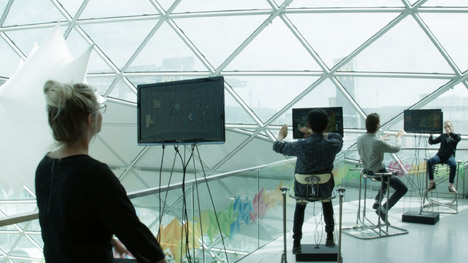

 Ole Scheeren
 CCTV Headquarters, Beijing
 Angkasa Raya, Kuala Lumpur
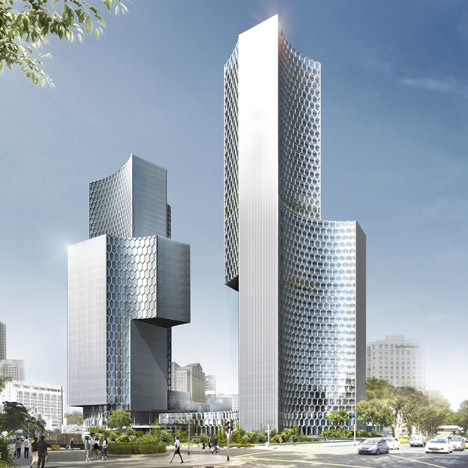 DUO skyscrapers, Singapore
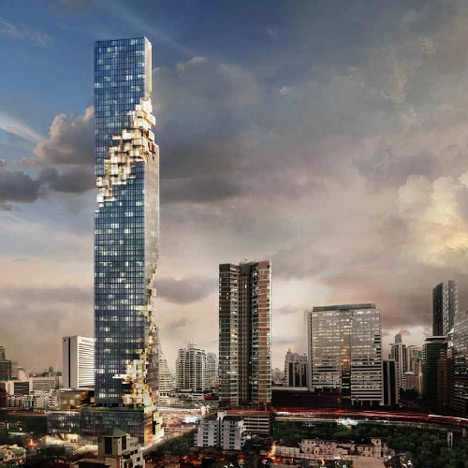 MahaNakhon, Bangkok
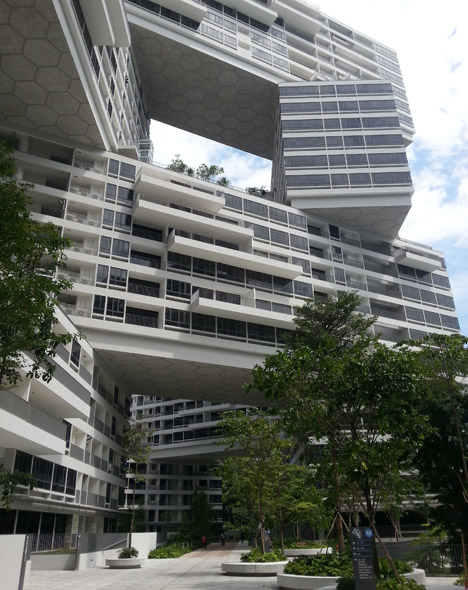 The Interlace, Singapore
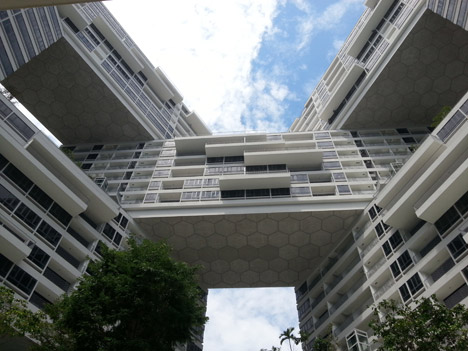 The Interlace, Singapore