Dominic Wilcox: “I’m deadly serious about being playful”
Dezeen and MINI Frontiers: playfulness is essential to creativity claims London designer Dominic Wilcox, who says that creatives should not “worry about what other people think” (+ movie).
“I believe that playfulness in design – particularly at the beginning, at the ideas stage – is really important,” says Wilcox, whose latest surreal invention is a car made from stained glass commissioned by Dezeen and MINI.
“I’m deadly serious about being playful. It’s really important.”
Dominic Wilcox
Playfulness is the “essential base of creativity,” he claims.
“When your mind is loose and thinking potentially crazy thoughts, other ideas click off that and other people get inspiration from that,” he says. “I think it’s very important to start off being playful, to not worry about what other people think.”
Wilcox is well-known for his surreal sketches and absurd inventions, many of which are collected in his book Variations on Normal.
Related story:Variations on Normal by Dominic Wilcox
He realised some of them for a window display at Selfridges earlier this year, including a tea cup with a cooling fan (above).
Wilcox claims he doesn’t mind if people don’t take his work seriously: “I don’t care,” he says.
Stained-glass Driverless Sleeper Car by Dominic Wilcox
For the Dezeen and MINI Frontiers exhibition Wilcox built a full-scale concept car made from stained glass, designed for a future where driverless technologies have made the safety features on today’s cars redundant.
Related story: Dominic Wilcox’s “car of the future” is driverless and made of stained glass
The exhibition took place at designjunction during London Design Festival from 17 to 21 September 2014.
Dezeen and MINI Frontiers is a year-long collaboration with MINI exploring how design and technology are coming together to shape the future.
News: work has begun on a Greek Orthodox Church designed by Spanish architect Santiago Calatrava to replace a building that was destroyed by the collapse of New York’s World Trade Center buildings on 9/11.
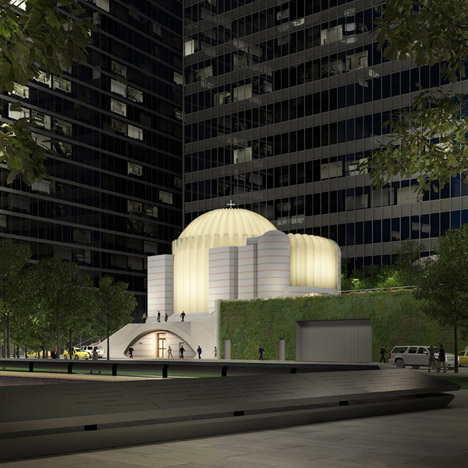
Santiago Calatrava has designed the Saint Nicholas National Shrine building for the Greek Orthodox Church, which will occupy a site at 130 Liberty Street on the edge of the National September 11 Memorial park.
Related story:Santiago Calatrava completes Florida Polytechnic University
Influenced by two existing places of worship in Istanbul – the Hagia Sofia and the Church of the Holy Saviour in Chora – Calatrava’s scheme was selected from over a dozen proposals to replace a 19th century building that was destroyed by falling debris and building parts from World Trade Center Tower Two during the 9/11 attacks in 2001.
The site of the church has been moved to accommodate the new World Trade Center masterplan, and the new building will sit opposite the pavilion of the 9/11 museum by Norwegian architecture firm Snøhetta.
“A former small tavern, the Church was always an interesting counterpoint to the skyscrapers that grew up around it,” said Calatrava in an open letter to the Greek Orthodox community after winning the commission.
“Like its forebear, the new Church is to be a tiny jewel in Lower Manhattan,” he said.
Built largely from white Vermont marble, the central dome-shaped structure and a portion of the rest of the building will be clad in a translucent skin that will make the building “illuminate from the inside” at night.
“The new Church is principally based around a central Cupola,” explained Calatrava. “This is purposefully different for the rectilinear lines of the former Church. Indeed, it harkens back to both the Greek classical architecture of the Acropolis and the Byzantine architecture of the Hagia Sophia.”
A public “Ground Blessing” ceremony earlier this month marked the beginning of construction on the project.
During the ceremony, Calatrava compared the reconstruction of the church to “the rebuilding of the Parthenon in Athens by the ancient Greeks,” according to a statement released by his studio.
The Greek Orthodox Church is currently seeking donations towards the \$20 million cost of the project.
News: Italian design brand Moroso has produced a limited-edition set of the table designed by architect Daniel Libeskind for an installation by artist Marina Abramovic .
Moroso has released 30 cement editions of the combined seat and table that Daniel Libeskind designed for Marina Abramovic’s live art piece, Counting the Rice, earlier this year.
Related story: Spirit House Chair by Daniel Libeskind
The installation involved participants sitting at the table for a minimum of six hours, while separating out and counting lentils and grains of rice.
Libeskind’s design is a series of connected angular planes that form the back, seat, base, supports and tabletop. The work surface is angled down towards the user and features a small lip to prevent the grains from rolling off.
“The slab of cement folds over itself, enfolding and pushing the body to carry out the performance, while the vigorous gestural expressiveness of the form is embossed across its surface with complex geometries that give a sense of visual fragmentation,” said a statement from Moroso.
First produced by the brand in wood, the prototype table was presented during Milan design week in April when students took it in turns to participate in the rice-counting exercise.
More were created when the project was developed to include multiple participants at the Centre d’Art Contemporain in Geneva from 1 to 11 May.
The new limited-edition pieces are formed from cement rather than wood to differentiate them. The first in this set was recently presented and auctioned in Basel on 20 September.
A cement version will also be presented alongside one of the wooden prototypes at Art Basel Miami Beach next month.
The collaboration between Moroso and Abramovic began when the brand’s creative director Patrizia Moroso met the artist in 2010.
“Marina has always been a great admirer of Moroso products, and personally chose many of our pieces for her private home in New York,” said Moroso. “The idea of working together on a shared project was a desire we had both developed over these past years.”
Opinion: from Chicago’s rat problem to transport startups like Bridj and Uber, data is being used to predict behaviour and manage our cities. But the idea of the “Predictive City” should be treated with a healthy dose of scepticism, argues Dan Hill.
John Lanchester tells a story in How to Speak Money – a book I recommend to any designer or architect wishing to understand the context their work is produced in — about the way Ancient Egypt worked. In short, everything hinged on the annual inundation of the Nile flood plain: the society itself, arguably the most stable the world has ever seen, its cultural artefacts, such as their calendar, their understanding of seasons, their taxation system, and of course their agricultural cycles — all were directly linked to the Nile’s flood. The priesthood of Egyptian society, drawing from rich mythologies, performed complex rituals to divine the nature of the flood, and thus the harvest, each year.
But Lanchester reveals how the priests actually did it: they were cheating. Unbeknownst to the population, they had a Nilometer, a device to predict the level of flood water. Based on measuring stations secreted in temples, the Nilometer captured the flow of the river, plotted it against various markers and – combined with flood records dating back centuries – enabled relatively accurate predictions of that year’s harvest. Lanchester suggests “the Nilometer was an essential tool for control of Egypt. It had to be kept secret by the ruling class and institutions, because it was a central component of their authority.”
Not that Herodotus would’ve put it like this, but this is perhaps the first example of predictive analytics in urban governance.
When people talk about predictive analytics and cities, they often turn to Chicago’s rats
Predictive analytics is the ability to deliver services for future events, before the need has manifested itself, based on the accretion of “big data” about past events. Although urban planning and policy has always been a form of prediction — sometimes combined with agency to make it true — this is an order of magnitude shift in data gathering and number crunching; and so, in turn, in the purported accuracy of what can be predicted.
The same principles are in play across an increasingly wide range of services. Based on the data they have, Amazon can apparently guess what you’re about to buy before you know you want to buy it, and will move it nearby accordingly (they filed a patent for “anticipatory shipping” earlier this year).
Yet when people talk about predictive analytics and cities, they often turn to Chicago’s rats. Combining many previously disparate data sets, such as calls to the city’s 311 services related to garbage or broken water mains, over geospatial databases — AKA maps — has enabled the city to predict where infestations are likely to occur before they do. Just as Mr. Rat has paid the deposit on a new place and picked up his keys, he turns the corner to find a Chicago Department of Streets and Sanitation officer leaning against the door, whistling.
Few realise that these systems are increasingly in use everywhere
This idea, and its impacts, could fundamentally change the way we think about running cities generally. Using similar techniques, and digging ever deeper into urban data, Chicago could soon predict which buildings are most likely to catch fire next, where vacant properties will occur, or where planning violations might be likely. More controversially, Chicago’s datasets include a “heat list” of those 400 or so individuals in the city that are most likely to be involved in a violent crime — it enables police to pre-emptively, well, “address” those on the list, which some see as an exaggerated extension of Stop-and-Frisk.
The “heat list” has come under much scrutiny in Chicago (and LA and New York, where similar software has been deployed) but few realise that these systems are increasingly in use everywhere, from Seattle to Kent. Here the difference between pest control and policing should be clear, but you can imagine the attraction to a certain kind of politician — “Sir, you can eradicate crime, nipping it in the bud before it happens” — irrespective of the enormous ethical, and indeed constitutional, issues. Once the list exists, it’s difficult to put that particular genie back in the bottle. What if you don’t act upon the list and someone dies? Equally, what if you do act upon the list? And how exactly do you do that?
Perhaps less immediately contentious is the use of predictive algorithms in public transport. If transport agencies can scrape data from the surfaces of their city’s interactions, they can build models of behaviour that enable them to predict where the demand for transport is needed, before anyone asks for it. In other words, instead of walking to the bus stop, the bus stop comes to you.
Many of the more useful reference points occur in more informal urban environments
These dynamics underpin Bridj, a transport startup in Boston. Bridj uses patterns of transport use, combined with social media analytics, in order to send its fleet of buses to where there is demand for a fleet of buses — on the fly. It is largely post-timetable, post-route. It could sit neatly between mass transit and private car ownership, working as a form of “relief valve” for the Boston MBTA.
Where have we seen on-demand transit before, outside the limited horizons of US tech culture? Interestingly enough, many of the more useful reference points for these developments occur in more informal urban environments.
Designer Keiichi Matsuda tells me about the gloriously-festooned buses that careen around Medellin, essentially occupying a legal grey area as well as often unpredictable street routes, and sometimes, the pavement. In Nairobi, the equally gaudy matutu buses are fighting off Google NFC-enabled smart cards, preferring to transact in cash — whilst matutu may observe a form of bus stop, they move through traffic at full pelt as if autonomous vehicles (though with a rather different safety record). Even highly-regulated cities like New York have what The Verge called “a shadow transportation network” of “dollar vans” and buses, serving areas like Chinatown, or particular communities. Often unlicensed, sometimes the police apparently turn a blind eye, and even welcome their presence; other times, not so much.
Startup culture plays by its own rules
These services fill in the cracks and gaps of the formal transit networks in a broadly similar way to Bridj, yet based on driver knowledge, instinct and small data, if we can call it that, about local culture. The fact they don’t scale doesn’t really matter, and in some senses they are more legible, local and, well, likeable than an Uber, say.
Yet both the matutu and the metro could be derailed by startups like Bridj, Lyft, Uber, Relayrides et al. None of these startups have a primary aim of putting public transit agencies out of business, yet the adjacent space they play in could be close enough to destabilise those incumbent agencies — just as Airbnb is not officially in the hotel business, yet clearly impacts upon it. Startup culture plays by its own rules, and is a little careless and untidy about how it does so.
More broadly, predictive analytics applied to crime could cause the rate of violence in a city to plummet — yet might the way it does this also shred social fabric? These implications are adjacent, slippery, opaque, and laden with assumptions about the positive effects of data-driven services on the city.
Uber says that regulation s, generally, are outdated, as they were written before we carried smartphones around. This is true. The question is what one does about it, and further, what ideologies underpin such decision-making.
The sheer unpredictability of cities is not only part of their charm, but a vital lesson
An excited Harvard Business Review notes that “It’s still pretty amazing that we can use analytics to predict the future. All we have to do is gather the right data, do the right type of statistical model, and be careful of our assumptions.”
Be careful of our assumptions, indeed. Whilst the notion of “path dependency” obsesses urbanists, a city is more than just the sum of its previous behaviours; just as a former violent criminal might not ever be violent again.
Fundamentally, with this Predictive City in mind, the sheer unpredictability of cities is not only part of their charm, but a vital lesson about the possibility of change. As Oscar Wilde said, “every saint has a past, and every sinner has a future.” Predictive analytics, if applied with a carelessness Lady Bracknell would recognise, has no time for such subtleties.
Such approaches needn’t necessarily be detrimental — they could be highly informative, in the context of more holistic, collaborative, imaginative approaches to designing and running cities. But only if, unlike the priests of Ancient Egypt and their secret Nilometers, we are openly discussing the potential pitfalls — the possibility that ironing out unpredictability also irons out difference, and the possibility of change itself — and sketching out richer versions of our urban future.
Dan Hill is executive director of futures at Future Cities Catapult. He is an adjunct professor in the Design, Architecture and Building faculty at University of Technology, Sydney, and his blog City of Sound covers the intersection between cities, design, culture and technology.
Instead of opting for a conventional house-tour video, the architects at Studio MK27 chose an intriguing story as a proper way to “describe” Casa Redux in Brazil. Produced by Pedro Kok and Gabriel Kogan, the video below is entitled “That was not my dream” and strangely enough, it narrates the “disadvantages” of living in an ultramodern home: ”Who would want that kind of house – cold, dull, lifeless? I was in search for what I had always imagined, a beautiful neoclassical project, the symbol of permanence, something with history. A home how we always dreamt… with pediments, ornamental columns… it will be impressive, beautiful, classical, a home as it should be.” Have a look at the movie and feel the irony in every sentence.
Casa Redux is a massive single-floor holiday residence in the exclusive Quinta da Baroneza neighborhood, north of São Paulo. As you can probably imagine, the story behind this movie is entirely fictional, yet we considered it an interesting approach to presenting a modern residence. “The idea was to intersect architecture with a narrative, making the space itself the central character. The human relationships here take place according to the architecture – they are transformed by it and they transform it,” architect Gabriel Kogan explained. We would love to know your thoughts on this artistic short film and the house it unconventionally depicts!
Recommended For You
Perfect Ski Retreat in Big Sky, Montana: The Rustic Redux Project


 Dominic Wilcox
 Stained-glass Driverless Sleeper Car by Dominic Wilcox













![Casa Redux A Story of Love and Modern Architecture: Unconventional Casa Redux Tour [Video]](https://decor10blog.com/wp-content/uploads/casa-redux.jpg "Casa Redux")
![modern house design A Story of Love and Modern Architecture: Unconventional Casa Redux Tour [Video]](https://decor10blog.com/wp-content/uploads/modern-house-design.jpg "modern house design")





 By Lavinia in Architecture