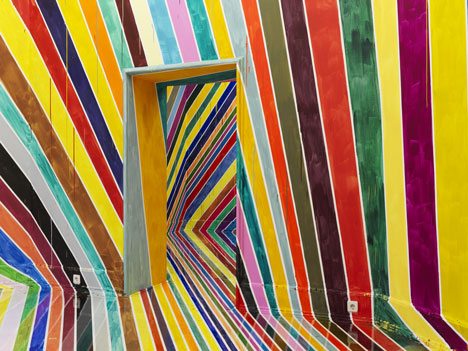
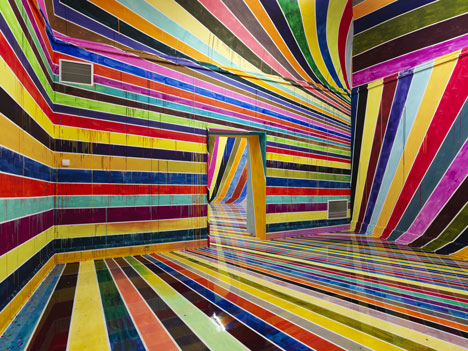
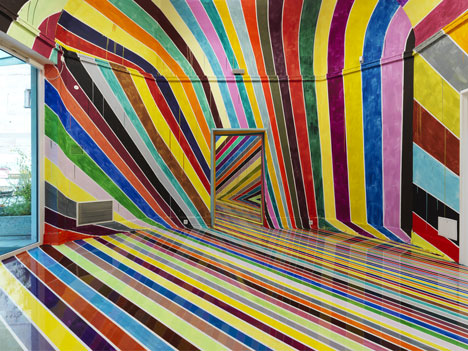
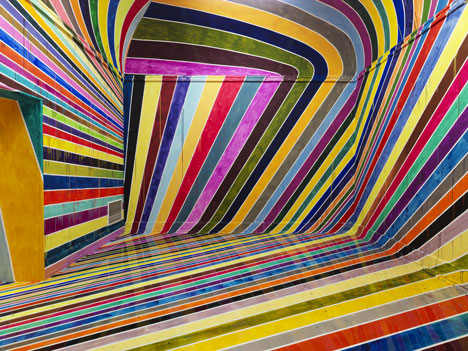
Brightly coloured stripes based on refracted light run across the walls, ceilings and floors of an art gallery in Nuremberg, Germany, in this immersive installation by Markus Linnenbrink .
Markus Linnenbrink painted the Off the Wall! installation over a period of two weeks in an exhibition space at the Kunsthalle Nürnberg. The work spans two connecting rooms – one with an octagonal floor plan, the other with a rectangular plan.
The Brooklyn-based artist is best known for creating site-specific installations that explore the impact of colour from a scientific, as well as a psychological perspective.
Related story:Daniel Buren installs mirrors and coloured glass on Le Corbusier’s Cité Radieuse rooftop
He cites his influences as Isaac Newton’s light refraction experiments, which saw white light split out into the individual colours that make up the spectrum, and Johann Wolfgang von Goethe’s colour theory, which considers human perception of colour.
“I like to start with a totally blank canvas,” Linnenbrink told Dezeen. “This way what I do in a specific architectural setting becomes very unique for that space.”
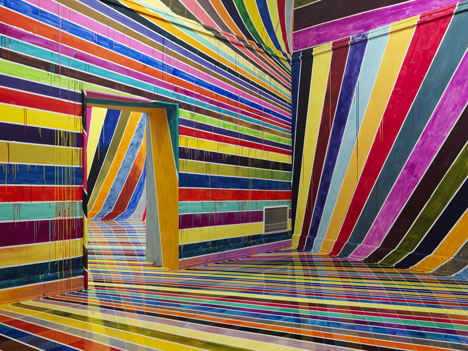
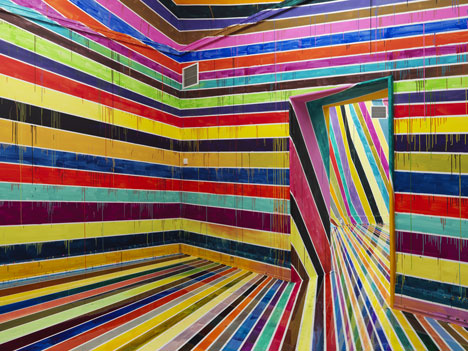
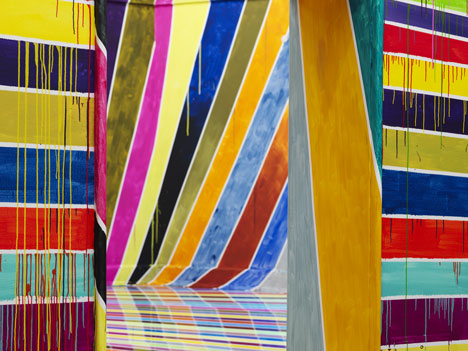
Every surface in the two adjoining rooms is striped with brightly-hued paint. The stripes spread across the door frames, picture rails and skirting-boards leaving only the plug sockets and vents unpainted.
“I wanted to create a painting throughout two rooms that would make them feel more united,” said the artist.
The lines stretch from one room onto the walls of the next, visually merging the two spaces. “I started with a diagonal line from the entry door through the connecting door,” said Linnenbrink.
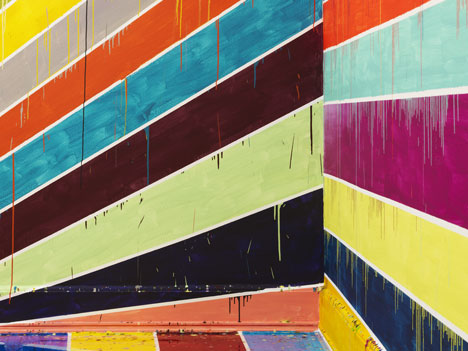
The stripes slope down around the walls and ceilings in opposing directions, separated by the white outlines left behind by masking-tape stencils. Spatters and drips are streaked across the lines, running one colour into the next.
“I let the stripes behave logical in some places, and I made them create more of a dissonant perspective in others,” added the artist.
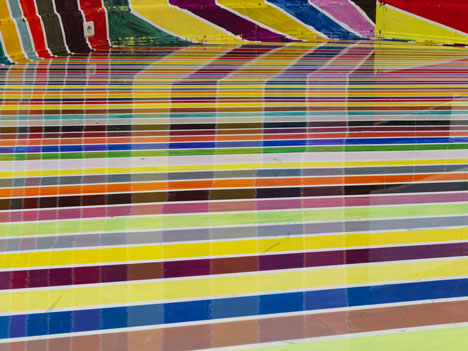
The width and direction of the lines fluctuate. Where the stripes meet the floor they change direction, creating an irregular chevron pattern.
Linnenbrink applied a glossy coating of epoxy resin over the matte acrylic paintwork to protect the piece and create a reflective surface.
The resin reflects the stripes from the wall in a cross-hatched pattern across the floor. “The shiny resin resulted in a mirroring effect to add to the visual overload,” added the artist.
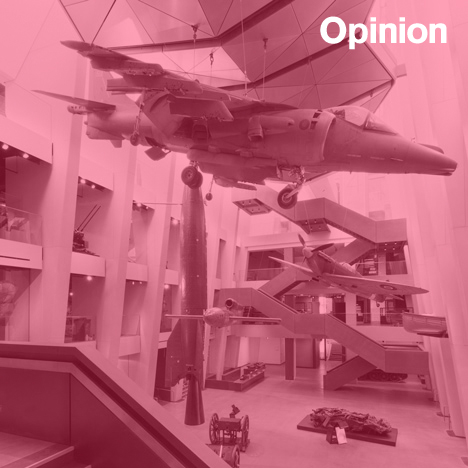
Opinion: the refurbishment of London’s Imperial War Museum by Norman Foster is a “botched” job, but it’s hardly surprising given the UK’s strange attitude to its own history, says Owen Hatherley.
The 100th anniversary of the beginning of the First World War this autumn was always bound to lead to some bad architecture. However, Daniel Libeskind has not used slopes and titanium to act as a synechdoche for trenchfoot or shelling on some Centenary War Experience in the Flanders Fields this time. The very 1990s memorialising architecture that he and other deconstructivists specialised in is not terribly fashionable in 2014. The favoured model of memorial space now is much closer to something like Carmody Groake’s 7/7 Memorial in London, with its sober steel stelae, than the ambitious clashing forms of Libeskind’s war museum in Dresden or Jewish Museum in Berlin, cheapened by their overuse for more prosaic functions like students’ unions and luxury flats.
But while Libeskind’s Imperial War Museum North in Manchester now seems the product of a bygone New Labour era, the new refurbishment of the original Imperial War Museum in London by Norman Foster is so spectacularly ill-judged that you almost long for Libeskind’s earnestness – at least he gave the impression of actually caring about the subject matter. But exploring the refurbed museum is, at least, an instructive journey around a country’s massively confused sense of its own history.
The very notion of an Imperial War Museum may give a bit of a shudder in certain quarters; it’s strange it was kept as a name, when, for instance, the Imperial War Graves Commission – an influential sponsor of original classical architects like Charles Holden and Edwin Lutyens – renamed itself the Commonwealth War Graves Commission over half a century ago.
There’s still more than a whiff of Bedlam about it
The building itself has a deeply uncomfortable history, intriguingly so – beneath its sober portico and dome was previously Bethlehem Hospital, whose nickname, Bedlam, became a synonym for poorly run mental hospitals and for general chaos way beyond the corner of south London where it still sits, in attractive grounds furnished with rockets, memorial gardens and fragments of the Berlin Wall. Inside, there’s still more than a whiff of Bedlam about it.
In the obligatory atrium, planes are suspended and missiles point up at a jagged suspended ceiling, barely concealing an 1980s glass dome. A baffling system of circulation leads you constantly, pointlessly up and down, with levels that look like they connect leading nowhere, and inclined walls supporting it all. The glassy, airy business park atrium has long been Foster’s model for almost everything – from a City Academy to the British Museum to the Reichstag – but here the elegance and clarity Foster brings, at best, to this now rather tired type has disappeared in a mess of clumsy angles.
I’m quite sure Foster will have justified this as a reaction to perhaps the most important thing about the Imperial War Museum – its collection of paintings and sculptures, whose cross-section of British artists responding to the shock and horror of their wartime experiences made, and still makes it one of the best (and least used) modern art galleries in Britain. The most famous of these are Vorticist works by Wyndham Lewis, William Roberts and David Bomberg. Maybe those jagged roofs are a “reference” to Lewis’ A Battery Shelled, a panoramic landscape of abstracted destruction now translated into faceted metal suspended ceilings. If so, the metaphor is rather hard to take as the building’s much more makeshift – if much less counter-intuitive – previous refurbishment keeps poking out in the corners.
Lots of pointless bits of circulation have been crammed into it to make it feel both triumphalist and claustrophobic
The main atrium was always a faintly triumphalist collection of random big weapons under a big and cheap dome, and it is still that, except lots of pointless bits of circulation have been crammed into it to make it feel both triumphalist and claustrophobic. Curiously, one of the sillier exhibits, where you go through the “real” sights and smells of a trench has been discontinued, as if aware that it was rather distasteful.
In the building as a whole, the Libeskind defence of angular architecture as a means of representing the real disorientation of conflict doesn’t stand up: it just looks as if the architects haven’t particularly thought the space out properly.
Arbitrary patterns lead their way up the atrium to something called the Lord Ashcroft Gallery. That confusion is constantly reflected in the exhibits. The art collection aside, the museum has been aimed at children for some time, but the infantilisation now feels especially extreme. Little “post-it notes” appear next to every exhibit on the floor that outlines Britain’s post-1945 military history, sketching out in the minimum of words with the minimum of length the minimum of information, as jollily as possible. Even then, a cursory wander round can uncover outright inaccuracies (eg, the Korean War as a battle between the “democratic” south and the dictatorial north, when the south didn’t hold fair elections until several decades after the conflict). Or, more unsurprisingly, refusals to confront anything too uncomfortable – the Troubles in Northern Ireland are presented as if the British Army was a baffled onlooker rather than an active participant, but all ending happily when Ian Paisley and Martin McGuinness open an Ikea together. Given that there’s actually an exhibit specifically for children – a show about spying, based around one of the Horrible Histories books – it’s unclear whether this isn’t actually a matter of talking down to adults.
It’s no wonder they botched it
All is explained, as always, in the gift shop. After you’ve gone pointlessly up and down a few flights of steps, there are two distinct shops. One is “serious” and sells history books and a new catalogue with an introduction by the Duke of Cambridge; the other is a great big emporium devoted to the austerity nostalgia that Britain has been stuffing its face with since 2008, a place to binge yourself on Keep Calm and Carry On.
The exhibits come across like a three-dimensional version of one of those books that tell you with big pictures and minimal text what it was like fighting the bosches and eating spam – narcissistic wallowing in fake poverty and barely coherent history as a way of avoiding any thought of how to drag ourselves out of our current, needless and far less egalitarian version of austerity. The “rationing experience”, organic wartime cuisine to be cooked in the Aga of a ruthlessly scrubbed ex-council flat. There’s probably an app for it. The perpetuation of this nonsense is the real function that Foster had to design for, so it’s no wonder they botched it.
Owen Hatherley is a critic and author, focussing on architecture, politics and culture. His books include Militant Modernism (2009), A Guide to the New Ruins of Great Britain (2010), and A New Kind of Bleak: Journeys Through urban Britain (2012).
Dezeen promotion: annual hotel design event Sleep is set to return to London’s Business Design Centre next month.
Taking place from 26 to 27 November, the two-day conference and exhibition brings together leading figures from across the hotel design, development and architecture industries for networking events, discussions and product showcases.
This image: Interior of Four Seasons Toronto, Canada, by Yabu Pushelberg – top image: Bellevue by Very Wood
As part of the Sleep Conference programme, attendees will have the chance to watch a selection of talks and on-stage interviews with leading figures in hotel design and hospitality.
Guest speakers include Patrick Jouin and Sanjit Manku of Paris-based design studio Jouin Manku, and George Yabu and Glenn Pushelberg of Yabu Pushelberg, who will discuss their work on the London Edition Hotel, Four Seasons Toronto and Public Chicago hotels.
Interior of London Edition Hotel, UK, by Yabu Pushelberg
New to this year’s edition of Sleep is Above & Beyond, a space dedicated to landscape design curated by Phil Jaffa of Scape Design Associates. Visitors to Above & Beyond will encounter a variety of concepts for rooftop bars, terraces and gardens.
Also appearing at Sleep 2014 for the first time is mycoocoon’s colour immersion pod, which has been designed to relax users by bathing their bodies in an array of coloured lights.
Digitalhotel, a collaboration between Polcom, Peter Dann, BIM Technologies, and studio ånyo will also make its debut at Sleep. The project uses building information modelling (BIM) technology to rethink how hotels are designed and built and will present a full-size model of a Whitbread Premier Inn ‘hub’ room. Visitors will also be able to don virtual reality headsets to experience 3D hotel room designs with Soluis.
Pod by mycoocoon
Products launching at the event include Acrylic Couture’s Italian-manufactured metacrylic cladding panels, and the Punkt USB charging station designed in partnership with Jasper Morrison.
The show will also include a number of brands new to Sleep including office furniture maker Orangebox and French lighting brand Designheure.
Bayerischer Hof Hotel in Munich, Germany, by Jouin Manku
Tickets to the show and places at the conference are free to those who register beforehand on the Sleep website.
Here is more information from the event organiser:
Sleep 2014: hotel design excellence
Europe’s leading hotel design and development event returns to London’s Business Design Centre on 26 and 27 November with innovative and inspirational highlights to engage industry professionals. The two-day conference features some of the most illustrious names in the business, an exhibition of design-led products from new and exclusive brands, installations introducing cutting-edge technology and appearances from the finest design talent. The event is free to attend for all who pre-register online.
An exciting new industry development to be unveiled at Sleep is a full-size prototype of the new Whitbread ‘hub’ room concept, planned for roll out across urban sites. Digitalhotel is a partnership between modular specialists Polcom and Peter Dann, along with BIM Technologies and architects studio ånyo, which will demonstrate how BIM technology is assimilated with 3D virtual reality to produce a streamlined solution from concept to manufacture and construction, delivering better value, performance and quality for operators. Sleep visitors will be invited to ‘experience’ hotel room designs as a virtual reality in the digitalhotel lounge, where an Oculus Rift headset and pioneering software from BIM Technologies and Soluis will show how the integrated process is managed from beginning to end.
Mandarin Oriental Bodrum, Turkey, landscaped by Scape Design Associates
For a global perspective on the latest developments in the dynamic hospitality landscape, the Sleep Conference presents an unparalleled opportunity to engage with the industry’s top creative professionals, key influencers, and big thinkers. This year’s programme highlights include illuminating interviews with celebrated international names in hospitality design, including George Yabu and Glenn Pushelberg who will share their passion for experimenting with new materials and working with independent artisans to defy conventional aesthetics and transcend design trends.
Patrick Jouin and Sanjit Manku of renowned Parisian studio Jouin Manku will join conference moderator Guy Dittrich to reveal the philosophy behind their conceptual and experimental approach to design, a fusion of industrial production and craftsmanship that results in beautifully realised hotel spaces from the Mandarin Oriental and Plaza Athénée in Paris to historic renovations in Tours and Strasbourg.
Showcasing the benefits of well-appointed outdoor spaces is Above & Beyond, a new feature curated by Phil Jaffa of Scape Design Associates furnished by Kettal Outdoor Collections with surface and light sourced by Cullinan Interior. This special area dedicated to landscape design will provide ideas and inspiration for creating unrivalled experiences for hotel guests including rooftop bars, restaurants, terraces, pool decks and gardens. Above & Beyond will also host talks and refreshments.
New to Sleep, mycoocoon will have one of its innovative pods set up for visitors to experience colour immersion therapy, used to balance energy levels and awaken the senses. Destined for hotels and spas, the pods immerse the whole body in key colours in a pre-determined sequence, coming together to create a moment of relaxation, with sounds and aromas to enhance the experience.
Superbude II hostel, Hamburg, Germany by Dreimeta, competing in Sleep Set
Punkt. will unveil its latest collaboration with British industrial designer Jasper Morrison: the UC 01 USB Charger, a compact charging station for convenient, high-speed charging of up to three mobile devices at the same time, offering an ideal solution for effortless charging in any hotel room.
Acrylic Couture will debut at Sleep with its prize-winning Italian-manufactured metacrylic panels in which fabrics and other materials are suspended to achieve intensely radiant 3D effects that offer boundless opportunities for bespoke high-end projects.
Known for its contemporary workplace furniture, newcomer Orangebox will preview products designed to function in hotel lobbies – dynamic spaces in which to work, relax or socialise.
Crystal Rock lights by Arik Levy for Lasvit
Also new to Sleep is French lighting specialist Designheure who will showcase the sculptural striking Nénuphar, a modular system whose sculptural shape allows enormous creative scope for designers.
Italian furniture company Very Wood will be showcasing its finely crafted Bellevue collection of upholstery and wood pieces. Designed with elegant, contemporary lines, they can be produced in a combination of finishes to suit individual project requirements.
Lasvit returns for its third year with the astonishingly beautiful Crystal Rock light designed by Arik Levy. Described as being “closer to Kryptonite”, the contemporary fixture is formed from perfectly cut, yet roughly sculpted, silex glass suspended in the air like a frozen shooting star.
Sleep Set concept by NoChintz
Sleep Set teams will present its built room concepts for a new hotel brand whose core value is “Simplexity”, with the winning team announced at 7pm on Wednesday 26 November in the Sleep Bar. German interior designers Dreimeta, Manchester-based NoChintz and SKM Design are confirmed to date.
Keep up with the latest news on Twitter @sleepevent and look out for the hashtag #Sleep14.
Powerhouse Company has remodelled the lower floors of a 1980s office block in Rotterdam to create a marble-lined foyer and dining space designed to emulate a hotel lobby .
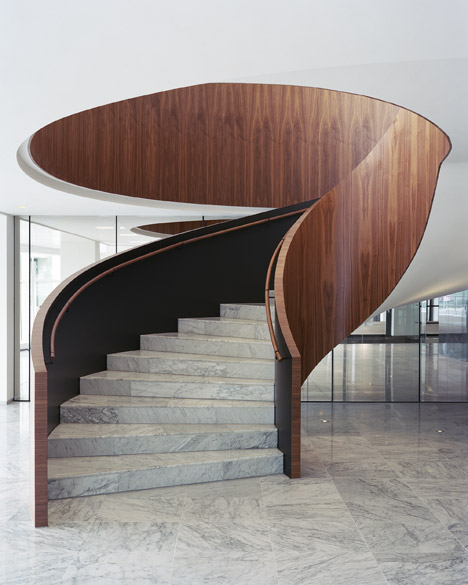
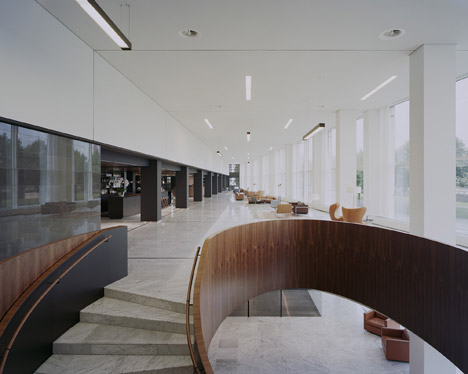
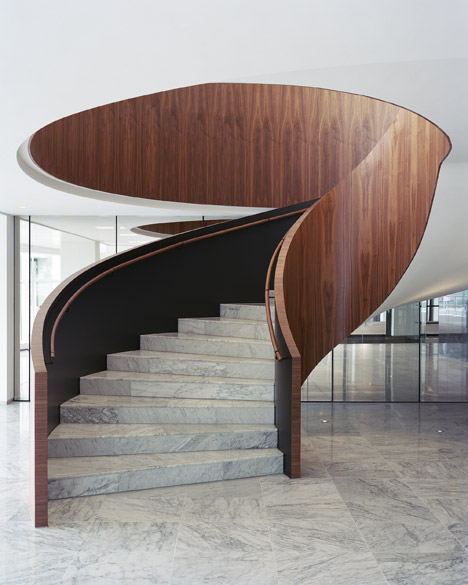
Powerhouse Company added a restaurant and bar overlooking the Nieuwe Maas river and a spiralling wood and marble staircase to the space to create a hotel-like style intended to “attract future tenants” and “encourage chance encounters”.
“We wanted the lobby to have a high-end hotel feel, so we included dining and drinking establishments,” said the studio, whose past projects include a Danish holiday home with five charred-timber gables.
Related story: The New Dance and Music Centre in The Hague by RAU Architects & Powerhouse Company
“We wanted people to actively use this space for meeting both formally and informally, not just a reception lobby where people pass through. We hoped also this would encourage chance encounters,” the team told Dezeen.
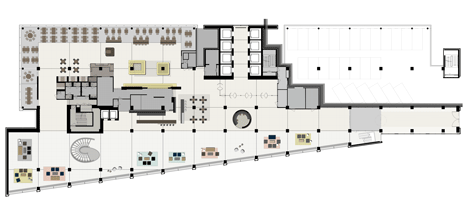
The architects renovated the basement and ground floor of the trapezoid Willemswerf Office Building, by Dutch architect Wim Quist, for the Office as a Hotel project – part of a larger scheme with Dutch developer ASR Vastgoed Vermogensbeheer that will see all 24 floors of the 1988 building refurbished.
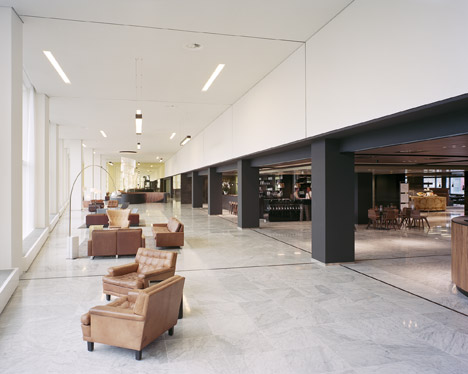
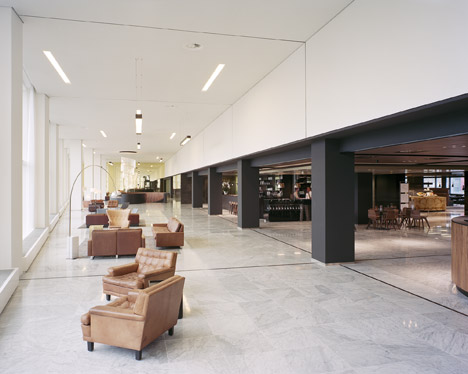
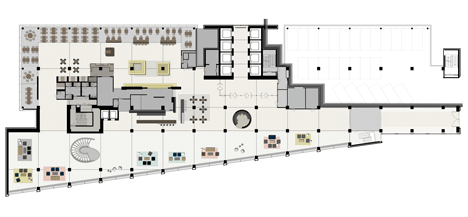
Powerhouse’s approach was for a “sensitive and respectful” restoration of the interior spaces, keeping to the strict grid layout of the original building, and introducing a limited palette of materials that emulate a “high-end hotel environment.”
“We made the existing geometric grid established by Wim Quist our guiding principle, adding warm, luxurious materials to create a more welcoming, tactile atmosphere,” said the architects.
The building was originally designed as the headquarters for a Dutch shipping company, but later leased out to multiple tenants with the lobby left unclaimed by any one company.
This set-up informed the architect’s decision to move an existing first floor restaurant to the ground level, freeing up the upper floor as a rentable space.
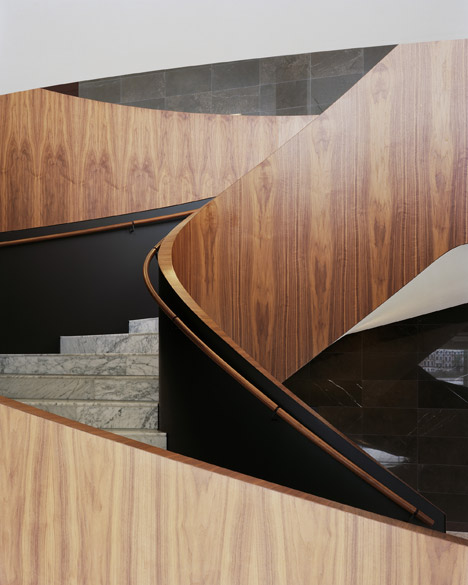
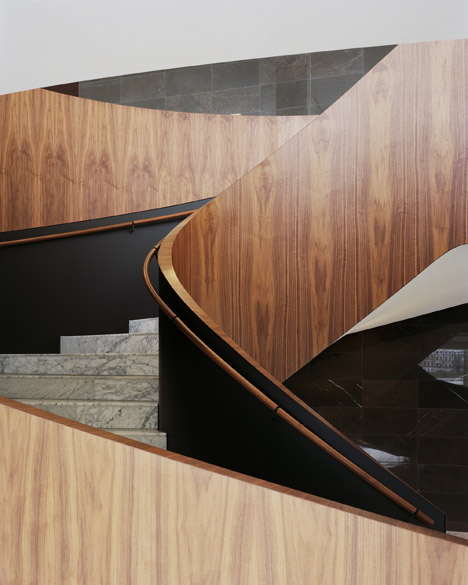
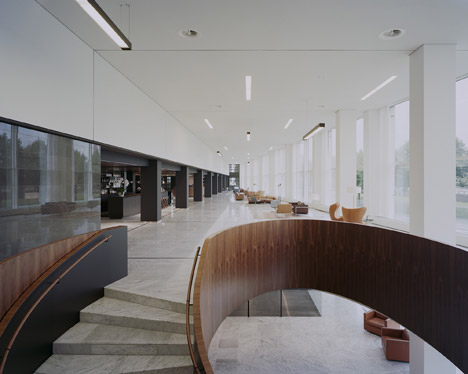
The architects clad the interior space in marble tiles and added a helix-shaped staircase with a dark-wood balustrade to connect the ground floor lobby with the basement level.
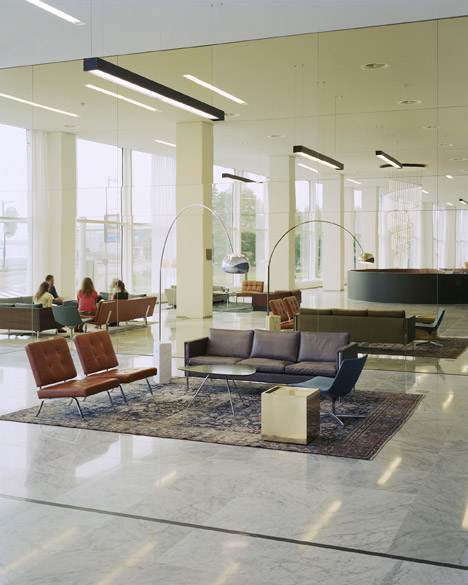
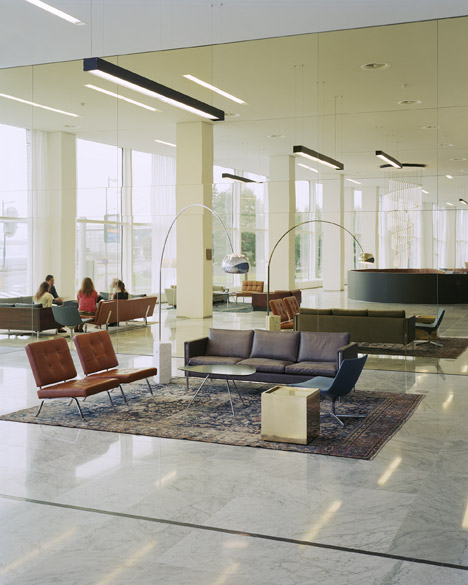
A spiral pendant light, designed by Powerhouse co-founder Nanne de Ru, hangs over the stairwell and reflects light in a mirrored wall beyond the well.
Clusters of Modernist furniture arranged on rugs on the marble floor create an informal area for the building’s tenants to receive clients and visitors.
“Worn-out rugs from Morocco and standing lamps give intimacy to each of the seating areas by marking out imaginary walls and rooms,” said the studio.
The seating area occupies a wedge of floor-space between the glazed facade and a coffee-bar and restaurant to the rear of the building.
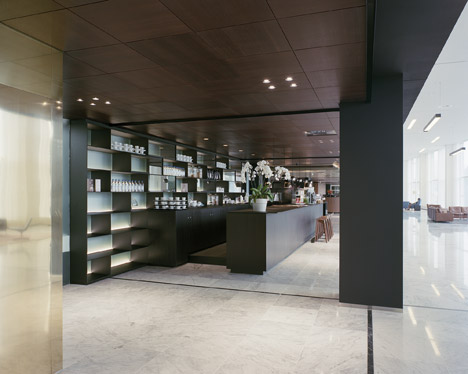
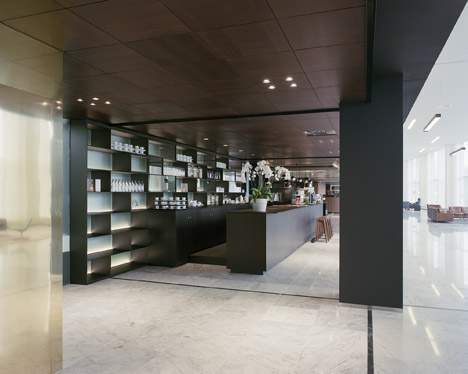
Under a lowered ceiling, a coffee bar lined in dark wood faces the seating area.
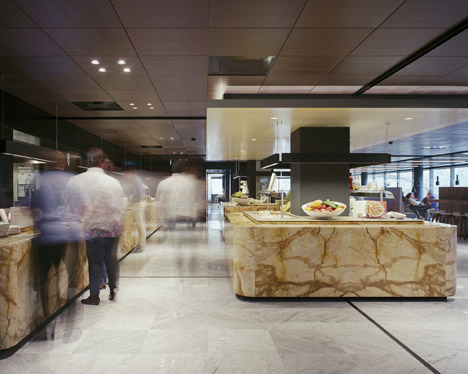
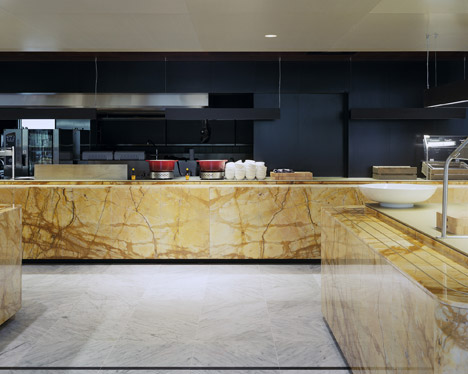
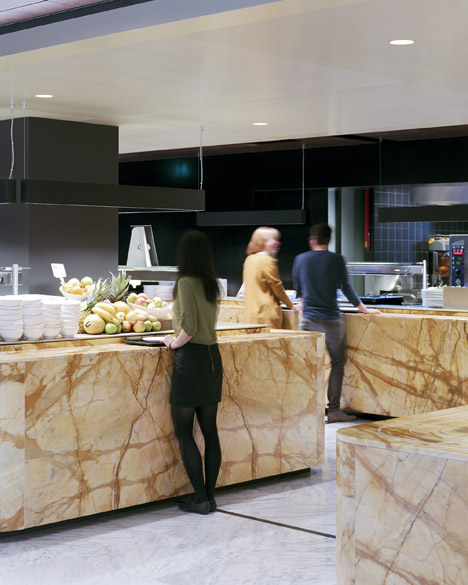
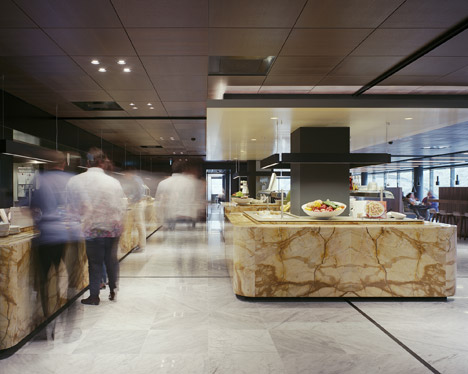
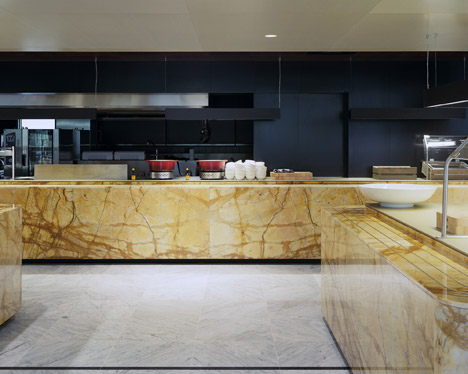
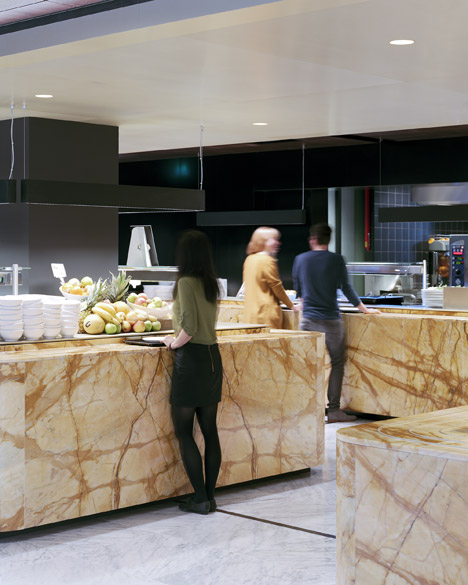
Behind, the restaurant has brown marble counters and four leather-upholstered seating booths.
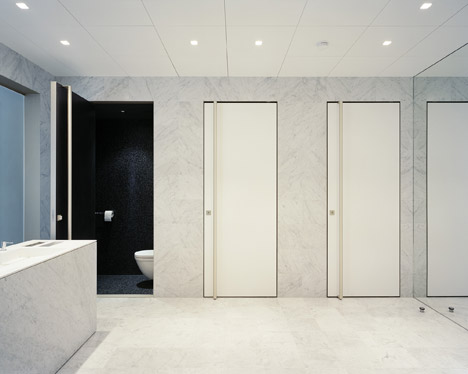
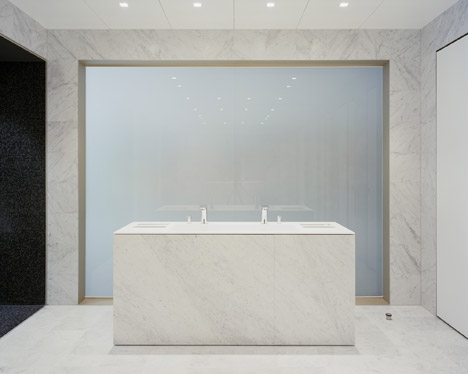
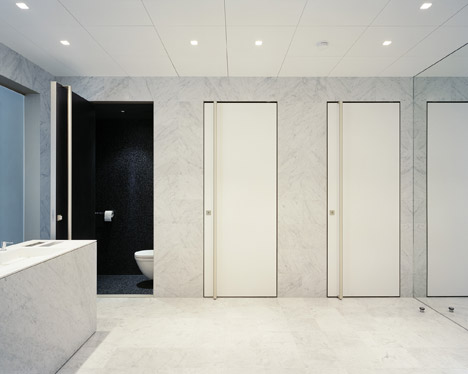
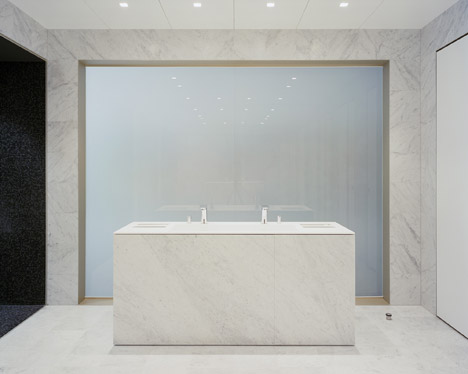
The toilets, housed in a block to the rear of the restaurant, are clad in the same pale grey marble as the lobby.
The interior walls of the cubicles are mosaicked in glossy black tiles that contrast the brightly lit bathroom.
Powerhouse has been commissioned to renovate the remaining 22 floors of the 24-storey building over the next eight years. The firm is also currently working on a 100-metre-tall Turkish broadcast and observation tower in collaboration with IND architects. Photography is by Kim Zwarts.
Powerhouse Company has remodelled the lower floors of a 1980s office block in Rotterdam to create a marble-lined foyer and dining space designed to emulate a hotel lobby .
Powerhouse Company added a restaurant and bar overlooking the Nieuwe Maas river and a spiralling wood and marble staircase to the space to create a hotel-like style intended to “attract future tenants” and “encourage chance encounters”.
“We wanted the lobby to have a high-end hotel feel, so we included dining and drinking establishments,” said the studio, whose past projects include a Danish holiday home with five charred-timber gables.
Related story: The New Dance and Music Centre in The Hague by RAU Architects & Powerhouse Company
“We wanted people to actively use this space for meeting both formally and informally, not just a reception lobby where people pass through. We hoped also this would encourage chance encounters,” the team told Dezeen.
The architects renovated the basement and ground floor of the trapezoid Willemswerf Office Building, by Dutch architect Wim Quist, for the Office as a Hotel project – part of a larger scheme with Danish developer ASR Vastgoed Vermogensbeheer that will see all 24 floors of the 1988 building refurbished.
Powerhouse’s approach was for a “sensitive and respectful” restoration of the interior spaces, keeping to the strict grid layout of the original building, and introducing a limited palette of materials that emulate a “high-end hotel environment.”
“We made the existing geometric grid established by Wim Quist our guiding principle, adding warm, luxurious materials to create a more welcoming, tactile atmosphere,” said the architects.
The building was originally designed as the headquarters for a Dutch shipping company, but later leased out to multiple tenants with the lobby left unclaimed by any one company.
This set-up informed the architect’s decision to move an existing first floor restaurant to the ground level, freeing up the upper floor as a rentable space.
The architects clad the interior space in marble tiles and added a helix-shaped staircase with a dark-wood balustrade to connect the ground floor lobby with the basement level.
A spiral pendant light, designed by Powerhouse co-founder Nanne de Ru, hangs over the stairwell and reflects light in a mirrored wall beyond the well.
Clusters of Modernist furniture arranged on rugs on the marble floor create an informal area for the building’s tenants to receive clients and visitors.
“Worn-out rugs from Morocco and standing lamps give intimacy to each of the seating areas by marking out imaginary walls and rooms,” said the studio.
The seating area occupies a wedge of floor-space between the glazed facade and a coffee-bar and restaurant to the rear of the building.
Under a lowered ceiling, a coffee bar lined in dark wood faces the seating area.
Behind, the restaurant has brown marble counters and four leather-upholstered seating booths.
The toilets, housed in a block to the rear of the restaurant, are clad in the same pale grey marble as the lobby.
The interior walls of the cubicles are mosaicked in glossy black tiles that contrast the brightly lit bathroom.
Powerhouse has been commissioned to renovate the remaining 22 floors of the 24-storey building over the next eight years. The firm is also currently working on a 100-metre-tall Turkish broadcast and observation tower in collaboration with IND architects. Photography is by Kim Zwarts.




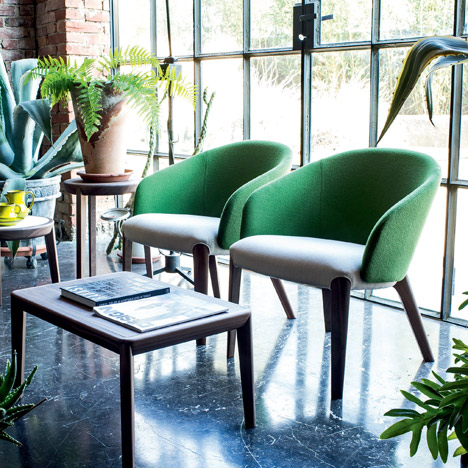
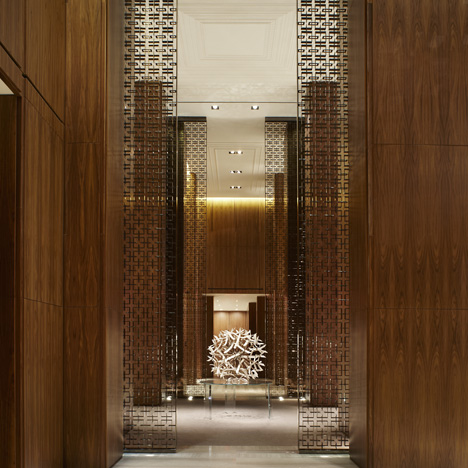 This image: Interior of Four Seasons Toronto, Canada, by Yabu Pushelberg – top image: Bellevue by Very Wood
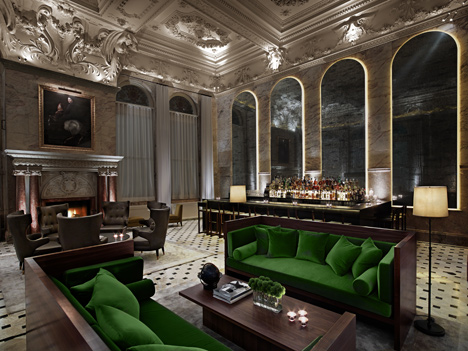 Interior of London Edition Hotel, UK, by Yabu Pushelberg
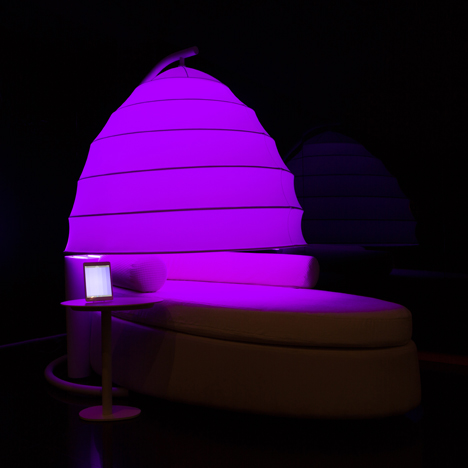 Pod by mycoocoon
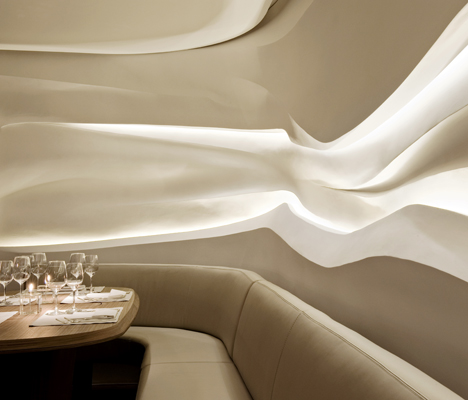 Bayerischer Hof Hotel in Munich, Germany, by Jouin Manku
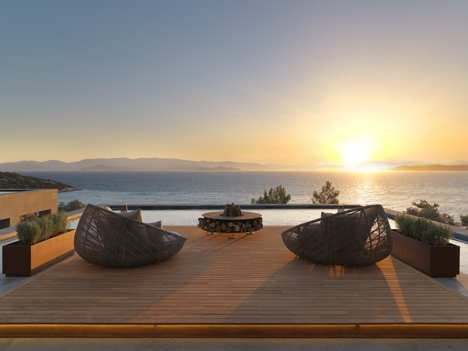 Mandarin Oriental Bodrum, Turkey, landscaped by Scape Design Associates
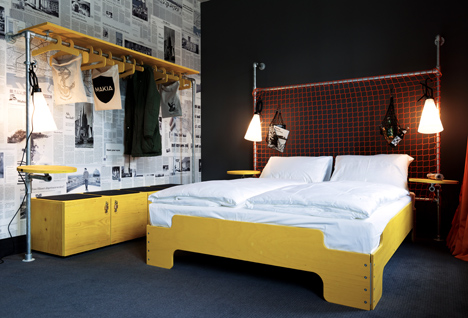 Superbude II hostel, Hamburg, Germany by Dreimeta, competing in Sleep Set
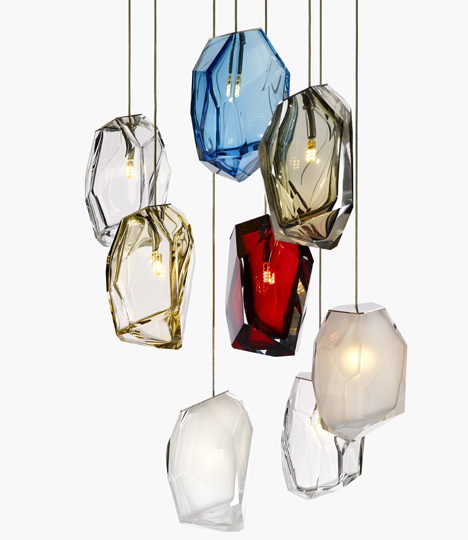 Crystal Rock lights by Arik Levy for Lasvit
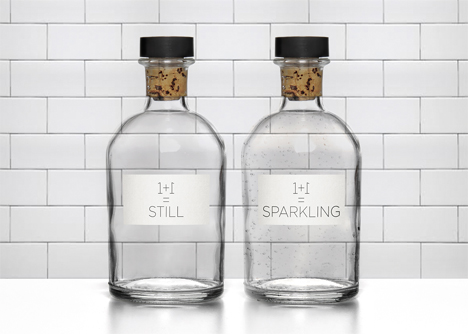 Sleep Set concept by NoChintz
 Floor plan –
 Floor plan –