Bartlett Students Create Building Components From Skeletal Modules Wrapped In Stretchy "skin"

A group of graduates from London’s Bartlett School of Architecture has developed an experimental technique for creating intricate building components by wrapping sticks in stretchy fabric and using them to cast concrete .
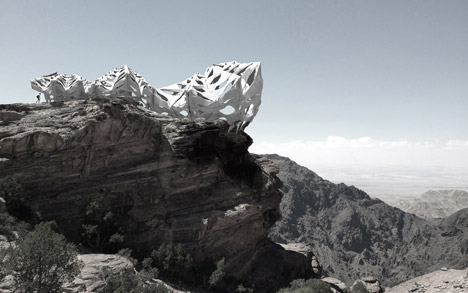
Augmented Skin by Miyamoto Kazushi Pavilion design

The project titled Augmented Skin was completed by Kazushi Miyamoto, Youngseok Doo and Theodora Maria Moudatsou under the tutorship of Daniel Widrig, Stefan Bassing and Soomeen Hahm, who encouraged the students to explore the notion of “freehand self-production in the age of computational design”.


Related story: The Liquid Light of Diego Garcia by Viktor Westerdahl
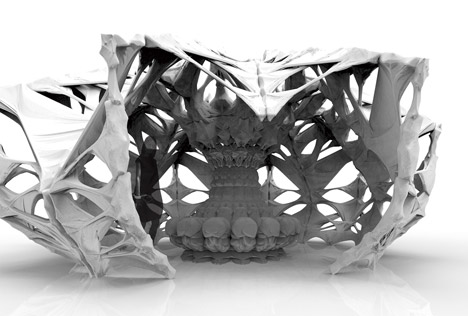

Augmented Skin by Kazushi Miyamoto, Youngseok Doo and Theodora Maria Moudatsou Pavilion design

The project team developed a production technique that involves creating frameworks from intersecting wooden sticks, which are then wrapped in a tensile fabric skin to form moulds for casting materials such as concrete.
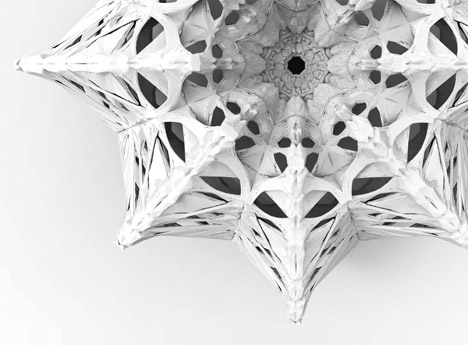
Augmented Skin by Kazushi Miyamoto, Youngseok Doo and Theodora Maria Moudatsou Pavilion design

Digital simulation software was used to study the arrangement of the sticks, to optimise the shape and structural strength of the resulting castings.
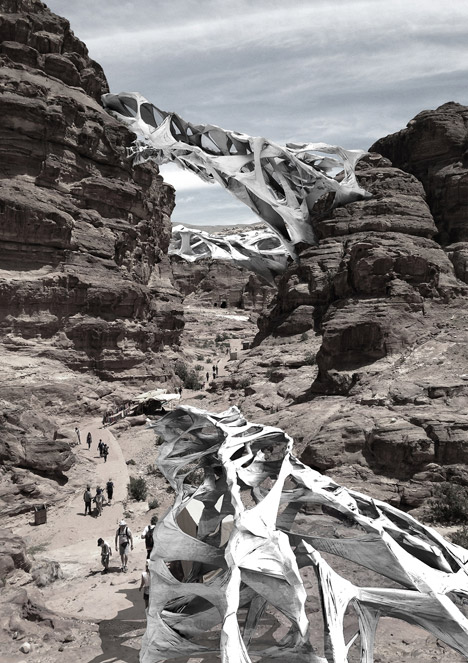
Augmented Skin by Miyamoto Kazushi Bridge design

“We believe that combining this low-budget handcrafting technique and digital design process could have a possibility of making a new discovery of inimitable design,” Kazushi Miyamoto told Dezeen.

Augmented Skin by Kazushi Miyamoto, Youngseok Doo and Theodora Maria Moudatsou External view of a conceptual structure

Components cast in long strings described as “strands” could be used as beams or columns in architectural applications. These could then also be wrapped in another stretchy “skin” to create surfaces used for roofs or walls.

Augmented Skin by Kazushi Miyamoto, Youngseok Doo and Theodora Maria Moudatsou Interior view of a conceptual structure

“The main advantage of the manufacturing process is flexibility of design and the mould,” Miyamoto explained. “The flexible strand component is able to generate seamless and intricate shapes and space. By altering the size and density of internal sticks we can control the flexibility of detail as well.”
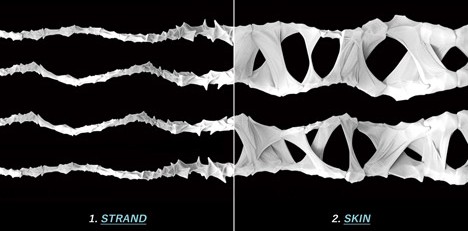
Augmented Skin by Kazushi Miyamoto, Youngseok Doo and Theodora Maria Moudatsou Concept diagram

Once the sticks have been positioned inside the fabric to form joints, concrete is poured in to create a solid connecting form without the need for a supporting framework. The sticks remain inside the mould, adding a reinforcing internal structure.
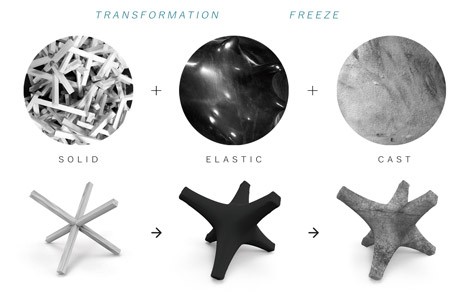
Augmented Skin by Kazushi Miyamoto, Youngseok Doo and Theodora Maria Moudatsou Concept diagram

To demonstrate potential applications for the casting process, the team developed several visualisations of the sorts of architectural structures that could be created including pavilions and bridges.
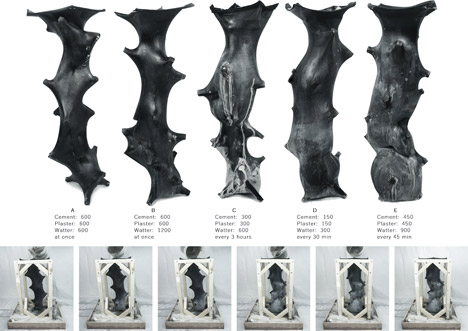
Augmented Skin by Kazushi Miyamoto, Youngseok Doo and Theodora Maria Moudatsou Material research and casting process

These were presented at the Bartlett’s B-Pro Show 2014 graduation exhibition in September, alongside a chair and an arch constructed using the technique.
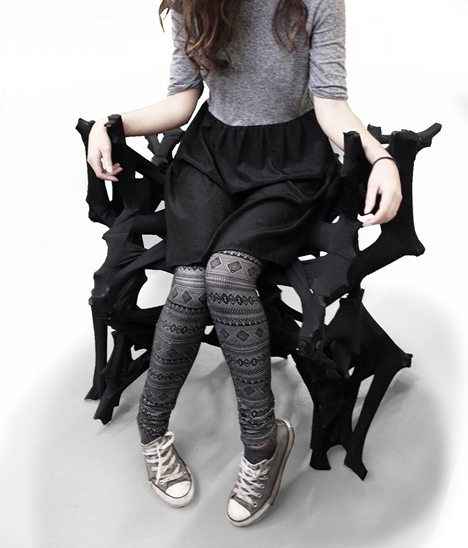
Augmented Skin by Kazushi Miyamoto, Youngseok Doo and Theodora Maria Moudatsou Chair prototype

“We confirmed from the material research that this technique is certainly effective up to the scale of pavilions,” said Miyamoto. “I would say that the technique has many design possibilities, especially for furniture. We also believe this process could be developed for use on an architectural scale with further testing of a mock-up and more research.”
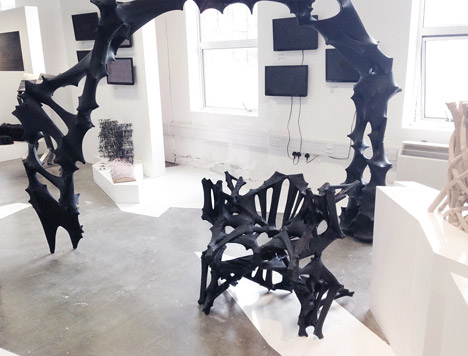
Augmented Skin by Kazushi Miyamoto, Youngseok Doo and Theodora Maria Moudatsou Prototypes on display at the B-Pro Show 2014 at the Bartlett School of Architecture
Dezeen

Marlies Schets' Reflective Fabrics Turn Everyday Accessories Into Cycling Safety Gear

SEEN reflective textiles at Dutch Design Week 2014

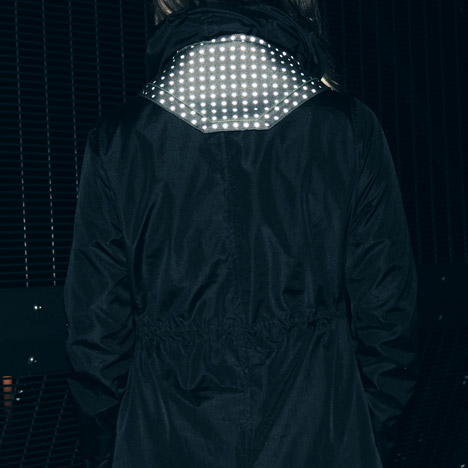
Dutch Design Week 2014: retro-reflective thread is woven into a range of fabrics by Marlies Schets to create a line of accessories that reflect light at night, turning them into cycling safety garments.

Marlies Schets created the reflective material for a line of accessories called Seen as part of her graduation project for Design Academy Eindhoven.


Related story: Interacket by Drap og Design is a jacket that changes colour like a chameleon


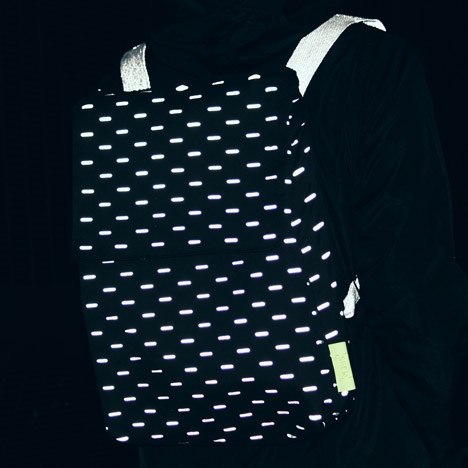
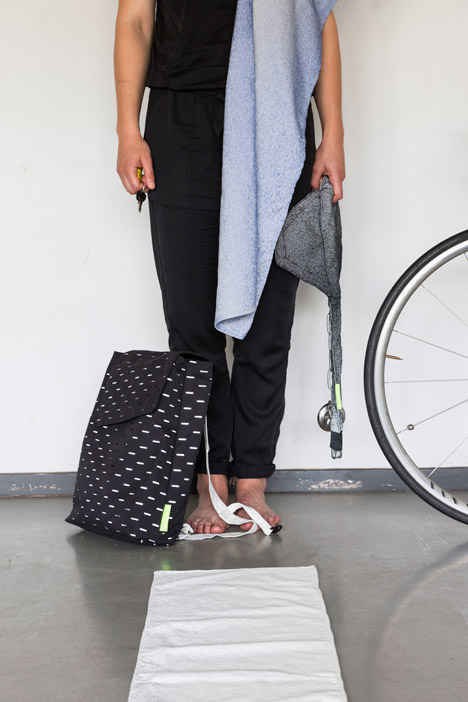
The collection, which includes a scarf and backpack, has been designed to have the same light-reflective properties as typical high-visibility clothing by night, but appear relatively inconspicuous during the day.

SEEN reflective textiles at Dutch Design Week 2014

Schets wanted to create a range of attractive items to try and overcome the reluctance of night-time cyclists and pedestrians to wear the standard “shapeless” neon vest with reflective strips that is widely available as a safety garment.

“I noticed that not many people like to wear the neon jacket during their casual ride or walk with the dog because the jacket is shapeless and way too obvious, which is not always necessary during daytime,” Schets told Dezeen.

SEEN reflective textiles at Dutch Design Week 2014

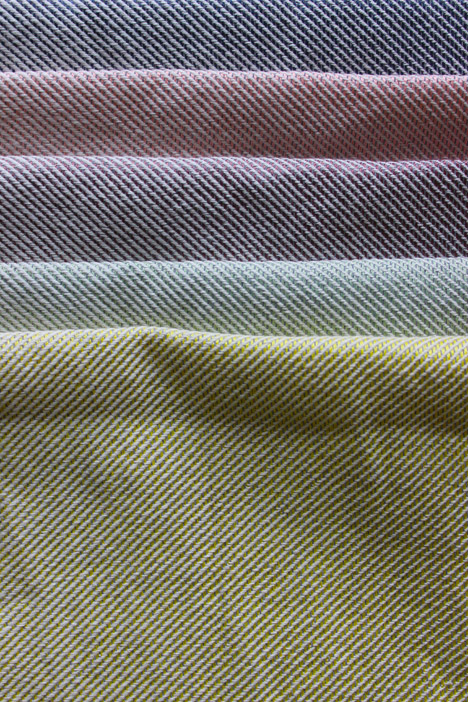
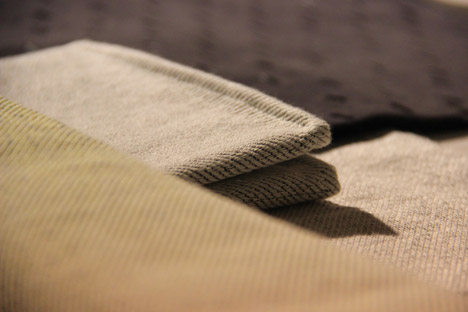
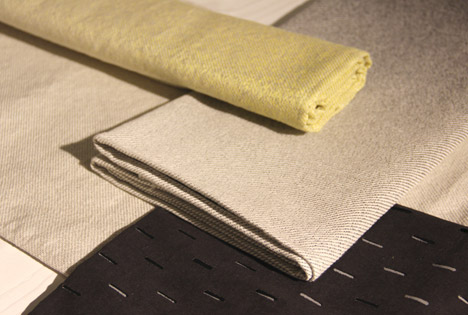
The fabric is woven from two colours of cotton yarn and a synthetic yarn that can only be detected when it is illuminated by passing light sources at night.

SEEN reflective textiles at Dutch Design Week 2014

This thread is described as retro-reflective as it reflects light back towards its source when it hits the surface of the fabric, rather than in all directions.

SEEN reflective textiles at Dutch Design Week 2014

“[The items] all look fairly normal during the day, but at night they glow under the luminescence of artificial light,” said Schets. “The impact on the wearer is that he or she will be safer, without wearing something they might not like.”

SEEN reflective textiles at Dutch Design Week 2014

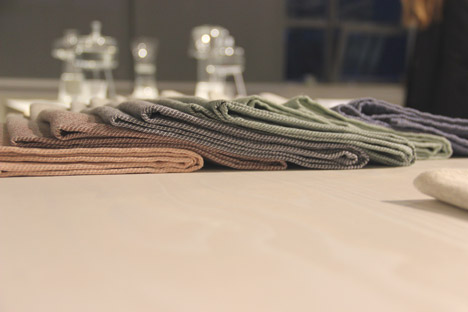
A scarf made from a length of the woven fabric comes in a range of pastel hues, while a black backpack has luminous straps and a series of small ellipses in an outer layer that reveals patches of fabric that light up in the dark.

SEEN reflective textiles at Dutch Design Week 2014

“What I’m trying to do is reduce the gap between wearing nothing and wearing a neon jacket by integrating reflective materials into daily used products,” Schets said.

SEEN reflective textiles at Dutch Design Week 2014

The products were exhibited at the Design Academy Eindhoven graduate show during Dutch Design Week earlier this month. The designer is also in the process of developing a water-resistant bike lock that will be made completely from synthetic yarns.

Dezeen

Jólan Van Der Wiel Creates Spiky Shoes For Iris Van Herpen Using Magnets

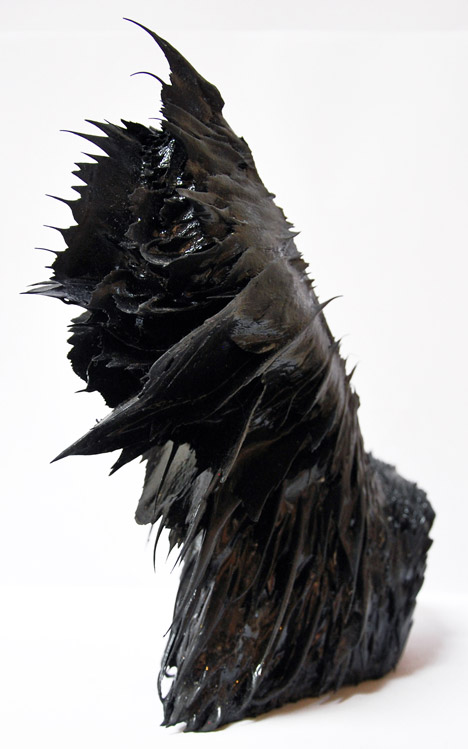
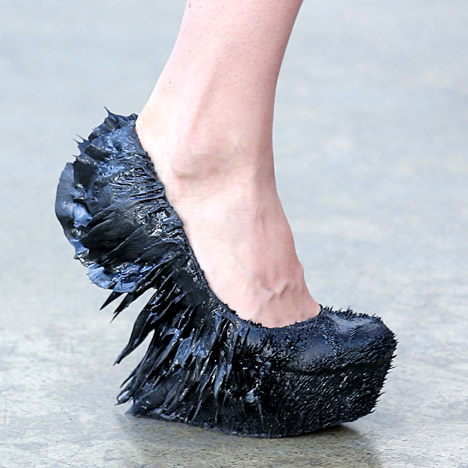
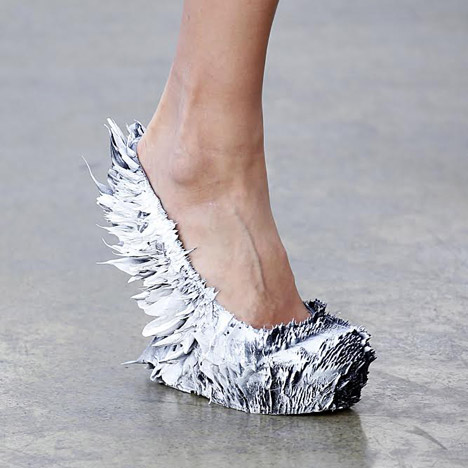
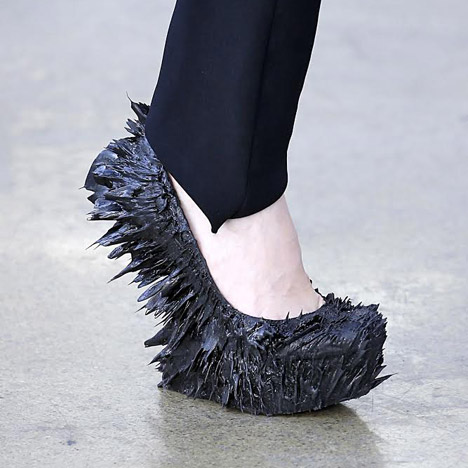
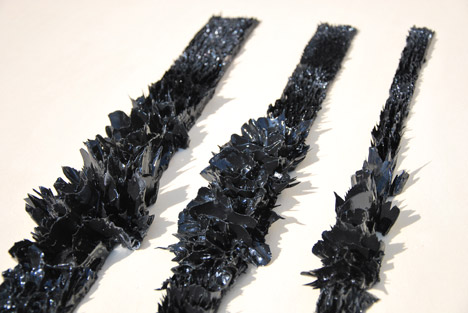
These prickly-looking shoes and accessories by Dutch designer Jólan van der Wiel were formed using magnets and worn during Iris van Herpen’s latest catwalk show .

Jolan van der Wiel magnetic shoes for Iris van Herpen

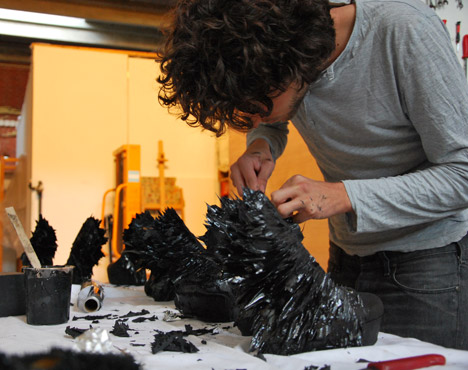
To create the textured footwear, Jólan van der Wiel combined resin with iron filings and shaped the mixture around a base shoe.


Related story: Iris van Herpen uses 3D printing and magnets to form Spring Summer 2015 fashion collection


Before the soft plastic material set into shape, strong magnets were used to pull small portions into spikes across the surfaces.

Jolan van der Wiel magnetic shoes for Iris van Herpen Photograph by Yannis Vlamos

“What you see on these shoes is that the front has really small spikes and the back has very long ones,” Van der Wiel told Dezeen. “The material itself is very soft, almost cuddly. So it looks dangerous but they feel great and are great to walk in.”

Jolan van der Wiel magnetic shoes for Iris van Herpen Photograph by Yannis Vlamos
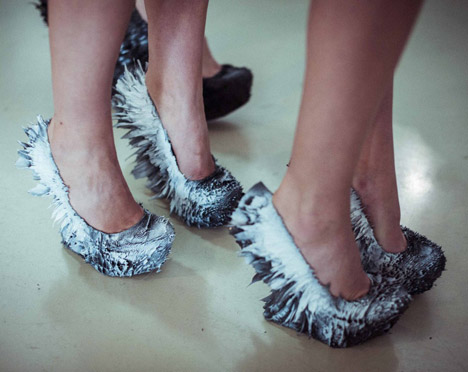
Each pair of platforms is unique due to the production process. The material behaves slightly differently when manipulated by the magnets due to the arrangement of the filings.

Jolan van der Wiel magnetic shoes for Iris van Herpen Photograph by Yannis Vlamos
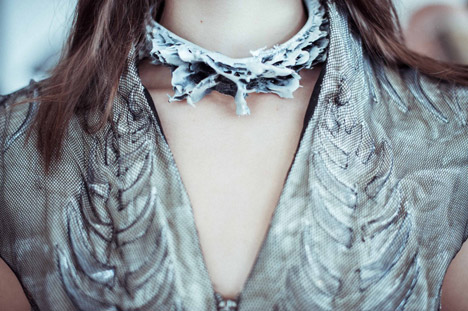
Raised heels project backwards from the sole to appear unsupported. Pigments are mixed into the resin in different quantities and distributions, creating a variety of colours from pure black through to marbled grey.

Jolan van der Wiel magnetic shoes for Iris van Herpen

The shoes were worn by all of the models in Dutch fashion designer Iris van Herpen’s Spring Summer 2015 fashion show in Paris last month, which also featured belts, jewellery and clutch bags made in the same way.

Jolan van der Wiel magnetic shoes for Iris van Herpen

Waist belts and choker necklaces both have longer spikes in their centres so they point out further from the front of the body.

Jolan van der Wiel magnetic shoes for Iris van Herpen

This is the second time the Dutch designers have collaborated – the duo “grew” dresses using magnets for Van Herpen’s Autumn Winter 2013 collection show last July.

Jolan van der Wiel magnetic shoes for Iris van Herpen

Van der Wiel has experimented with magnetism to create products since launching his Gravity series of stools shaped using the technique in 2011.

Jolan van der Wiel magnetic shoes for Iris van Herpen

He has since produced candlesticks and fantastical architectural models with variations of the same method, which has developed over time.

“We have been practicing more and more, and we are getting better in the detail,” the designer said.

Dezeen

Expressive Brazilian Architecture to Inspire Your Next Home Makeover

Recommended For You
Charming Home Makeover in Los Angeles by Hunter Kenihan

Charming Home Makeover in Los Angeles by Hunter Kenihan

Compact Leisure Home Pays Tribute to Brazilian Modernist Architecture

Compact Leisure Home Pays Tribute to Brazilian Modernist Architecture

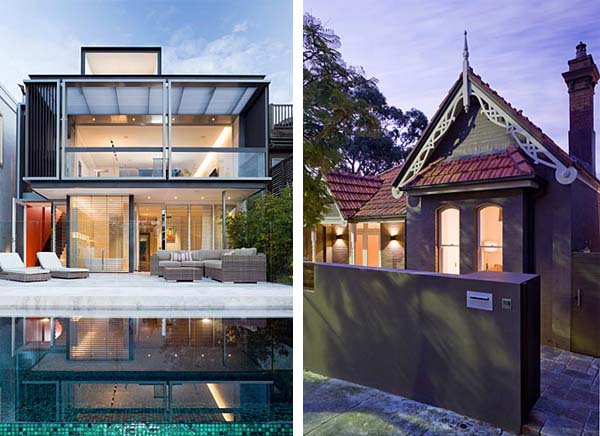
Modern Family House Makeover: Woollahra 1 by Stanic Harding Architecture

Modern Family House Makeover: Woollahra 1 by Stanic Harding Architecture

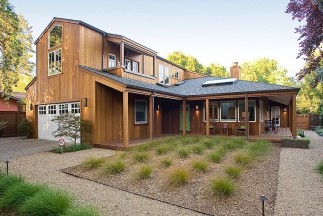
Exquisite Sea Ranch Home Makeover by Marcus & Willers Architects

Exquisite Sea Ranch Home Makeover by Marcus & Willers Architects

An imposing Example of Modern Brazilian Architecture: Planalto House

An imposing Example of Modern Brazilian Architecture: Planalto House

Clever Family Home Makeover in London by Neil Dusheiko Architects

Clever Family Home Makeover in London by Neil Dusheiko Architects

Freshome.com – Interior Design & Architecture Magazine

Dubai Plans To Build World's Tallest Twin Towers

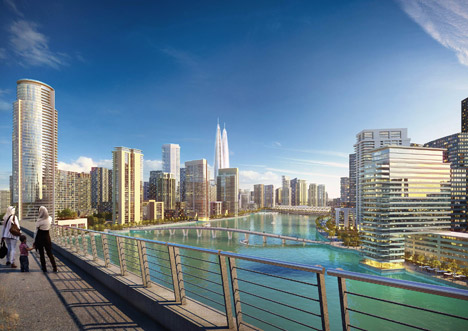
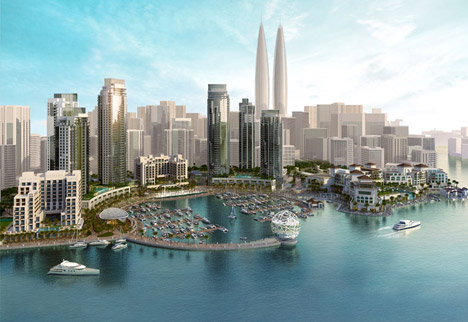
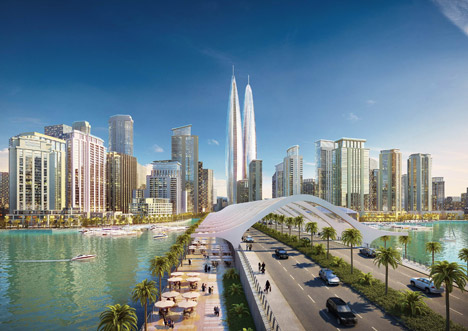
News: the massive 6 million-square-metre Dubai Creek Harbour development launched this week will include a pair of record-breaking towers, according to the developers.

Dubai Creek Harbour twin towers by Emaar Properties and Dubai Holdings

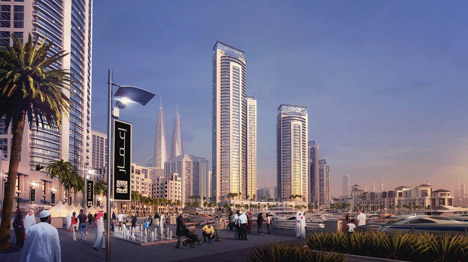
Developers Emaar Properties and Dubai Holdings have partnered to create a huge development on the Dubai waterfront, with six residential towers as well as a pair of rocket-shaped buildings they say will be the world’s tallest twinned skyscrapers.


Related story: World’s first climate-controlled city set for construction in Dubai


Although no architect has been officially named for the project, a masterplan design has been unveiled for the new district. This shows an area three times the size of Emaar’s previous Downtown Dubai development, which houses the Burj Khalifa, the world’s tallest tower.

Dubai Creek Harbour twin towers by Emaar Properties and Dubai Holdings

“Planned on an open site, Dubai Creek Harbour will combine the city with the natural contours of the creek,” said a statement from Emaar. “With no legacy ties to infrastructure, this new Dubai will leapfrog many of the world’s other global cities. The masterplan is an order of magnitude larger than Downtown Dubai and will support its commercial and cultural development.”

The project will create 39,000 homes and 22 hotels, with the first residences being pre-sold from the beginning of November.

No start date has yet been set for construction of the centrepiece twin towers, whose height has yet to be confirmed, according to local newspaper The National.

Dubai Creek Harbour twin towers by Emaar Properties and Dubai Holdings

“When planning a project like this, you can’t look at 2015. It’s about the fundamentals of the city,” said Emaar chairman Mohamed Alabbar at a press conference.

“I think all the stakeholders in Dubai in this business learnt their lessons and they have matured. What it boils down to is supply and demand.”

The scheme replaces former plans for the area in downtown Dubai, which is called The Lagoons as it includes a cluster of islands just off the coast.

Dubai Creek Harbour twin towers by Emaar Properties and Dubai Holdings

The site is adjacent to the Ras Al Khor Wildlife Sanctuary, home to around 450 different animal species. Emaar said that the sanctuary would “remain sacrosanct”, with the Dubai Creek Harbour plans including a new visitor centre that would bring “a message of sustainable biodiversity to new generations”.

Other proposals for this area have included a Zaha Hadid-designed opera house and cultural centre – part of a masterplan for the area called The Seven Pearls that was put on hold when the worldwide financial crisis reached Dubai around the start of the decade.

Dezeen

Latest Ideas!